Voros Jamie L, Sherman Sage O, Rise Rachel, Kryuchkov Alexander, Stine Ponder, Anderson Allison P, Clark Torin K
Ann & H.J. Smead Department of Aerospace Engineering Sciences, University of Colorado-Boulder, Boulder, CO, United States.
Front Neurosci. 2021 Mar 31;15:640984. doi: 10.3389/fnins.2021.640984. eCollection 2021.
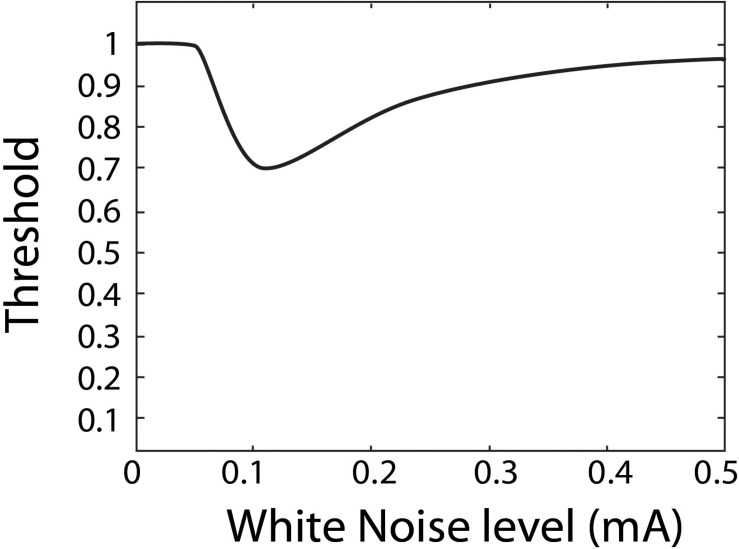
Stochastic resonance (SR) refers to a faint signal being enhanced with the addition of white noise. Previous studies have found that vestibular perceptual thresholds are lowered with noisy galvanic vestibular stimulation (i.e., "in-channel" SR). Auditory white noise has been shown to improve tactile and visual thresholds, suggesting "cross-modal" SR.
We investigated galvanic vestibular white noise (nGVS) ( = 9 subjects) to determine the cross-modal effects on visual and auditory thresholds.
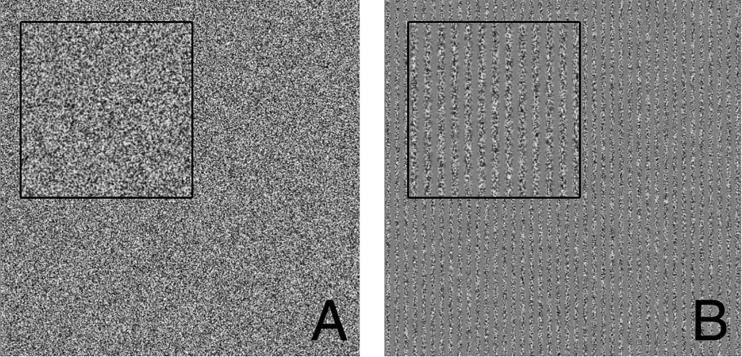
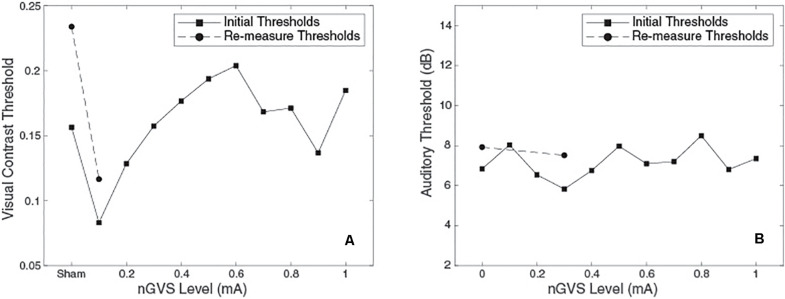
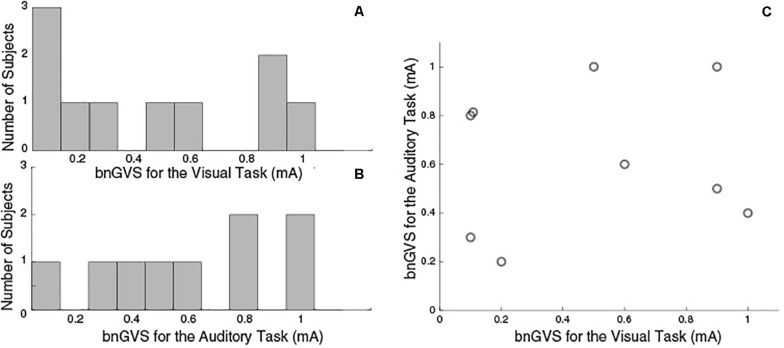
We measured auditory and visual perceptual thresholds of human subjects across a swath of different nGVS levels in order to determine if some individual-subject determined best nGVS level elicited a reduction in thresholds as compared the no noise condition (sham).
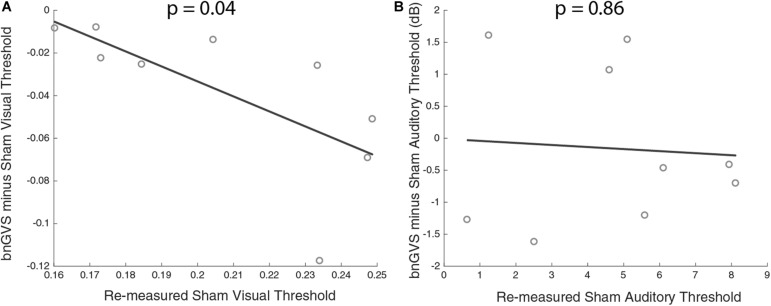
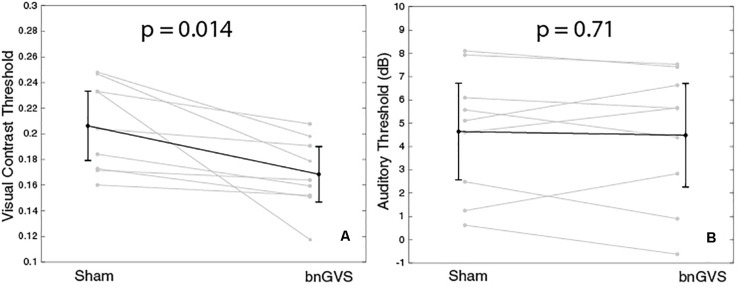
We found improvement in visual thresholds (by an average of 18%, = 0.014). Subjects with higher (worse) visual thresholds with no stimulation (sham) improved more than those with lower thresholds ( = 0.04). Auditory thresholds were unchanged by vestibular stimulation.
These results are the first demonstration of cross-modal improvement with galvanic vestibular stimulation, indicating galvanic vestibular white noise can produce cross-modal improvements in some sensory channels, but not all.
随机共振(SR)是指微弱信号在添加白噪声后得到增强。先前的研究发现,噪声性电前庭刺激可降低前庭感知阈值(即“通道内”随机共振)。已有研究表明,听觉白噪声可改善触觉和视觉阈值,提示“跨模态”随机共振。
我们研究了电前庭白噪声(nGVS)(n = 9名受试者)对视觉和听觉阈值的跨模态影响。
我们测量了人类受试者在一系列不同nGVS水平下的听觉和视觉感知阈值,以确定是否有个体确定的最佳nGVS水平与无噪声条件(假刺激)相比能降低阈值。
我们发现视觉阈值有所改善(平均提高18%,P = 0.014)。无刺激(假刺激)时视觉阈值较高(较差)的受试者比阈值较低的受试者改善得更多(P = 0.04)。前庭刺激对听觉阈值没有影响。
这些结果首次证明了电前庭刺激可产生跨模态改善,表明电前庭白噪声可在某些感觉通道而非所有通道中产生跨模态改善。