Ji Yixin, Zhang Yutao, Shi Haifeng, Jiao Zhuqing, Wang Shui-Hua, Wang Chuang
School of Microelectronics and Control Engineering, Changzhou University, Changzhou, China.
School of Computer Science and Artificial Intelligence, Changzhou University, Changzhou, China.
Front Neurosci. 2021 Apr 1;15:669345. doi: 10.3389/fnins.2021.669345. eCollection 2021.
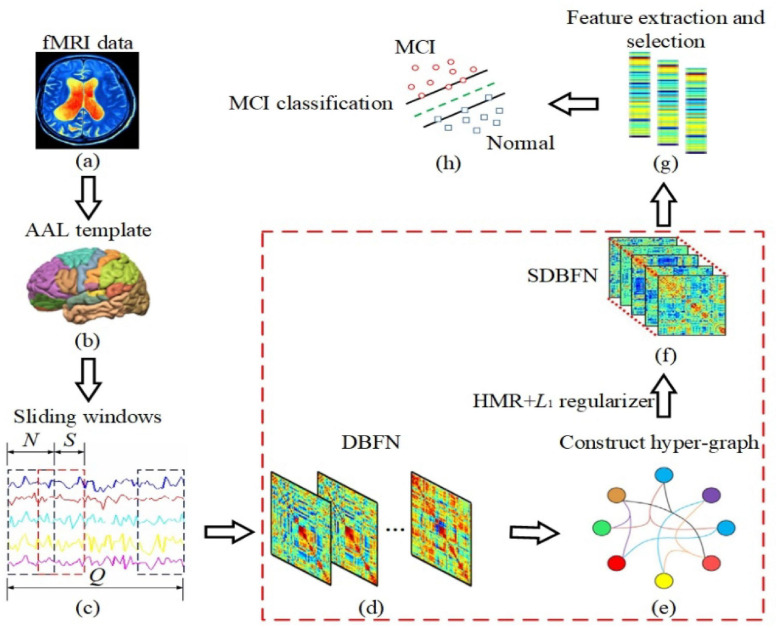
Brain functional networks (BFNs) constructed via manifold regularization (MR) have emerged as a powerful tool in finding new biomarkers for brain disease diagnosis. However, they only describe the pair-wise relationship between two brain regions, and cannot describe the functional interaction between multiple brain regions, or the high-order relationship, well. To solve this issue, we propose a method to construct dynamic BFNs (DBFNs) via hyper-graph MR (HMR) and employ it to classify mild cognitive impairment (MCI) subjects. First, we construct DBFNs via 's correlation (PC) method and remodel the PC method as an optimization model. Then, we use -nearest neighbor (KNN) algorithm to construct the hyper-graph and obtain the hyper-graph manifold regularizer based on the hyper-graph. We introduce the hyper-graph manifold regularizer and the 1-norm regularizer into the PC-based optimization model to optimize DBFNs and obtain the final sparse DBFNs (SDBFNs). Finally, we conduct classification experiments to classify MCI subjects from normal subjects to verify the effectiveness of our method. Experimental results show that the proposed method achieves better classification performance compared with other state-of-the-art methods, and the classification accuracy (ACC), the sensitivity (SEN), the specificity (SPE), and the area under the curve (AUC) reach 82.4946 ± 0.2827%, 77.2473 ± 0.5747%, 87.7419 ± 0.2286%, and 0.9021 ± 0.0007, respectively. This method expands the MR method and DBFNs with more biological significance. It can effectively improve the classification performance of DBFNs for MCI, and has certain reference value for the research and auxiliary diagnosis of Alzheimer's disease (AD).
通过流形正则化(MR)构建的脑功能网络(BFN)已成为寻找脑部疾病诊断新生物标志物的有力工具。然而,它们仅描述了两个脑区之间的成对关系,无法很好地描述多个脑区之间的功能相互作用或高阶关系。为了解决这个问题,我们提出了一种通过超图MR(HMR)构建动态BFN(DBFN)的方法,并将其用于对轻度认知障碍(MCI)受试者进行分类。首先,我们通过主成分(PC)方法构建DBFN,并将PC方法重塑为一个优化模型。然后,我们使用K近邻(KNN)算法构建超图,并基于该超图获得超图流形正则化器。我们将超图流形正则化器和1-范数正则化器引入基于PC的优化模型中,以优化DBFN并获得最终的稀疏DBFN(SDBFN)。最后,我们进行分类实验,将MCI受试者与正常受试者进行分类,以验证我们方法的有效性。实验结果表明,与其他现有方法相比,该方法具有更好的分类性能,分类准确率(ACC)、灵敏度(SEN)、特异性(SPE)和曲线下面积(AUC)分别达到82.4946±0.2827%、77.2473±0.5747%、87.7419±0.2286%和0.9021±0.0007。该方法扩展了MR方法和具有更多生物学意义的DBFN。它可以有效提高DBFN对MCI的分类性能,对阿尔茨海默病(AD)的研究和辅助诊断具有一定的参考价值。