Medaura María Cecilia, Guivernau Miriam, Moreno-Ventas X, Prenafeta-Boldú Francesc X, Viñas Marc
Faculty of Engineering, National University of Cuyo, Mendoza, Argentina.
GIRO Program, Institute of Agrifood Research and Technology (IRTA), Caldes de Montbui, Barcelona, Spain.
Front Microbiol. 2021 Mar 31;12:626436. doi: 10.3389/fmicb.2021.626436. eCollection 2021.
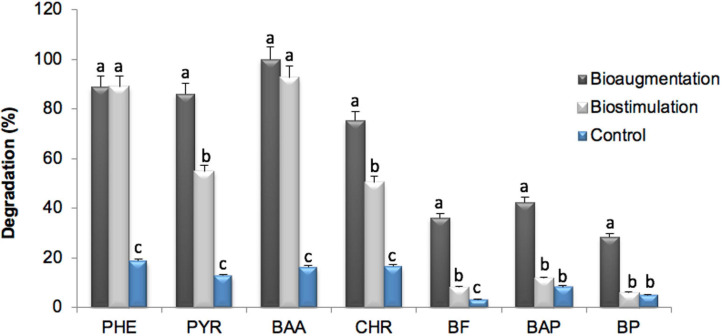
The concurrence of structurally complex petroleum-associated contaminants at relatively high concentrations, with diverse climatic conditions and textural soil characteristics, hinders conventional bioremediation processes. Recalcitrant compounds such as high molecular weight polycyclic aromatic hydrocarbons (HMW-PAHs) and heavy alkanes commonly remain after standard soil bioremediation at concentrations above regulatory limits. The present study assessed the potential of native fungal bioaugmentation as a strategy to promote the bioremediation of an aged industrially polluted soil enriched with heavy hydrocarbon fractions. Microcosms assays were performed by means of biostimulation and bioaugmentation, by inoculating a defined consortium of six potentially hydrocarbonoclastic fungi belonging to the genera , , , and , which were isolated previously from the polluted soil. The biodegradation performance of fungal bioaugmentation was compared with soil biostimulation (water and nutrient addition) and with untreated soil as a control. Fungal bioaugmentation resulted in a higher biodegradation of total petroleum hydrocarbons (TPH) and of HMW-PAHs than with biostimulation. TPH (C-C) decreased by a 39.90 ± 1.99% in bioaugmented microcosms vs. a 24.17 ± 1.31% in biostimulated microcosms. As for the effect of fungal bioaugmentation on HMW-PAHs, the 5-ringed benzo(a)fluoranthene and benzo(a)pyrene were reduced by a 36% and 46%, respectively, while the 6-ringed benzoperylene decreased by a 28%, after 120 days of treatment. Biostimulated microcosm exhibited a significantly lower reduction of 5- and 6-ringed PAHs (8% and 5% respectively). Higher TPH and HMW-PAHs biodegradation levels in bioaugmented microcosms were also associated to a significant decrease in acute ecotoxicity (EC) by bioluminiscence inhibition assays. Molecular profiling and counting of viable hydrocarbon-degrading bacteria from soil microcosms revealed that fungal bioaugmentation promoted the growth of autochthonous active hydrocarbon-degrading bacteria. The implementation of such an approach to enhance hydrocarbon biodegradation should be considered as a novel bioremediation strategy for the treatment of the most recalcitrant and highly genotoxic hydrocarbons in aged industrially polluted soils.
结构复杂的石油相关污染物在相对高浓度下与多样的气候条件和土壤质地特征同时存在,阻碍了传统生物修复过程。难降解化合物,如高分子量多环芳烃(HMW - PAHs)和重链烷烃,在标准土壤生物修复后通常仍以高于监管限值的浓度存在。本研究评估了本地真菌生物强化作为一种促进老化的、富含重烃馏分的工业污染土壤生物修复策略的潜力。通过生物刺激和生物强化进行微观试验,接种从污染土壤中先前分离出的属于、、和属的六种潜在烃降解真菌的特定组合。将真菌生物强化的生物降解性能与土壤生物刺激(添加水和养分)以及未处理土壤作为对照进行比较。真菌生物强化导致总石油烃(TPH)和HMW - PAHs的生物降解率高于生物刺激。在生物强化微观试验中,TPH(C - C)下降了39.90±1.99%,而在生物刺激微观试验中下降了24.17±1.31%。至于真菌生物强化对HMW - PAHs的影响,在处理120天后,五环的苯并(a)荧蒽和苯并(a)芘分别减少了36%和46%,而六环的苯并苝减少了28%。生物刺激微观试验中五环和六环PAHs的减少量明显较低(分别为8%和5%)。通过生物发光抑制试验,生物强化微观试验中较高的TPH和HMW - PAHs生物降解水平也与急性生态毒性(EC)的显著降低有关。对土壤微观试验中可存活的烃降解细菌进行分子分析和计数表明,真菌生物强化促进了本地活性烃降解细菌的生长。应将这种增强烃生物降解的方法的实施视为一种用于处理老化工业污染土壤中最难降解和高遗传毒性烃的新型生物修复策略。