Ding Xiaodong, Wang Yiqin, Hao Yiming, Lv Yi, Chen Rui, Yan Haixia
Shanghai Key Laboratory of Health Identification and Assessment, Laboratory of Traditional Chinese Medicine Four Diagnostic Information, Shanghai University of Traditional Chinese Medicine, Shanghai, China.
Comput Math Methods Med. 2021 Apr 1;2021:5597559. doi: 10.1155/2021/5597559. eCollection 2021.
Pulse rate variability monitoring and atrial fibrillation detection algorithms have been widely used in wearable devices, but the accuracies of these algorithms are restricted by the signal quality of pulse wave. Time synchronous averaging is a powerful noise reduction method for periodic and approximately periodic signals. It is usually used to extract single-period pulse waveforms, but has nothing to do with pulse rate variability monitoring and atrial fibrillation detection traditionally. If this method is improved properly, it may provide a new way to measure pulse rate variability and to detect atrial fibrillation, which may have some potential advantages under the condition of poor signal quality.
The objective of this paper was to develop a new measure of pulse rate variability by improving existing time synchronous averaging and to detect atrial fibrillation by the new measure of pulse rate variability.
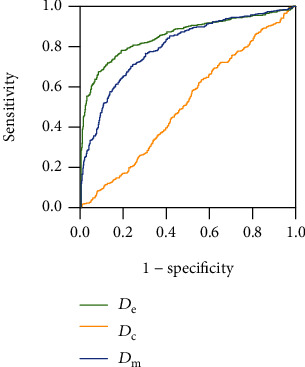
During time synchronous averaging, two adjacent periods were regarded as the basic unit to calculate the average signal, and the difference between waveforms of the two adjacent periods was the new measure of pulse rate variability. 3 types of distance measures (Euclidean distance, Manhattan distance, and cosine distance) were tested to measure this difference on a simulated training set with a capacity of 1000. The distance measure, which can accurately distinguish regular pulse rate and irregular pulse rate, was used to detect atrial fibrillation on the testing set with a capacity of 62 (11 with atrial fibrillation, 8 with premature contraction, and 43 with sinus rhythm). The receiver operating characteristic curve was used to evaluate the performance of the indexes.
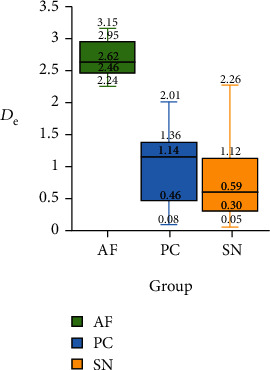
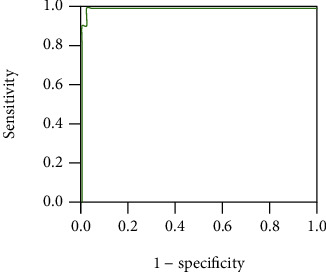
The Euclidean distance between waveforms of the two adjacent periods performs best on the training set. On the testing set, the Euclidean distance in atrial fibrillation group is significantly higher than that of the other two groups. The area under receiver operating characteristic curve to identify atrial fibrillation was 0.998. With the threshold of 2.1, the accuracy, sensitivity, and specificity were 98.39%, 100%, and 98.04%, respectively. This new index can detect atrial fibrillation from pulse wave signal.
This algorithm not only provides a new perspective to detect AF but also accomplishes the monitoring of PRV and the extraction of single-period pulse wave through the same technical route, which may promote the popularization and application of pulse wave.
脉搏率变异性监测和房颤检测算法已在可穿戴设备中广泛应用,但这些算法的准确性受脉搏波信号质量的限制。时间同步平均是一种用于周期性和近似周期性信号的强大降噪方法。它通常用于提取单周期脉搏波形,但传统上与脉搏率变异性监测和房颤检测无关。如果对该方法进行适当改进,可能会为测量脉搏率变异性和检测房颤提供一种新方法,在信号质量较差的情况下可能具有一些潜在优势。
本文旨在通过改进现有的时间同步平均来开发一种新的脉搏率变异性测量方法,并通过该新的脉搏率变异性测量方法检测房颤。
在时间同步平均过程中,将两个相邻周期视为计算平均信号的基本单元,两个相邻周期波形之间的差异即为脉搏率变异性的新测量方法。在容量为1000的模拟训练集上测试了3种距离度量(欧几里得距离、曼哈顿距离和余弦距离)来测量这种差异。使用能够准确区分规则脉搏率和不规则脉搏率的距离度量在容量为62的测试集(11例房颤、8例早搏和43例窦性心律)上检测房颤。采用受试者工作特征曲线评估指标性能。
两个相邻周期波形之间的欧几里得距离在训练集上表现最佳。在测试集上,房颤组的欧几里得距离显著高于其他两组。识别房颤的受试者工作特征曲线下面积为0.998。阈值为2.1时,准确率、灵敏度和特异度分别为98.39%、100%和98.04%。该新指标可从脉搏波信号中检测房颤。
该算法不仅为检测房颤提供了新视角,还通过相同技术路线实现了脉搏率变异性监测和单周期脉搏波提取,可能会推动脉搏波的推广应用。