Díaz-Vélez Cristian, Failoc-Rojas Virgilio E, Valladares-Garrido Mario J, Colchado Juan, Carrera-Acosta Lourdes, Becerra Mileny, Moreno Paico Dafne, Ocampo-Salazar Elgin Thom
Oficina de Inteligencia Sanitaria, Hospital Nacional Almanzor Aguinaga Asenjo, EsSalud, Chiclayo, Peru.
Facultad de Medicina, Universidad Cesar Vallejo, Chiclayo, Peru.
PeerJ. 2021 Apr 6;9:e11210. doi: 10.7717/peerj.11210. eCollection 2021.
Estimating the cumulative prevalence of SARS-COV-2 will help to understand the epidemic, contagion, and immunity to COVID-19 in vulnerable populations. The objective is to determine the extent of infection in the general population and the cumulative incidence by age group.
It was carried out with a longitudinal analytical study, in the population of the Lambayeque region, located in the north of Peru. The selection was carried out in multistages (districts, area, household, and finally choosing the interviewee within the house). Seroprevalence was estimated as a positive result of the rapid test whether it was positive IgM or positive IgG. An adjustment was made for the sampling weights used.
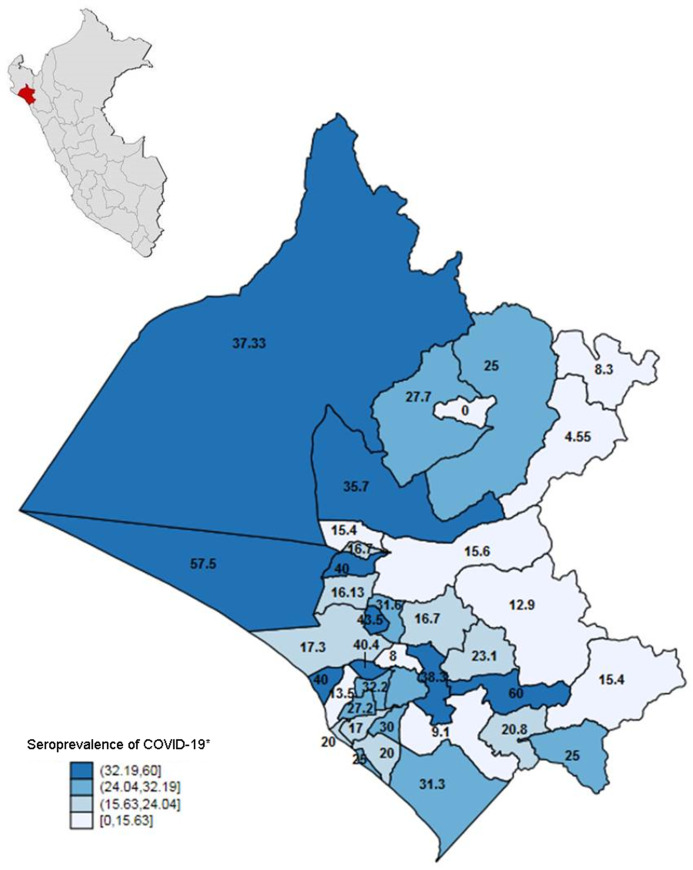
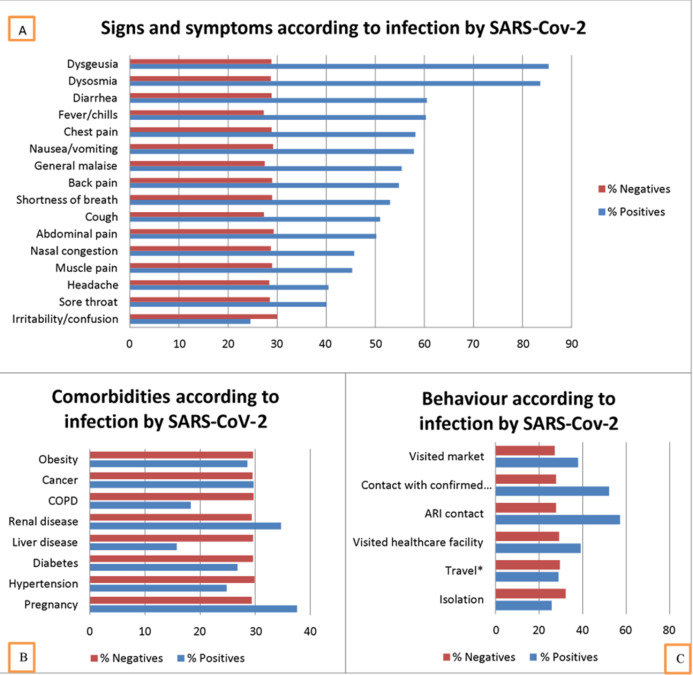
The seroprevalence found in the region was 29.5%. Young people between 21 and 50 years old presented the highest seroprevalence frequencies. A total of 25.4% were asymptomatic. The most frequent complaint was dysgeusia and dysosmia (85.3% and 83.6%). Dysosmia (PR = 1.69), chest pain (PR = 1.49), back pain (PR = 1.45), cough (PR = 1.44), fever (PR = 1.41), general malaise (PR = 1.27) were associated factors with the higher the frequency of seropositivity for SARS-CoV-2. Reporting of complete isolation at home decreased the frequency of positivity (PR = 0.80), however, reporting having ARI contact (PR = 1.60), having contact with a confirmed case (PR = 1.51), and going to market (PR = 1.26) increased the frequency of positivity for SARS-CoV-2.
These results suggest that Lambayeque is the region with the highest seroprevalence in the world, well above Spain, the United States and similar to a study in India.
估计严重急性呼吸综合征冠状病毒2(SARS-CoV-2)的累积流行率将有助于了解新型冠状病毒肺炎(COVID-19)在脆弱人群中的流行情况、传播情况和免疫力。目的是确定普通人群中的感染程度以及各年龄组的累积发病率。
在秘鲁北部的兰巴耶克地区人群中开展了一项纵向分析研究。选择过程分多阶段进行(从地区、区域、家庭,最后在家庭中选择受访者)。血清阳性率通过快速检测的阳性结果来估计,无论其为IgM阳性还是IgG阳性。对所使用的抽样权重进行了调整。
该地区的血清阳性率为29.5%。21至50岁的年轻人血清阳性率最高。共有25.4%的人无症状。最常见的症状是味觉障碍和嗅觉障碍(分别为85.3%和83.6%)。嗅觉障碍(相对危险度=1.69)、胸痛(相对危险度=1.49)、背痛(相对危险度=1.45)、咳嗽(相对危险度=1.44)、发热(相对危险度=1.41)、全身不适(相对危险度=1.27)是与SARS-CoV-2血清阳性频率较高相关的因素。报告在家中完全隔离降低了阳性频率(相对危险度=0.80),然而,报告有急性呼吸道感染(ARI)接触史(相对危险度=1.60)、与确诊病例接触(相对危险度=1.51)以及去过市场(相对危险度=1.26)会增加SARS-CoV-2的阳性频率。
这些结果表明,兰巴耶克是世界上血清阳性率最高的地区,远高于西班牙、美国,与印度的一项研究结果相近。