Macedonian Academy of Sciences and Arts, Skopje, Macedonia.
Centre for Research in Public Health and Community Care, University of Hertfordshire, Hatfield, United Kingdom.
Front Public Health. 2021 Apr 1;9:587459. doi: 10.3389/fpubh.2021.587459. eCollection 2021.
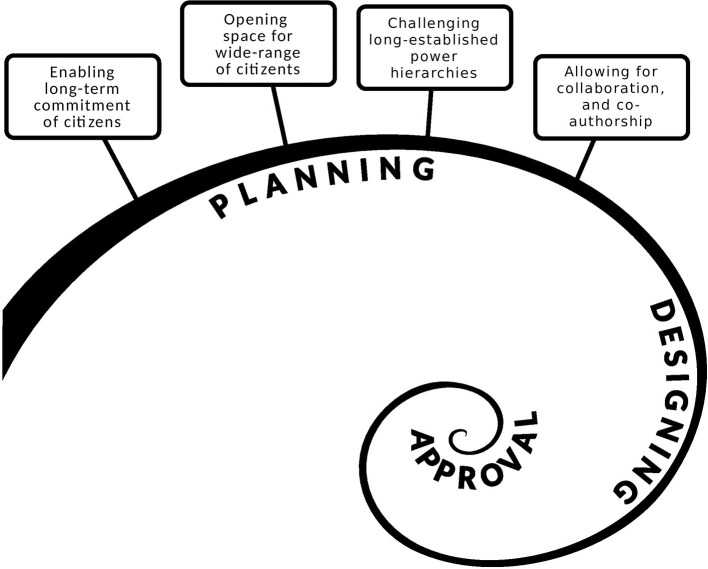
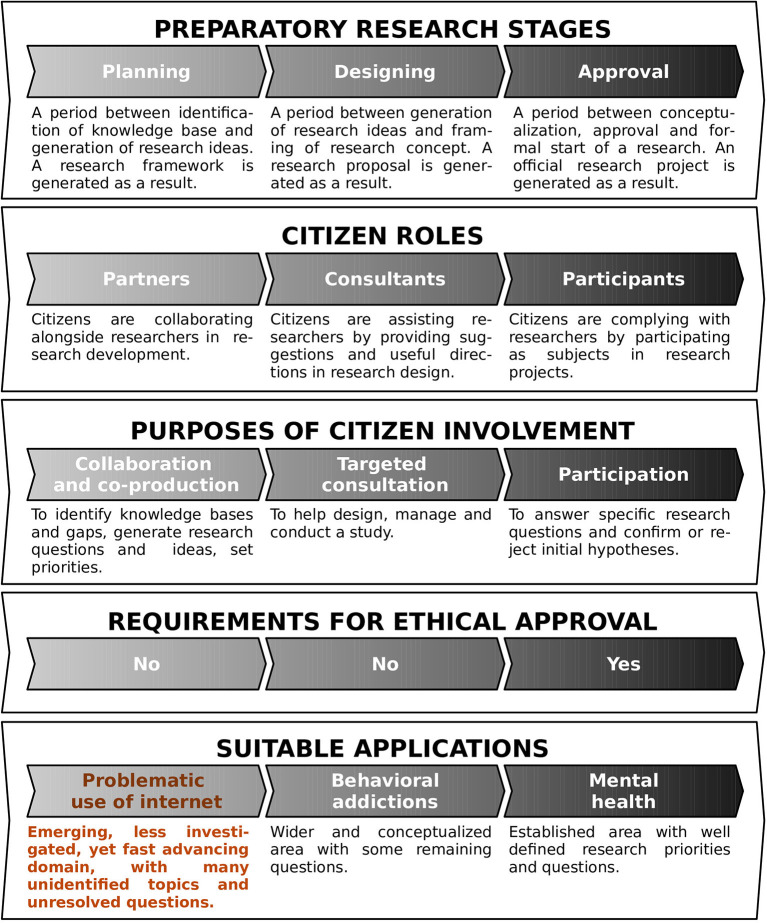
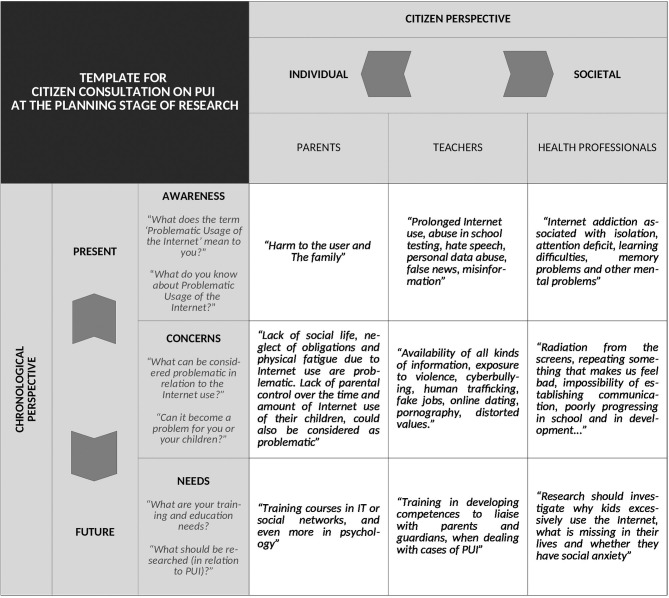
Citizens and scientists can work together to improve the collective well-being, if citizens are inspired to help the advancement of science, and researchers motivated to listen to the voices of citizens. The benefits of such collaboration are increasingly recognized by both citizens and scientists, as reflected in the growing number of related publications and initiatives. This is especially relevant for emerging areas of research, where early involvement of citizens could help to envision, prioritize, and plan prospective studies. The Problematic Usage of the Internet (PUI) is one such area, which is fast becoming a public mental health concern. However, there remains a lack of clarity regarding the practical guidelines and ethical requirements for citizen involvement at the earliest stages of PUI. In our paper, we propose a conceptual framework and a template for initial involvement of citizens in PUI. They are derived from our community case studies, conducted in six European countries (Georgia, Greece, Malta, North Macedonia, Portugal, and Spain) and consisting of consultation with diverse groups of interested citizens (students, parents, teachers, and health professionals). Informed by our consultation exercises, we also highlight four ethical aspects for citizen involvement in the research on PUI or novel disciplines in general. They follow simple guiding principles to ensure that scientists will: enable a long-term commitment and inclusive opportunities for citizens, challenge established power hierarchies, and support collaboration, co-production and co-authorship with citizens. We believe that the proposed practical guidelines and ethical considerations, provide a valuable foundation on which to advance our understanding and generate international strategies for citizen involvement in PUI.
公民和科学家可以共同努力,提高集体福祉,如果公民受到激励去帮助科学进步,而研究人员也有动力去倾听公民的声音。这种合作的好处越来越被公民和科学家所认识,这反映在相关出版物和倡议的数量不断增加上。对于新兴的研究领域来说,这种合作尤其重要,因为公民的早期参与有助于设想、优先考虑和规划未来的研究。互联网不良用语(PUI)就是这样一个领域,它迅速成为公众关注的心理健康问题。然而,在 PUI 的早期阶段,公民参与的实际指导方针和道德要求仍然不够明确。在我们的论文中,我们提出了一个概念框架和一个公民初步参与 PUI 的模板。它们源自我们在六个欧洲国家(格鲁吉亚、希腊、马耳他、北马其顿、葡萄牙和西班牙)进行的社区案例研究,研究内容包括与不同利益相关的公民群体(学生、家长、教师和卫生专业人员)进行协商。根据我们的协商活动,我们还强调了公民参与 PUI 研究或一般新学科的四个伦理方面。它们遵循简单的指导原则,以确保科学家将:使公民能够长期承诺和获得包容性机会,挑战既定的权力等级制度,并支持与公民的合作、共同生产和共同创作。我们相信,所提出的实际指导方针和道德考虑为推进我们对公民参与 PUI 的理解并制定国际战略提供了有价值的基础。