Spinelli Gabriella, Weaver Paul, Marks Michael, Victor Christina
Ageing Studies, Institute for the Environment, Health and Societies, Brunel University London, Uxbridge, United Kingdom.
Groundswell Research Associates, London, United Kingdom.
Front Sociol. 2019 Apr 2;4:19. doi: 10.3389/fsoc.2019.00019. eCollection 2019.
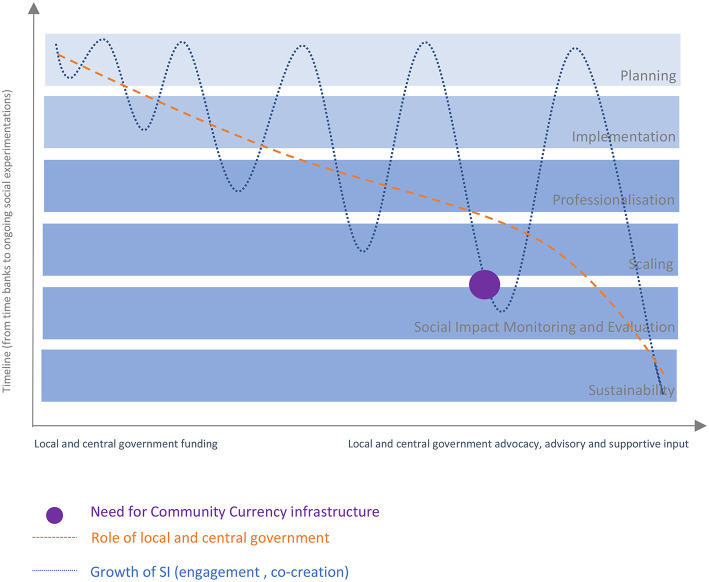
Aging is continuously depicted as a force majeure event despite clear and robust premonitions of its coming. However, such depiction serves to justify the unpreparedness and inadequacy of policies manifesting in loneliness and isolation, unsatisfied demands in health and social care, lack of suitably inclusive residential and social facilities, and inequitable access to support and services. Recent years have seen an increase in social innovation that involves alternative transaction models, such as time-banks and circular economies. These initiatives represent collective responses to changes and challenges such as aging by identifying and innovatively capturing and exchanging locally- and freely- available assets with the intent to fulfill economic needs (more affordable goods and services), social ambitions (skills development and exchange, repurposing space, social inclusion, and cohesion) environmental aspirations (up-cycle) and psychological needs (sense of purpose, identity, belonging, recognition). Whilst it is often assumed that measures are appropriate to resolve the challenges posed by an aging demographic, the learnt assumption that underpins this work is that aging is a systemic issue and ought to be understood, and resolved, in its context, not by producing niche- relevant policy and interventions, but considering the impacts it has on the whole society. Henceforth it is proposed that truly transformative social innovation for the aging population must consider and resolve the challenges of communities as these are where older adults can stay relevant socially and, in the presented approach, also economically. Through the review of four international case studies, a framework with four cornerstones has emerged. This includes the changing role of local and central governments, the models of value creation, co-creation mechanisms, and finally, technology, especially digital social currency. The concurrent presence of the four factors in the framework is not always a requirement for social innovation to emerge and flourish. However, the presented analysis suggests that all four themes have an impact even when not being direct agents of social innovation. The authors conclude by making a case for developing Living Labs for Aging-in-Place, to experiment and study proposed solutions for systemic challenges facing the aging population, grounded in community-led schemes.
尽管衰老有明显且强烈的先兆,但它仍一直被描绘成一场不可抗力事件。然而,这种描述为政策的无准备和不足提供了正当理由,这些不足表现为孤独与孤立、健康和社会护理需求未得到满足、缺乏适当的包容性居住和社会设施,以及获得支持和服务的机会不平等。近年来,社会创新有所增加,其中涉及时间银行和循环经济等替代交易模式。这些举措代表了对诸如老龄化等变化和挑战的集体回应,它们通过识别并创新性地获取和交换当地免费可得的资产,以满足经济需求(更实惠的商品和服务)、社会抱负(技能发展与交流、空间重新利用、社会包容与凝聚)、环境期望(升级再造)和心理需求(目标感、身份认同、归属感、认可)。虽然人们通常认为这些措施适合解决老龄化人口带来的挑战,但支撑这项工作的既定假设是,老龄化是一个系统性问题,应该在其背景下理解和解决,不是通过制定特定领域相关的政策和干预措施,而是考虑其对整个社会的影响。因此,有人提出,针对老年人口的真正变革性社会创新必须考虑并解决社区面临的挑战,因为老年人在社区中能够保持社会相关性,并且在所提出的方法中还能保持经济相关性。通过对四个国际案例研究的回顾,出现了一个有四个基石的框架。这包括地方和中央政府角色的变化、价值创造模式、共同创造机制,最后是技术,特别是数字社会货币。框架中这四个因素同时存在并非社会创新出现和繁荣的必要条件。然而,所呈现的分析表明,即使这四个主题并非社会创新的直接推动者,它们也都有影响。作者最后主张建立就地养老生活实验室,以试验和研究针对老年人口面临的系统性挑战提出的解决方案,这些方案基于社区主导的计划。