Yu Xiao-He, Huang Jian, Ge Nai-Jian, Yang Ye-Fa, Zhao Jin-Yan
Department of Radioactive Intervention, Eastern Hepatobiliary Surgery Hospital, The Second Military Medical University, Shanghai 200438, China.
Department of Laboratory Medicine, Shanghai General Hospital, Shanghai Jiao Tong University School of Medicine, Shanghai 200080, China.
World J Clin Cases. 2021 Apr 6;9(10):2281-2288. doi: 10.12998/wjcc.v9.i10.2281.
Undifferentiated embryonal sarcoma of the liver (UESL) is a neoplasm that rarely develops in adults. The main treatments for UESL are upfront gross total surgical resection and adjuvant multiagent chemotherapy. Here, we report a case of recurrent UESL in an adult treated with pembrolizumab and discuss a method to identify proper candidates for antibody of programmed cell death protein 1 (anti-PD-1) treatment.
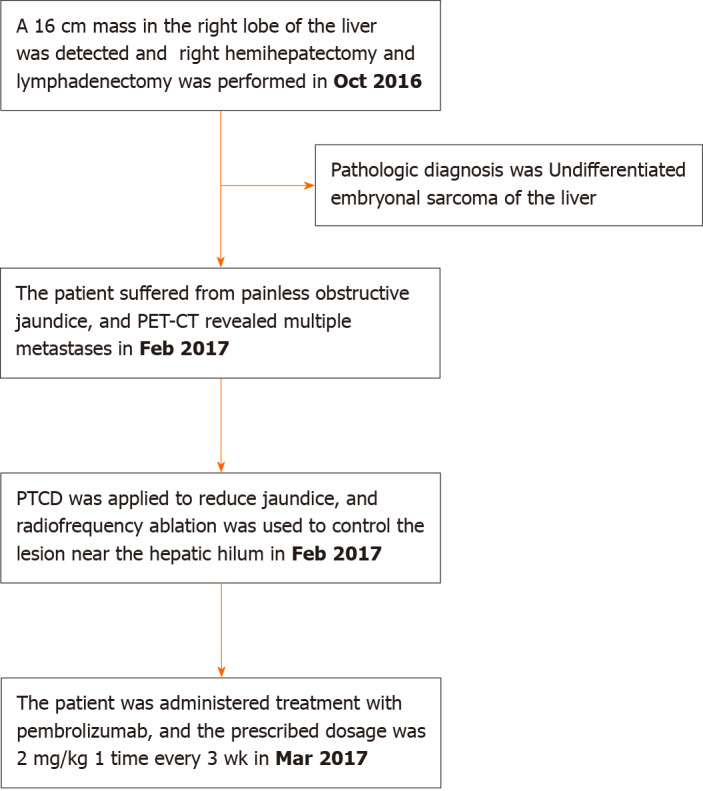
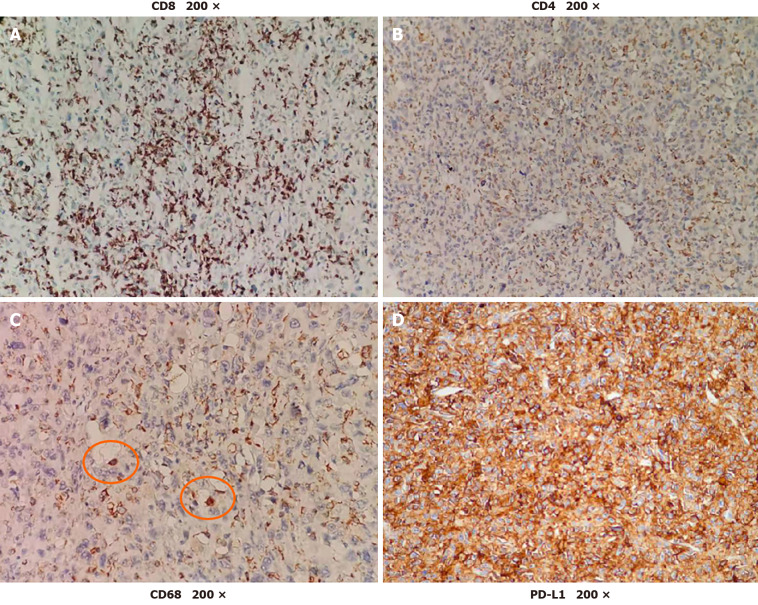
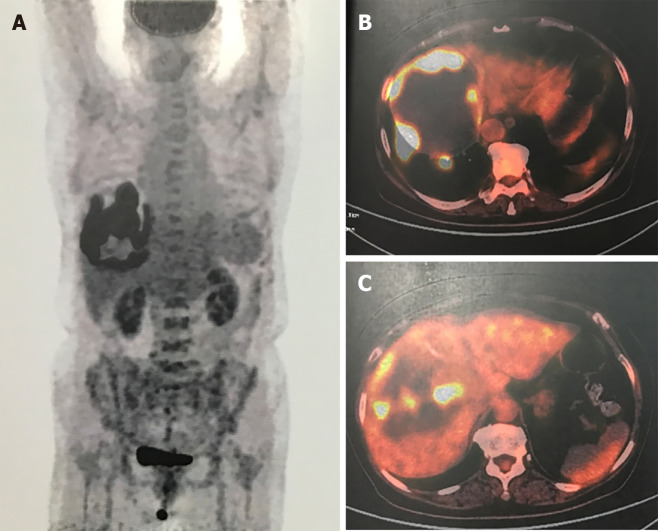
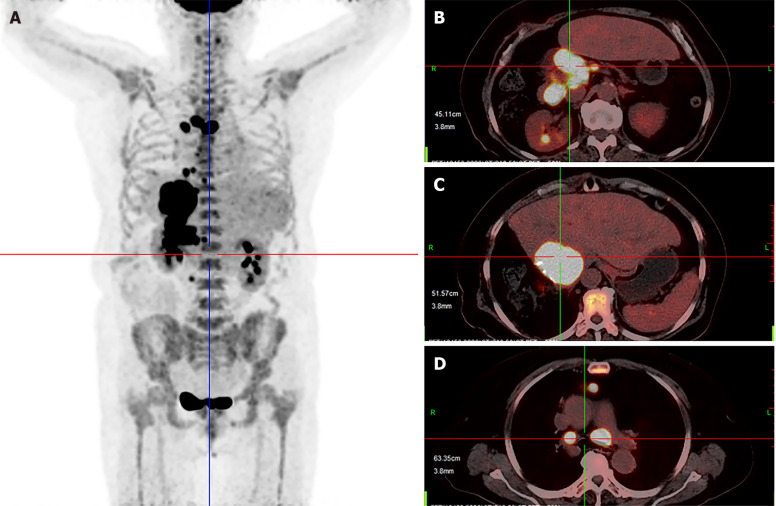
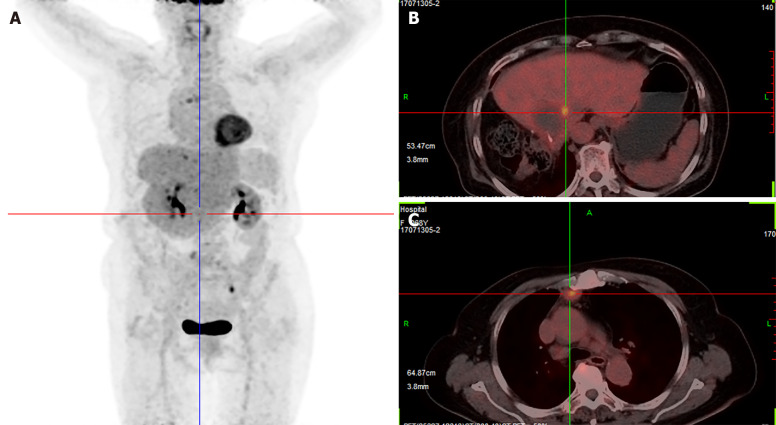
A 69-year-old woman was admitted for abdominal pain that developed for 1 wk. Computed tomography showed a 16 cm mass in the right lobe of the liver. Right hemihepatectomy and lymphadenectomy were performed, and histological diagnosis was UESL. Six months later, the patient suffered from painless obstructive jaundice, and positron emission tomography-computed tomography revealed multiple metastases. Then, percutaneous transhepatic cholangial drainage was applied to reduce jaundice, and radiofrequency ablation was used to control the lesion near the hepatic hilum. However, the patient suffered from a serious fever caused by the tumor. The patient received treatment with pembrolizumab, and the prescribed dosage was 2 mg/kg every 3 wk. After the seventh dose, positron emission tomography-computed tomography revealed that the multiple metastases had nearly disappeared. Radiologic exam was used to evaluate the disease state, and no new lesions were found. Next-generation sequencing and immunohistology were applied to determine the reason why the patient had such a favorable response to pembrolizumab. Tumor mutation burden, microsatellite instability, and programmed death ligand 1 expression can be combined to predict the effect of PD-1 antibodies. When every one of these biomarkers are detected in a tumor patient, the patient may be a proper candidate for PD-1 antibodies.
Anti-PD-1 treatment for tumors needs further research to identify indications and proper biomarkers.
肝未分化胚胎性肉瘤(UESL)是一种在成人中很少发生的肿瘤。UESL的主要治疗方法是 upfront 全切除手术和辅助多药化疗。在此,我们报告一例使用派姆单抗治疗的成人复发性UESL病例,并讨论一种识别程序性细胞死亡蛋白1抗体(抗PD-1)治疗合适候选者的方法。
一名69岁女性因持续1周的腹痛入院。计算机断层扫描显示肝脏右叶有一个16厘米的肿块。进行了右半肝切除术和淋巴结切除术,组织学诊断为UESL。6个月后,患者出现无痛性梗阻性黄疸,正电子发射断层扫描 - 计算机断层扫描显示多处转移。然后,采用经皮经肝胆道引流以减轻黄疸,并使用射频消融控制肝门附近的病变。然而,患者因肿瘤出现严重发热。患者接受派姆单抗治疗,规定剂量为每3周2毫克/千克。第七剂之后,正电子发射断层扫描 - 计算机断层扫描显示多处转移几乎消失。通过放射学检查评估疾病状态,未发现新病变。应用下一代测序和免疫组织学来确定患者对派姆单抗反应良好的原因。肿瘤突变负荷、微卫星不稳定性和程序性死亡配体1表达可联合起来预测PD-1抗体的疗效。当在肿瘤患者中检测到这些生物标志物中的每一种时,该患者可能是PD-1抗体的合适候选者。
肿瘤的抗PD-1治疗需要进一步研究以确定适应症和合适的生物标志物。