Nuffield Department of Population Health University of Oxford United Kingdom.
Nuffield Department of Primary Care Health Sciences University of Oxford United Kingdom.
J Am Heart Assoc. 2021 May 4;10(9):e019337. doi: 10.1161/JAHA.120.019337. Epub 2021 Apr 19.
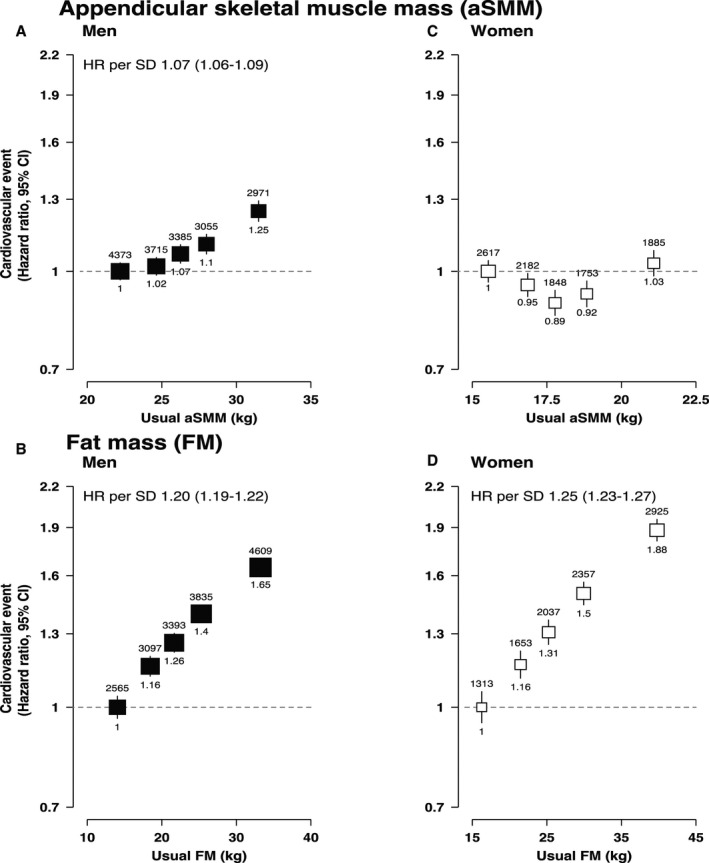
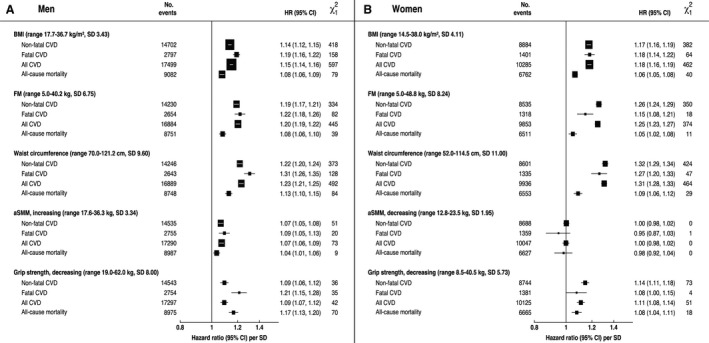
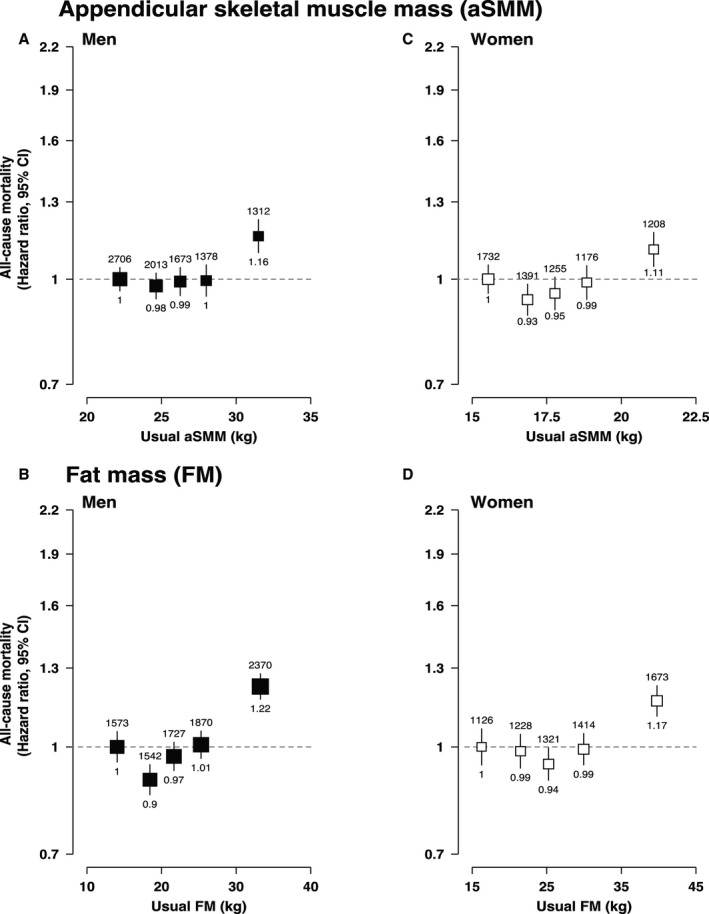
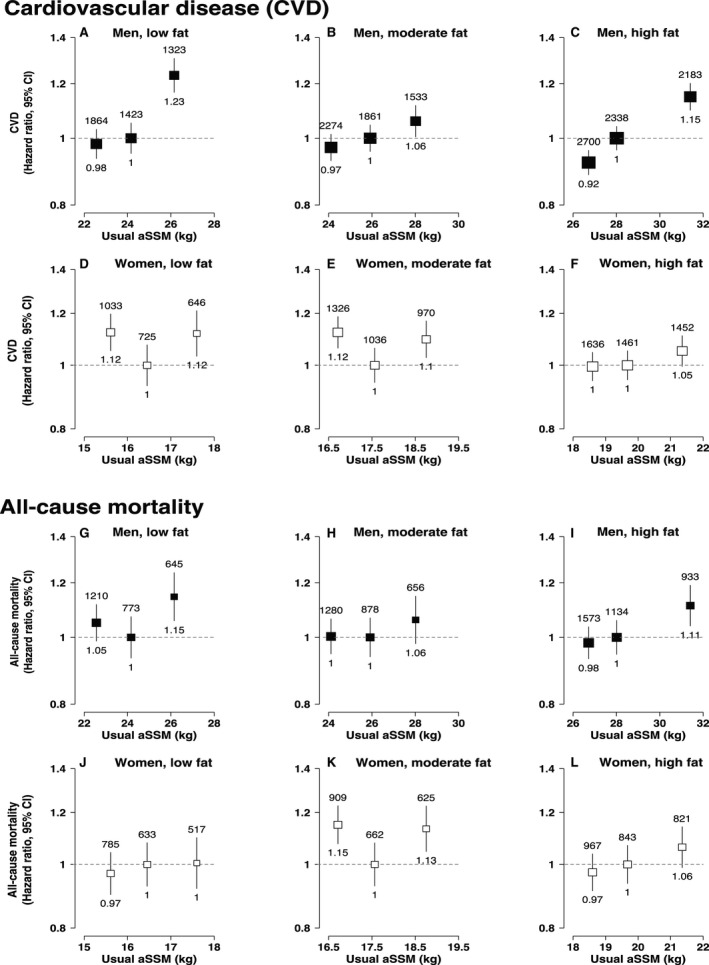
Background There is debate whether body mass index is a good predictor of health outcomes because different tissues, namely skeletal muscle mass (SMM) and fat mass (FM), may be differentially associated with risk. We investigated the association of appendicular SMM (aSMM) and FM with fatal and nonfatal cardiovascular disease (CVD) and all-cause mortality. We compared their prognostic value to that of body mass index. Methods and Results We studied 356 590 UK Biobank participants aged 40 to 69 years with bioimpedance analysis data for whole-body FM and predicted limb muscle mass (to calculate aSMM). Associations between aSMM and FM with CVD and all-cause mortality were examined using multivariable Cox proportional hazards models. Over 3 749 501 person-years of follow-up, there were 27 784 CVD events and 15 844 all-cause deaths. In men, aSMM was positively associated with CVD incidence (hazard ratio [HR] per 1 SD 1.07; 95% CI, 1.06-1.09) and there was a curvilinear association in women. There were stronger positive associations between FM and CVD with HRs per SD of 1.20 (95% CI, 1.19-1.22) and 1.25 (95% CI, 1.23-1.27) in men and women respectively. Within FM tertiles, the associations between aSMM and CVD risk largely persisted. There were J-shaped associations between aSMM and FM with all-cause mortality in both sexes. Body mass index was modestly better at discriminating CVD risk. Conclusions FM showed a strong positive association with CVD risk. The relationship of aSMM with CVD risk differed between sexes, and potential mechanisms need further investigation. Body fat and SMM bioimpedance measurements were not superior to body mass index in predicting population-level CVD incidence or all-cause mortality.
体质指数(BMI)是否是健康结果的良好预测指标存在争议,因为不同的组织,即骨骼肌质量(SMM)和脂肪质量(FM),可能与风险有不同的关联。我们研究了四肢 SMM(aSMM)和 FM 与致命和非致命心血管疾病(CVD)以及全因死亡率的关系。我们将其预后价值与 BMI 进行了比较。
我们研究了 356590 名年龄在 40 至 69 岁的英国生物银行参与者,这些参与者具有全身 FM 的生物阻抗分析数据和预测的肢体肌肉质量(计算 aSMM)。使用多变量 Cox 比例风险模型检查 aSMM 和 FM 与 CVD 和全因死亡率之间的关系。在 3749501 人年的随访期间,发生了 27784 例 CVD 事件和 15844 例全因死亡。在男性中,aSMM 与 CVD 发生率呈正相关(每 SD 增加 1.07 的 HR;95%CI,1.06-1.09),女性中存在曲线关系。FM 与 CVD 的正相关更强,男性和女性每 SD 的 HR 分别为 1.20(95%CI,1.19-1.22)和 1.25(95%CI,1.23-1.27)。在 FM 三分位数内,aSMM 与 CVD 风险之间的关系基本保持不变。在两性中,aSMM 与 FM 与全因死亡率之间均存在 J 形关系。BMI 在区分 CVD 风险方面表现略好。
FM 与 CVD 风险呈强正相关。aSMM 与 CVD 风险的关系在两性之间存在差异,潜在机制需要进一步研究。身体脂肪和 SMM 生物阻抗测量在预测人群 CVD 发生率或全因死亡率方面并不优于 BMI。