MD Anderson Cancer Center, Houston, TX, USA.
University of Wisconsin, Madison, WI, USA.
Integr Cancer Ther. 2021 Jan-Dec;20:1534735420986615. doi: 10.1177/1534735420986615.
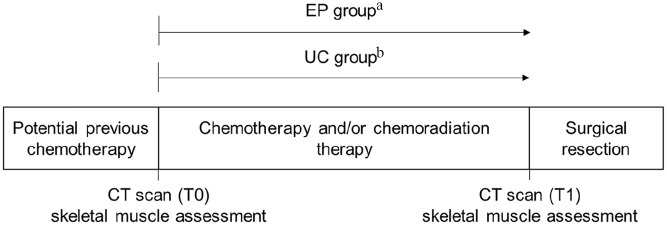
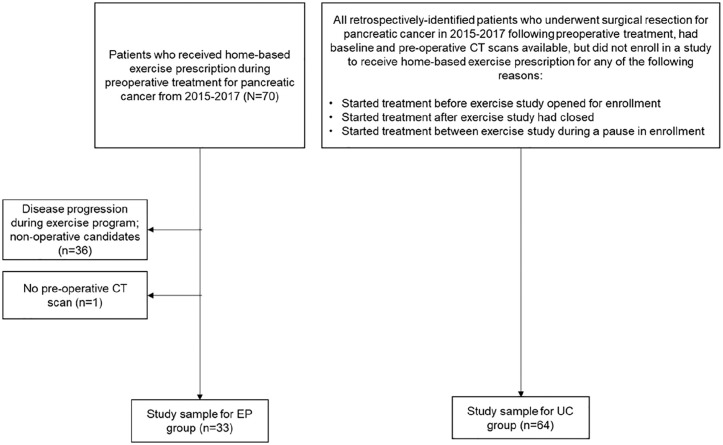
Loss of skeletal muscle and inferior muscle quality are associated with poor prognosis in patients undergoing preoperative treatment for pancreatic cancer, so maintaining skeletal muscle health before surgery may help accelerate patients' functional recovery and improve their quality of life following surgery. While exercise helps maintain or increase skeletal muscle in individuals undergoing cancer treatment, its efficacy during pancreatic cancer treatment is unclear. Accordingly, in this study we compared changes in skeletal muscle quantity (skeletal muscle index [SMI]) and quality (skeletal muscle density [SMD]) during preoperative pancreatic cancer treatment in participants in a home-based exercise program (EP) and a historical cohort of patients who received the usual care (UC) with no formal exercise programming. Recommendations for the EP cohort included both aerobic and resistance exercise. We assessed changes in SMI and SMD using computed tomography scans administered at treatment planning (T0, prior to EP enrollment) and preoperative restaging (T1) for 33 EP and 64 UC patients and compared changes between groups. The UC patients had statistically significant SMI decreases from T0 to T1 (-1.4 ± 3.8 cm/m; = .005), while the EP patients did not (0.2 ± 3.2 cm/m; = .7). The SMI loss was significantly worse for the UC than for the EP patients ( = .03). Neither group demonstrated statistically significant changes in SMD from T0 to T1, nor did the groups differ in the amount of change in SMD. An adjusted linear regression model demonstrated that EP participation was significantly associated with better SMI maintenance ( = .02). These results suggest that participation in a home-based EP during preoperative treatment may help improve skeletal muscle health and clinical and quality of life outcomes for pancreatic cancer survivors.
骨骼肌丧失和肌肉质量下降与接受胰腺癌术前治疗的患者预后不良相关,因此在手术前保持骨骼肌健康可能有助于加速患者的功能恢复并提高术后生活质量。虽然运动有助于维持或增加正在接受癌症治疗的个体的骨骼肌,但在胰腺癌治疗期间其疗效尚不清楚。因此,在这项研究中,我们比较了接受家庭为基础的运动方案(EP)的参与者与接受常规治疗(UC)的历史队列患者在术前胰腺癌治疗期间骨骼肌量(骨骼肌指数 [SMI])和质量(骨骼肌密度 [SMD])的变化,UC 组没有进行正式的运动方案。EP 组的运动方案建议包括有氧运动和抗阻运动。我们使用在治疗计划(T0,在 EP 登记之前)和术前重新分期(T1)时进行的计算机断层扫描来评估 SMI 和 SMD 的变化,共评估了 33 名 EP 患者和 64 名 UC 患者,并比较了两组之间的变化。UC 患者从 T0 到 T1 的 SMI 显著下降(-1.4 ± 3.8 cm/m; = .005),而 EP 患者则没有(0.2 ± 3.2 cm/m; = .7)。UC 患者的 SMI 损失明显比 EP 患者差( = .03)。两组患者从 T0 到 T1 的 SMD 均无统计学显著变化,SMD 变化量也无差异。调整后的线性回归模型表明,EP 参与与更好的 SMI 维持显著相关( = .02)。这些结果表明,在术前治疗期间参加家庭为基础的 EP 可能有助于改善胰腺癌幸存者的骨骼肌健康以及临床和生活质量结局。