Manchester Centre of Health Psychology, Division of Psychology and Mental Health, School of Health Sciences, University of Manchester, Coupland Street, Manchester, M13 9PL, England.
NIHR Manchester Biomedical Research Centre, Manchester Academic Health Science Centre, Central Manchester University Hospitals NHS Foundation Trust, Manchester, England.
Br J Cancer. 2023 Apr;128(8):1548-1558. doi: 10.1038/s41416-023-02156-7. Epub 2023 Feb 11.
Adding risk stratification to standard screening via the NHS Breast Screening Programme (NHSBSP) allows women at higher risk to be offered additional prevention and screening options. It may, however, introduce new harms such as increasing cancer worry. The present study aimed to assess whether there were differences in self-reported harms and benefits between women offered risk stratification (BC-Predict) compared to women offered standard NHSBSP, controlling for baseline values.
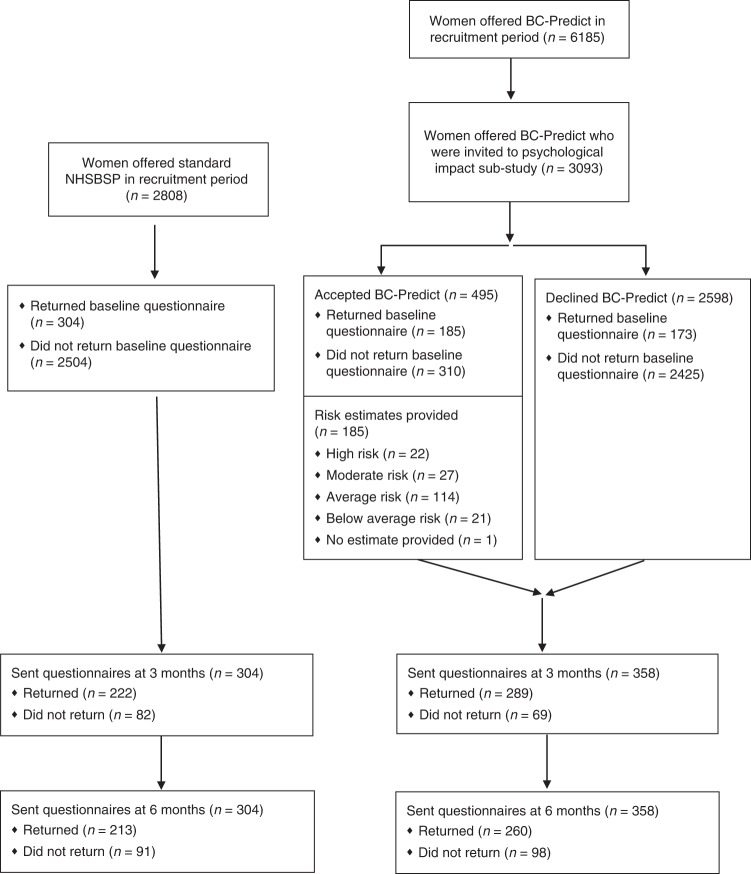
As part of the larger PROCAS2 study (NCT04359420), 5901 women were offered standard NHSBSP or BC-Predict at the invitation to NHSBSP. Women who took up BC-Predict received 10-year risk estimates: "high" (≥8%), "above average (moderate)" (5-7.99%), "average" (2-4.99%) or "below average (low)" (<2%) risk. A subset of 662 women completed questionnaires at baseline and at 3 months (n = 511) and 6 months (n = 473).
State anxiety and cancer worry scores were low with no differences between women offered BC-Predict or NHSBSP. Women offered BC-Predict and informed of being at higher risk reported higher risk perceptions and cancer worry than other women, but without reaching clinical levels.
Concerns that risk-stratified screening will produce harm due to increases in general anxiety or cancer worry are unfounded, even for women informed that they are at high risk.
通过国民保健制度乳房筛查计划(NHSBSP)在标准筛查中加入风险分层,可以为高风险女性提供额外的预防和筛查选择。然而,这可能会引入新的危害,如增加癌症担忧。本研究旨在评估与接受标准 NHSBSP 的女性相比,接受风险分层(BC-Predict)的女性在自我报告的危害和获益方面是否存在差异,同时控制基线值。
作为更大规模的 PROCAS2 研究的一部分(NCT04359420),5901 名女性在 NHSBSP 邀请时选择接受标准 NHSBSP 或 BC-Predict。接受 BC-Predict 的女性会收到 10 年风险估计:“高”(≥8%)、“高于平均水平(中度)”(5-7.99%)、“平均”(2-4.99%)或“低于平均水平(低)”(<2%)。662 名女性中的一部分在基线和 3 个月(n=511)和 6 个月(n=473)时完成了问卷。
状态焦虑和癌症担忧评分较低,接受 BC-Predict 或 NHSBSP 的女性之间没有差异。接受 BC-Predict 并被告知处于高风险的女性比其他女性报告了更高的风险感知和癌症担忧,但未达到临床水平。
由于普遍焦虑或癌症担忧的增加而导致风险分层筛查产生危害的担忧是没有根据的,即使是对被告知处于高风险的女性也是如此。