Jekauc Darko, Rayling Sabine, Klopp Sara, Schmidt Detlef, Rittmann Lena-Marie, Fritsch Julian
Institute for Sport and Sport Science, Karlsruhe Institute of Technology, Engler-Bunte-Ring 15, 76131, Karlsruhe, Germany.
BMC Musculoskelet Disord. 2021 Apr 19;22(1):366. doi: 10.1186/s12891-021-04239-z.
Rehabilitation is seen as crucial in dealing with the demographic change in many European countries. In Germany, for example, after having stayed in a rehabilitation center, patients have the possibility to participate in aftercare programs aimed at promoting long-term health behaviour. Despite the relevance of follow-up support for patients' long-term health and work ability, participation rates in aftercare programs are quite low. Here, web-based aftercare programs can be a viable alternative to the traditional face-to-face programs due to their flexibility in time and location. This research project aims to use quantitative and qualitative methods to gain more insight into the potential of web-based aftercare programs.
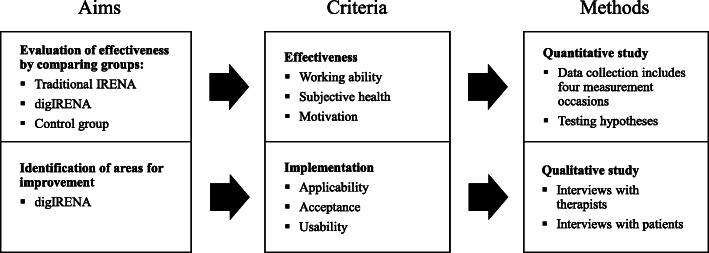
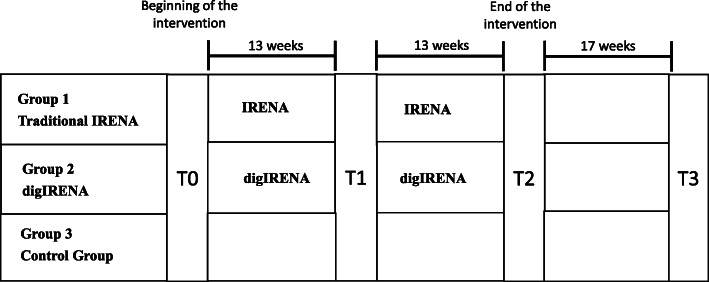
The goal is to recruit up to 1150 patients at baseline in five rehabilitation centers across Germany. For ethical reasons, partially randomized experimental study design is used to quantitatively assess the effectiveness of web-based aftercare programs. All patients are offered the traditional face-to-face aftercare treatment (IRENA). When patients deny to participate in traditional face-to-face aftercare, they are randomly distributed into either web-based aftercare (digIRENA) or a control group. In all three groups, the SF-12, which measures subjective health, and the WAI, which measures working ability, will be used at baseline, 13 weeks, 26 weeks and 43 weeks after the patients have left the rehabilitation center. BREQ-2, which measures motivation, is used only in the traditional aftercare group and the web-based aftercare group. A multivariate analysis of variance with repeated measurement and latent growth curve models will be used to compare the development of the variables in the three groups. For the qualitative part of the study, interviews with patients and therapists will be conducted to shed light on the applicability, acceptance, and usability of web-based aftercare programs.
This study may provide valuable insight into the potential of web-based rehabilitation aftercare programs as a way to supplement traditional face-to-face programs. This seems particularly promising if it can manage to reach those patients who do not currently participate in traditional face-to-face rehabilitation aftercare programs due to time and location constraints.
The trial has been registered at the German Register of Clinical Studies (DRKS) with the registration number: DRKS00022467 .
在许多欧洲国家,康复被视为应对人口结构变化的关键。例如,在德国,患者在康复中心停留后,有可能参与旨在促进长期健康行为的后续护理计划。尽管后续支持对患者的长期健康和工作能力至关重要,但后续护理计划的参与率相当低。在此,基于网络的后续护理计划因其在时间和地点上的灵活性,可能成为传统面对面计划的可行替代方案。本研究项目旨在使用定量和定性方法,更深入地了解基于网络的后续护理计划的潜力。
目标是在德国的五个康复中心招募多达1150名基线患者。出于伦理原因,采用部分随机实验研究设计来定量评估基于网络的后续护理计划的有效性。所有患者都将接受传统的面对面后续护理治疗(IRENA)。当患者拒绝参与传统的面对面后续护理时,他们将被随机分配到基于网络的后续护理(digIRENA)或对照组。在所有三组中,将在患者离开康复中心后的基线、13周、26周和43周使用测量主观健康的SF - 12和测量工作能力的WAI。仅在传统后续护理组和基于网络的后续护理组中使用测量动机的BREQ - 2。将使用重复测量的多变量方差分析和潜在增长曲线模型来比较三组中变量的发展情况。对于研究的定性部分,将对患者和治疗师进行访谈,以阐明基于网络的后续护理计划的适用性、可接受性和可用性。
本研究可能为基于网络的康复后续护理计划作为补充传统面对面计划的一种方式的潜力提供有价值的见解。如果它能够成功覆盖那些目前由于时间和地点限制而未参与传统面对面康复后续护理计划的患者,这似乎特别有前景。
该试验已在德国临床研究注册中心(DRKS)注册,注册号为:DRKS00022467 。