Molecular Physiology Laboratory, Cluster for Pioneering Research, RIKEN, Saitama, Japan.
Department of Biological Sciences, Graduate School of Science, The University of Tokyo, Bunkyo-Ku, Tokyo, Japan.
Commun Biol. 2021 Apr 19;4(1):476. doi: 10.1038/s42003-021-02001-8.
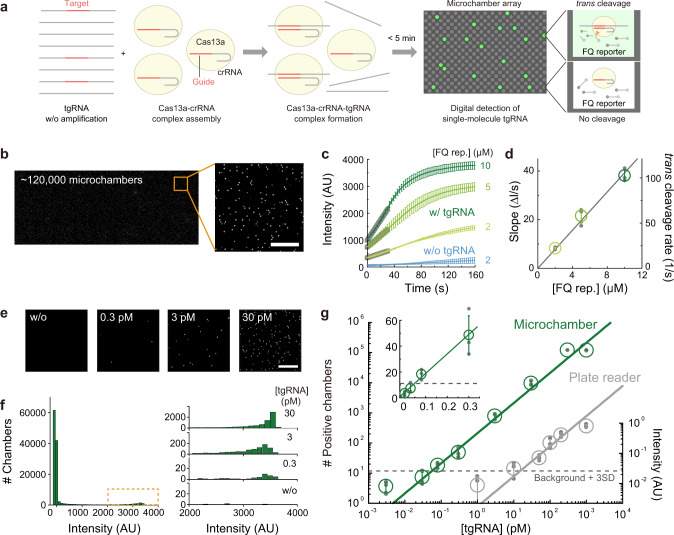
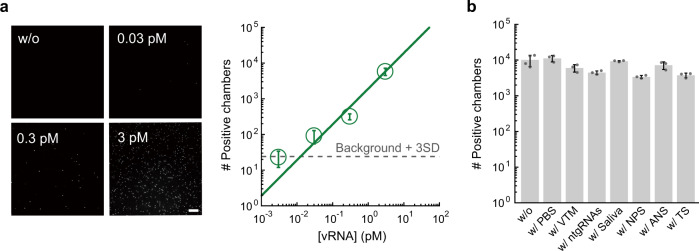
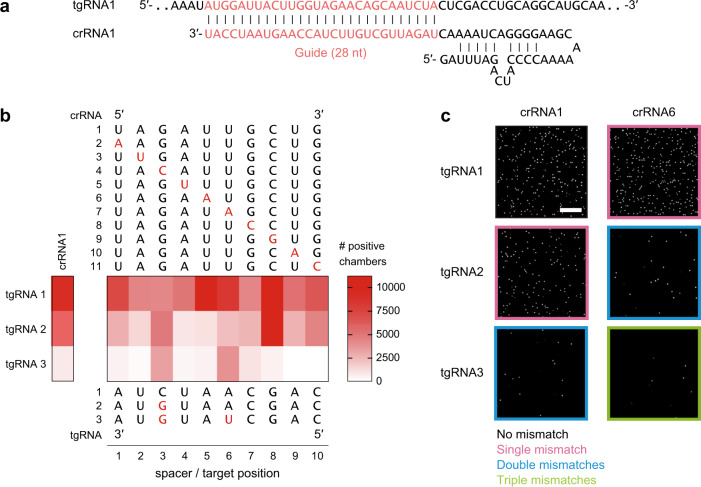
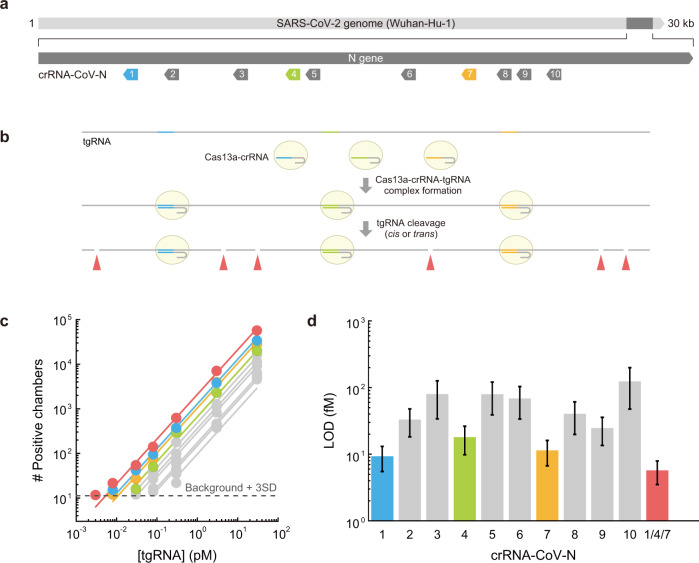
CRISPR-based nucleic-acid detection is an emerging technology for molecular diagnostics. However, these methods generally require several hours and could cause amplification errors, due to the pre-amplification of target nucleic acids to enhance the detection sensitivity. Here, we developed a platform that allows "CRISPR-based amplification-free digital RNA detection (SATORI)", by combining CRISPR-Cas13-based RNA detection and microchamber-array technologies. SATORI detected single-stranded RNA targets with maximal sensitivity of ~10 fM in <5 min, with high specificity. Furthermore, the simultaneous use of multiple different guide RNAs enhanced the sensitivity, thereby enabling the detection of the SARS-CoV-2 N-gene RNA at ~5 fM levels. Therefore, we hope SATORI will serve as a powerful class of accurate and rapid diagnostics.
基于 CRISPR 的核酸检测是一种新兴的分子诊断技术。然而,由于需要对靶核酸进行预扩增以提高检测灵敏度,这些方法通常需要几个小时,并且可能导致扩增错误。在这里,我们开发了一种平台,通过结合基于 CRISPR-Cas13 的 RNA 检测和微腔阵列技术,实现了“基于 CRISPR 的无扩增数字 RNA 检测(SATORI)”。SATORI 在 <5 min 内以 ~10 fM 的最大灵敏度检测单链 RNA 靶标,具有高特异性。此外,同时使用多个不同的向导 RNA 提高了灵敏度,从而能够以 ~5 fM 的水平检测 SARS-CoV-2 N 基因 RNA。因此,我们希望 SATORI 将成为一种强大的准确快速诊断方法。