Fundación Vida Plena, Juan Capriles 346, Cochabamba, Bolivia.
Department of Public Health and Primary Care, Faculty of Medicine and Health Sciences, Ghent University, Ghent, Belgium.
Int J Equity Health. 2021 Apr 20;20(1):104. doi: 10.1186/s12939-021-01442-1.
The rising prevalence of type 2 diabetes results in a worldwide public healthcare crisis, especially in low- and middle-income countries (LMICs) with unprepared and overburdened health systems mainly focused on infectious diseases and maternal and child health. Studies regarding type 2 diabetes in LMICs describe specific interventions ignoring a comprehensive analysis of the local factors people see influential to their health. This study aims to meet this research gap by exploring what people with type 2 diabetes in Bolivia need to maintain or improve their health, how important they perceive those identified needs and to what extent these needs are met.
From March until May 2019, 33 persons with type 2 diabetes from three periurban municipalities of the department of Cochabamba participated in this study. The concept mapping methodology by Trochim, a highly structured qualitative brainstorming method, was used to generate and structure a broad range of perspectives on what the participants considered instrumental for their health.
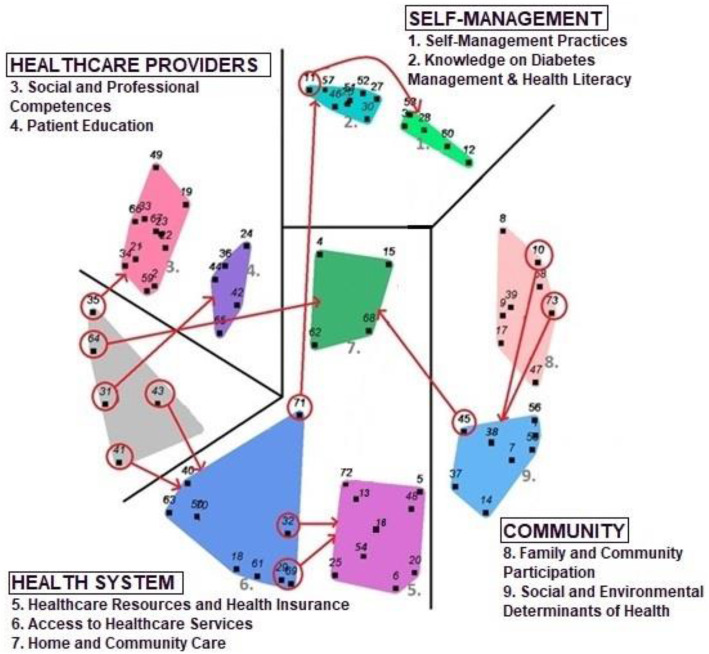
The brainstorming resulted in 156 original statements condensed into 72 conceptually different needs and resources, structured under nine conceptual clusters and four action domains. These domains illustrated with vital needs were: (1) self-management with use of plants and the possibility to measure sugar levels periodically; (2) healthcare providers with the need to trust and receive a uniform diagnosis and treatment plan; (3) health system with opportune access to care and (4) community with community participation in health and safety, including removal of stray dogs.
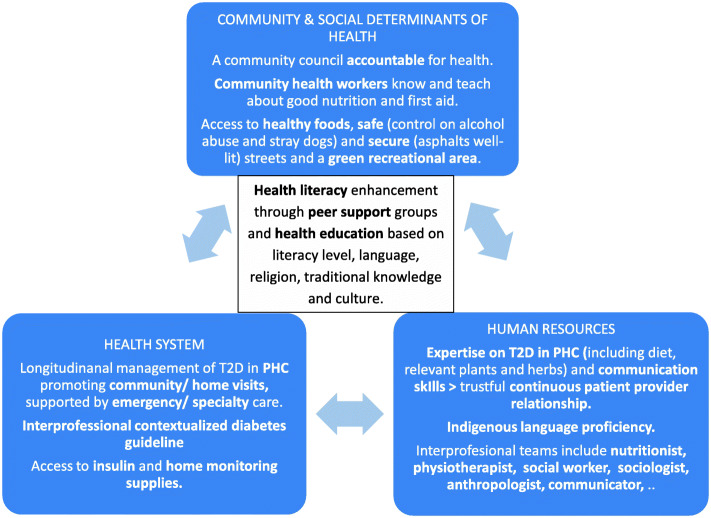
This study identifies mostly contextual factors like low literacy levels, linguistic problems in care, the need to articulate people's worldview including traditional use of natural remedies with the Bolivian health system and the lack of expertise on type 2 diabetes by primary health care providers. Understanding the needs and structuring them in different areas wherein action is required serves as a foundation for the planning and evaluation of an integrated people centred care program for people with type 2 diabetes. This participative method serves as a tool to implement the often theoretical concept of integrated people centred health care in health policy and program development.
2 型糖尿病的发病率不断上升,导致全球公共医疗保健危机,尤其是在卫生系统尚未做好准备且负担过重的中低收入国家(LMICs),这些国家主要关注传染病以及母婴健康。有关 LMICs 中 2 型糖尿病的研究描述了具体的干预措施,而忽略了对当地人认为对其健康有影响的当地因素进行全面分析。本研究旨在通过探讨玻利维亚 2 型糖尿病患者需要维持或改善健康的因素、他们对这些确定的需求的重视程度以及这些需求的满足程度来弥补这一研究空白。
2019 年 3 月至 5 月,来自科恰班巴省三个城郊市的 33 名 2 型糖尿病患者参与了本研究。采用 Trochim 的概念映射方法,这是一种高度结构化的定性头脑风暴方法,用于生成和构建参与者认为对其健康有帮助的广泛观点。
头脑风暴产生了 156 条原始陈述,浓缩为 72 个概念上不同的需求和资源,分为九个概念群和四个行动领域。这些领域以重要需求为例进行了说明:(1)自我管理,包括使用植物和定期测量血糖水平的可能性;(2)医疗保健提供者,需要建立信任并获得统一的诊断和治疗计划;(3)卫生系统,需要适时获得医疗服务;(4)社区,包括社区参与健康和安全,包括清除流浪狗。
本研究确定了大多数背景因素,如低文化程度、护理中的语言问题、需要将人们的世界观与玻利维亚卫生系统相结合,包括传统的天然药物使用,以及初级保健提供者缺乏 2 型糖尿病专业知识。了解需求并将其组织到需要采取行动的不同领域为规划和评估以患者为中心的综合护理计划奠定了基础。这种参与式方法可作为在卫生政策和方案制定中实施以患者为中心的综合卫生保健这一理论概念的工具。