Institute of Cardiology of Rio Grande do Sul/University Foundation of Cardiology, Av. Princesa Isabel, 395 Santana, Porto Alegre, RS, 90620-001, Brazil.
Clinical Pathology Laboratory, Hospital de Clínicas de Porto Alegre, Universidade Federal do Rio Grande do Sul, Porto Alegre, RS, Brazil.
Sci Rep. 2021 Apr 20;11(1):8528. doi: 10.1038/s41598-021-87990-6.
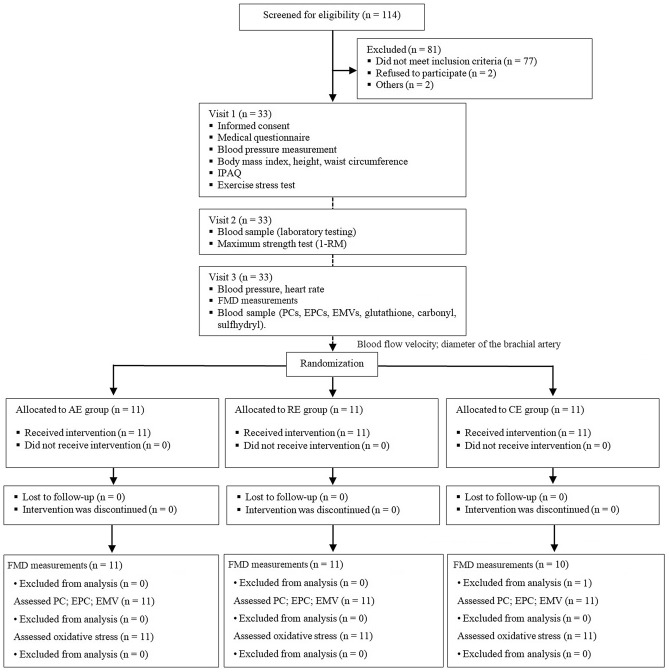
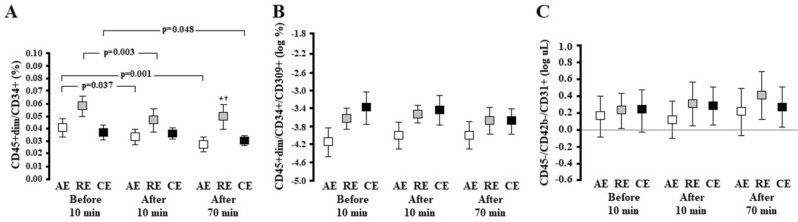
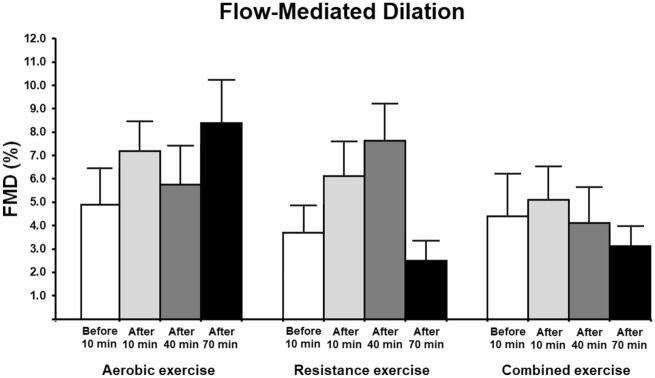
To examine the acute effects of aerobic exercise (AE), resistance exercise (RE) or combined exercise (CE) on flow-mediated dilation (FMD), progenitor cells (PCs), endothelial progenitor cells (EPCs), oxidative stress markers and endothelial-cell derived microvesicles (EMVs) in patients with hypertension. This is a randomized, parallel-group clinical trial involving an intervention of one session of three different modalities of exercise. Thirty-three males (43 ± 2y) were randomly divided into three groups: a session of AE (n = 11, 40 min, cycle ergometer, 60% HRR); a session of RE (n = 11, 40 min, 4 × 12 lower limb repetitions, 60% 1-RM); or a session of CE (n = 11, 20-min RE + 20-min AE). FMD was assessed 10 min before and 10, 40 and 70 min post-intervention. Blood samples were collected at the same time points (except 40 min). FMD were similar in all groups and from baseline (within each group) after a single exercise bout (AE, RE or CE). At 70 min, RE group showed higher levels of PCs compared to the AE (81%) and CE group (60%). PC levels were reduced from baseline in all groups (AE: 32%, p = 0.037; RE: 15%, p = 0.003; CE: 17%, p = 0.048). The levels of EPCs, EMVs and oxidative stress were unchanged. There were no acute effects of moderate-intensity exercise on FMD, EPCs, EMVs and oxidative stress, but PCs decreased regardless of the exercise modality. Individuals with controlled hypertension do not seem to have impaired vascular function in response to a single exercise bout.
为了研究有氧运动(AE)、抗阻运动(RE)或组合运动(CE)对高血压患者的血流介导的舒张功能(FMD)、祖细胞(PCs)、内皮祖细胞(EPCs)、氧化应激标志物和内皮细胞衍生的微泡(EMVs)的急性影响,进行了这项随机、平行组临床试验,该试验包括三种不同运动方式的单次干预。33 名男性(43±2 岁)被随机分为三组:AE 组(n=11,40 分钟,踏车运动,60%HRR);RE 组(n=11,40 分钟,4×12 次下肢重复,60%1-RM);或 CE 组(n=11,20 分钟 RE+20 分钟 AE)。FMD 在干预前 10 分钟、干预后 10、40 和 70 分钟进行评估。在相同时间点(除了 40 分钟)采集血样。单次运动后,所有组的 FMD 均相似,且与基线相比(各组内)也相似(AE、RE 或 CE)。在 70 分钟时,RE 组的 PCs 水平高于 AE(81%)和 CE(60%)组。所有组的 PC 水平均从基线下降(AE:32%,p=0.037;RE:15%,p=0.003;CE:17%,p=0.048)。EPCs、EMVs 和氧化应激水平不变。中等强度运动对 FMD、EPCs、EMVs 和氧化应激没有急性影响,但无论运动方式如何,PCs 都会减少。控制良好的高血压患者单次运动后血管功能似乎没有受损。