Department of Psychology I, Biological Psychology, Clinical Psychology And Psychotherapy, University of Würzburg, Marcusstraße 9-11, 97070, Würzburg, Germany.
Human-Computer Interaction, University of Würzburg, Würzburg, Germany.
J Neuroeng Rehabil. 2021 Apr 22;18(1):68. doi: 10.1186/s12984-021-00848-w.
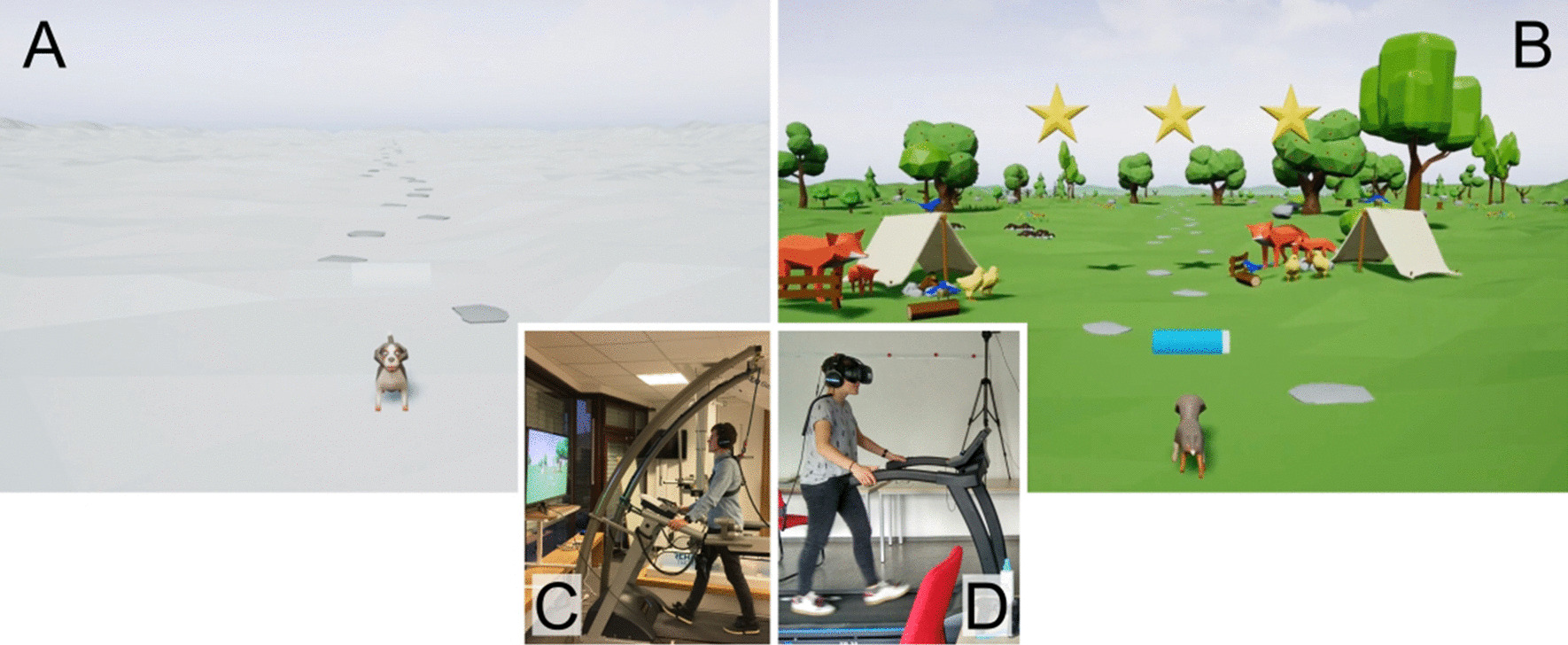
The rehabilitation of gait disorders in patients with multiple sclerosis (MS) and stroke is often based on conventional treadmill training. Virtual reality (VR)-based treadmill training can increase motivation and improve therapy outcomes. The present study evaluated an immersive virtual reality application (using a head-mounted display, HMD) for gait rehabilitation with patients to (1) demonstrate its feasibility and acceptance and to (2) compare its short-term effects to a semi-immersive presentation (using a monitor) and a conventional treadmill training without VR to assess the usability of both systems and estimate the effects on walking speed and motivation.
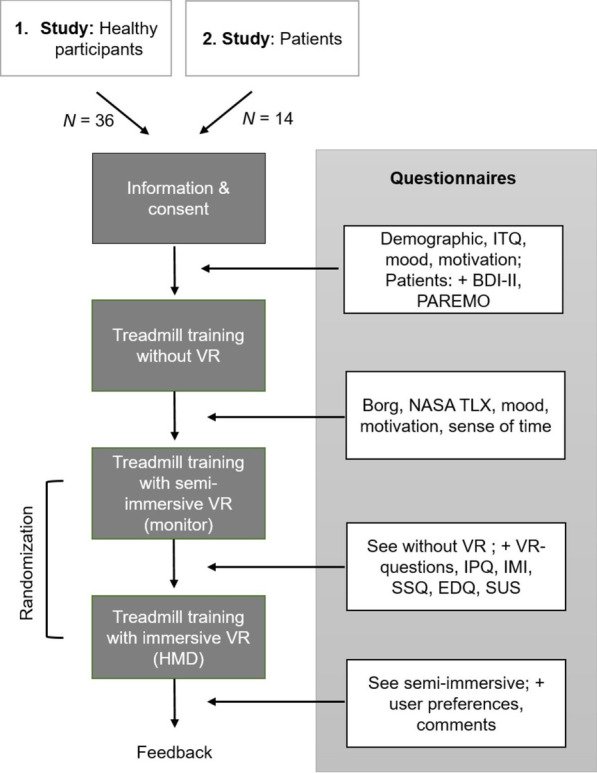
In a within-subjects study design, 36 healthy participants and 14 persons with MS or stroke participated in each of the three experimental conditions (VR via HMD, VR via monitor, treadmill training without VR).
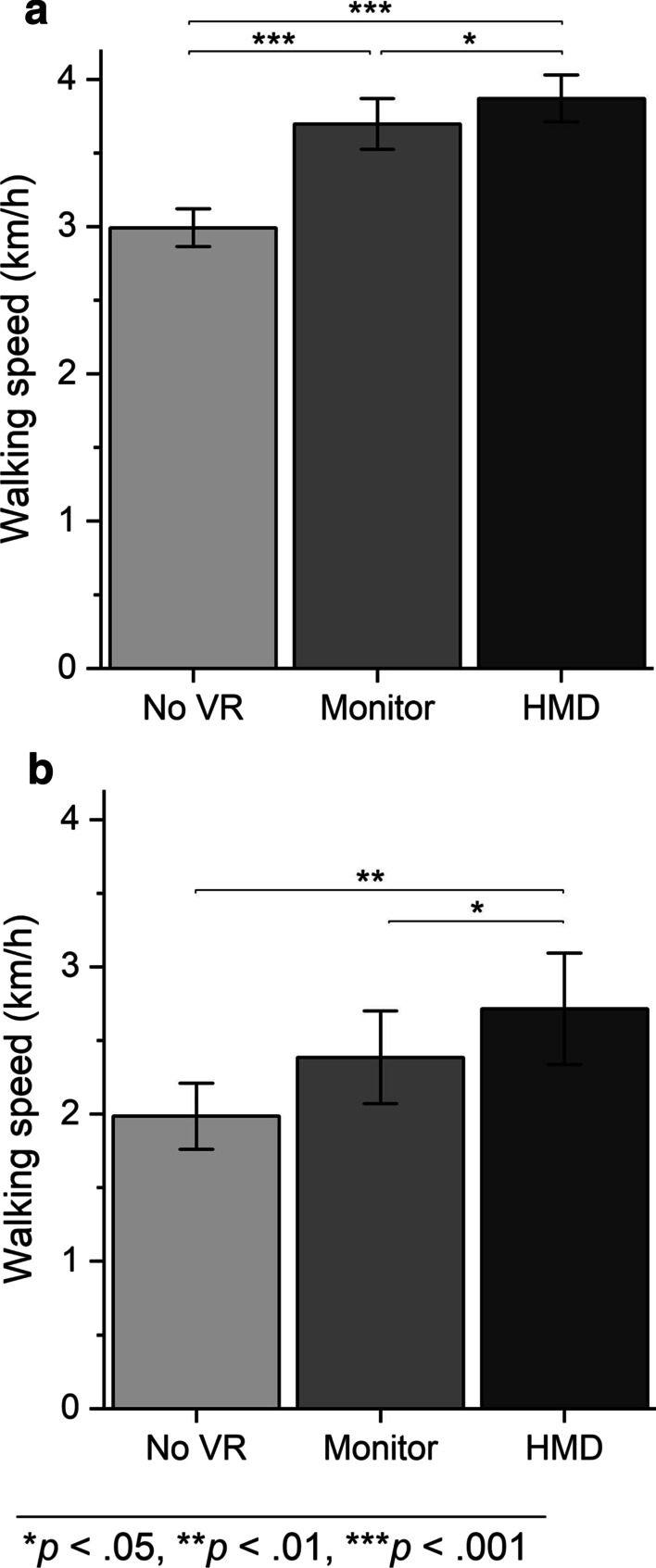
For both groups, the walking speed in the HMD condition was higher than in treadmill training without VR and in the monitor condition. Healthy participants reported a higher motivation after the HMD condition as compared with the other conditions. Importantly, no side effects in the sense of simulator sickness occurred and usability ratings were high. No increases in heart rate were observed following the VR conditions. Presence ratings were higher for the HMD condition compared with the monitor condition for both user groups. Most of the healthy study participants (89%) and patients (71%) preferred the HMD-based training among the three conditions and most patients could imagine using it more frequently.
For the first time, the present study evaluated the usability of an immersive VR system for gait rehabilitation in a direct comparison with a semi-immersive system and a conventional training without VR with healthy participants and patients. The study demonstrated the feasibility of combining a treadmill training with immersive VR. Due to its high usability and low side effects, it might be particularly suited for patients to improve training motivation and training outcome e. g. the walking speed compared with treadmill training using no or only semi-immersive VR. Immersive VR systems still require specific technical setup procedures. This should be taken into account for specific clinical use-cases during a cost-benefit assessment.
多发性硬化症(MS)和中风患者步态障碍的康复通常基于传统跑步机训练。基于虚拟现实(VR)的跑步机训练可以提高动机并改善治疗效果。本研究评估了一种沉浸式虚拟现实应用程序(使用头戴式显示器,HMD)用于步态康复,目的是:(1)展示其可行性和可接受性;(2)将其短期效果与半沉浸式呈现(使用监视器)和无 VR 的传统跑步机训练进行比较,以评估两个系统的可用性,并估计对行走速度和动机的影响。
在一项自身对照研究设计中,36 名健康参与者和 14 名 MS 或中风患者分别参加了三个实验条件(HMD 中的 VR、监视器中的 VR、无 VR 的跑步机训练)。
对于两个组,HMD 条件下的行走速度均高于无 VR 的跑步机训练和监视器条件。健康参与者报告说,与其他条件相比,HMD 条件后的动机更高。重要的是,没有出现模拟疾病的副作用,并且可用性评分很高。在 VR 条件下没有观察到心率增加。与监视器条件相比,两个用户组的 HMD 条件的存在评分更高。大多数健康研究参与者(89%)和患者(71%)在三种条件中更喜欢基于 HMD 的训练,并且大多数患者可以想象更频繁地使用它。
本研究首次评估了在直接比较与半沉浸式系统和无 VR 的传统训练的情况下,使用健康参与者和患者对用于步态康复的沉浸式 VR 系统的可用性。该研究证明了将跑步机训练与沉浸式 VR 相结合的可行性。由于其高可用性和低副作用,与使用无或仅半沉浸式 VR 的跑步机训练相比,它可能特别适合患者提高训练动机和训练效果,例如行走速度。沉浸式 VR 系统仍需要特定的技术设置程序。在成本效益评估期间,应考虑到特定的临床应用案例。