Fahed Mario, Steffens David C
Department of Psychiatry, University of Connecticut, School of Medicine, Farmington, CT, USA.
Clin Psychopharmacol Neurosci. 2021 May 31;19(2):181-189. doi: 10.9758/cpn.2021.19.2.181.
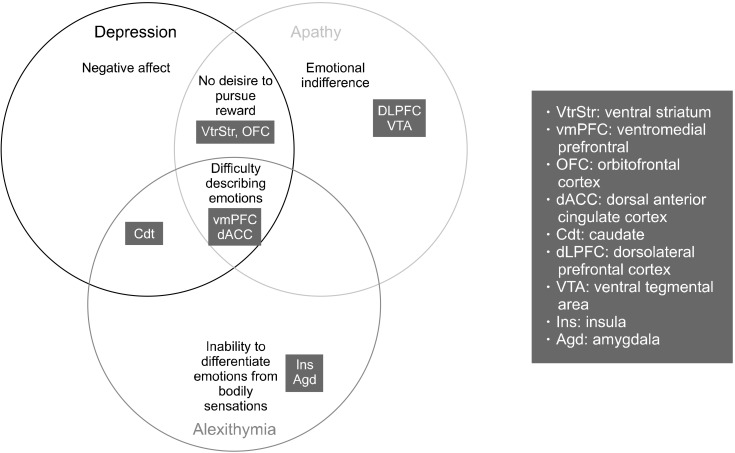
Apathy is a highly prevalent, disabling and treatment resistant syndrome. It is defined as a quantitative reduction of goal-directed activity in comparison to the patient's previous level of in multiple dimensions including behavior/cognition, emotion and social interaction. It has been described in major depressive disorder, Alzheimer's disease, frontotemporal dementia, Parkinson's Disease, cerebrovascular disease, and vascular dementia, among others. This review will address the neuropsychology and associated neurobiological underpinnings of apathy in the above conditions, identify specific methods to assess apathy clinically, and review the literature on managing apathy across these various disorders.
冷漠是一种高度普遍、致残且难治的综合征。它被定义为与患者先前水平相比,在行为/认知、情感和社会互动等多个维度上目标导向活动的定量减少。在重度抑郁症、阿尔茨海默病、额颞叶痴呆、帕金森病、脑血管疾病和血管性痴呆等疾病中均有描述。本综述将探讨上述疾病中冷漠的神经心理学及相关神经生物学基础,确定临床上评估冷漠的具体方法,并综述有关这些不同疾病中冷漠管理的文献。