Ravi Janani, Fioravanti Antonella
Pathobiology and Diagnostic Investigation, Michigan State University, East Lansing, MI, United States.
Structural and Molecular Microbiology, VIB-VUB Center for Structural Biology, Brussels, Belgium.
Front Microbiol. 2021 Apr 6;12:663468. doi: 10.3389/fmicb.2021.663468. eCollection 2021.
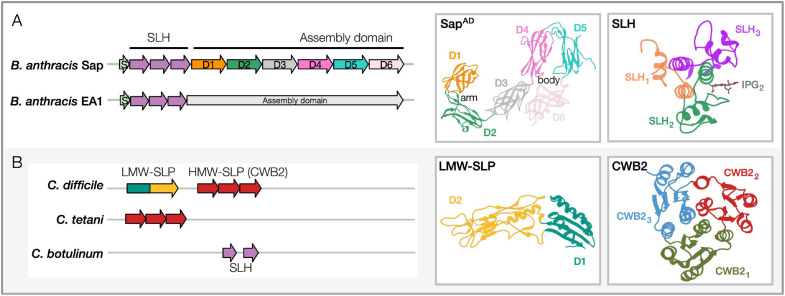
S-layers are self-assembled crystalline 2D lattices enclosing the cell envelopes of several bacteria and archaea. Despite their abundance, the landscape of S-layer structure and function remains a land of wonder. By virtue of their location, bacterial S-layers have been hypothesized to add structural stability to the cell envelope. In addition, S-layers are implicated in mediating cell-environment and cell-host interactions playing a key role in adhesion, cell growth, and division. Significant strides in the understanding of these bacterial cell envelope components were made possible by recent studies that have provided structural and functional insights on the critical S-layer and S-layer-associated proteins (SLPs and SLAPs), highlighting their roles in pathogenicity and their potential as therapeutic or vaccine targets. In this mini-review, we revisit the sequence-structure-function relationships of S-layers, SLPs, and SLAPs in Gram-positive pathogens, focusing on the best-studied classes, Bacilli () and Clostridia (). We delineate the domains and their architectures in archetypal S-layer proteins across Gram-positive genera and reconcile them with experimental findings. Similarly, we highlight a few key "flavors" of SLPs displayed by Gram-positive pathogens to assemble and support the bacterial S-layers. Together, these findings indicate that S-layers are excellent candidates for translational research (developing diagnostics, antibacterial therapeutics, and vaccines) since they display the three crucial characteristics: accessible location at the cell surface, abundance, and unique lineage-specific signatures.
S层是自组装的晶体二维晶格,包裹着多种细菌和古菌的细胞包膜。尽管它们数量众多,但S层的结构和功能领域仍然充满未知。由于其位置,细菌S层被认为能增加细胞包膜的结构稳定性。此外,S层还参与介导细胞与环境以及细胞与宿主的相互作用,在黏附、细胞生长和分裂中起关键作用。最近的研究为理解这些细菌细胞包膜成分取得了重大进展,这些研究提供了关于关键S层和S层相关蛋白(SLP和SLAP)的结构和功能见解,突出了它们在致病性中的作用以及作为治疗或疫苗靶点的潜力。在这篇小型综述中,我们重新审视革兰氏阳性病原体中S层、SLP和SLAP的序列-结构-功能关系,重点关注研究最多的类群,芽孢杆菌属()和梭菌属()。我们描绘了革兰氏阳性菌属原型S层蛋白中的结构域及其结构,并将它们与实验结果进行了协调。同样,我们强调了革兰氏阳性病原体展示的一些关键的SLP“类型”,这些SLP用于组装和支持细菌S层。总之,这些发现表明S层是转化研究(开发诊断方法、抗菌疗法和疫苗)的优秀候选对象,因为它们具有三个关键特征:位于细胞表面、数量丰富且具有独特的谱系特异性特征。