Department of Environmental and Preventive Medicine, Faculty of Medicine, Institute of Medical, Pharmaceutical and Health Sciences, Kanazawa University, Kanazawa, Japan.
Division of Nephrology, Kanazawa University Hospital, Kanazawa, Japan.
J Nutr Sci. 2021 Jan 22;10:e2. doi: 10.1017/jns.2020.54. eCollection 2021.
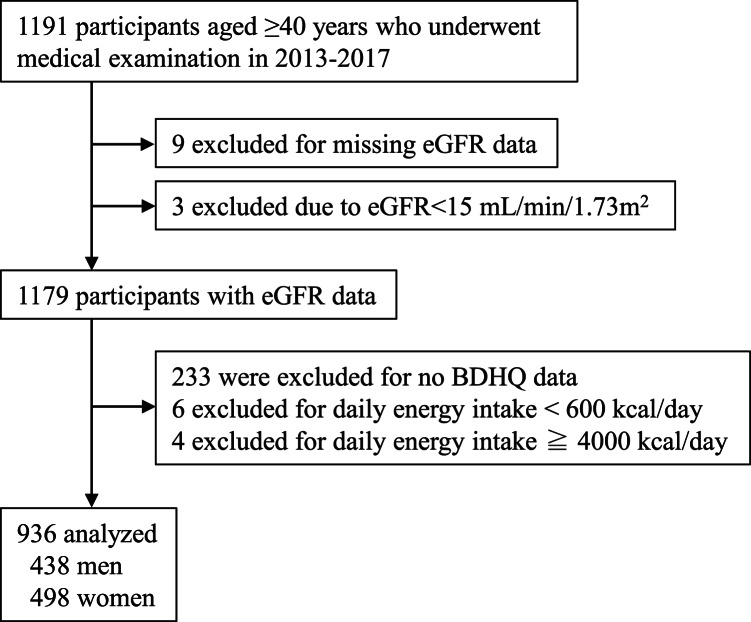
Dietary intake modification is important for the treatment of chronic kidney disease (CKD); however, little is known about the association between dietary intake of antioxidant vitamins and kidney function based on gender difference. We examined the relationship of dietary intake of antioxidant vitamins with decreased kidney function according to gender in Japanese subjects. This population-based, cross-sectional study included 936 Japanese participants with the age of 40 years or older. A validated brief self-administered diet history questionnaire was used to measure dietary intakes of vitamin E and its four isoforms, vitamin A and vitamin C. Decreased kidney function was defined as estimated glomerular filtration rate <60 ml/min/1·73 m. A total of 498 (53·2 %) of the study participants were women. Mean age was 62·4 ± 11·3 years. Overall, 157 subjects met the criteria of decreased kidney function. In the fully adjusted model, a high vitamin E intake is inversely associated with decreased kidney function in women (odds ratio, 0·886; 95 % confidence interval, 0·786-0·998), whereas vitamin E intake was not associated with decreased kidney function (odds ratio, 0·931; 95 % confidence interval, 0·811-1·069) in men. No significant association between dietary intake of vitamins A and C and decreased kidney function was observed in women and men. Higher dietary intake of vitamin E was inversely associated with decreased kidney function in middle-aged and older women, and the result may provide insight into the more tailored dietary approaches to prevent CKD.
饮食摄入的改变对慢性肾脏病(CKD)的治疗很重要;然而,基于性别的差异,关于抗氧化维生素的饮食摄入与肾功能之间的关系,人们知之甚少。我们在日本人群中研究了抗氧化维生素的饮食摄入与性别相关的肾功能下降之间的关系。这项基于人群的横断面研究共纳入了 936 名年龄在 40 岁及以上的日本参与者。使用经过验证的简短自我管理饮食史问卷来衡量维生素 E 及其四种同型物、维生素 A 和维生素 C 的饮食摄入量。肾功能下降定义为估算肾小球滤过率 <60 ml/min/1·73 m。研究参与者共有 498 名(53·2 %)为女性。平均年龄为 62·4 ± 11·3 岁。总体而言,157 名参与者符合肾功能下降的标准。在完全调整后的模型中,女性高维生素 E 摄入与肾功能下降呈负相关(比值比,0·886;95 %置信区间,0·786-0·998),而男性维生素 E 摄入与肾功能下降无关(比值比,0·931;95 %置信区间,0·811-1·069)。在女性和男性中,饮食中摄入维生素 A 和 C 与肾功能下降之间没有显著关联。中年和老年女性较高的维生素 E 饮食摄入与肾功能下降呈负相关,这一结果可能为更有针对性的预防 CKD 的饮食方法提供了一些启示。