
估算替法诺喹在巴西控制和消除间日疟原虫的影响:一项建模研究。
Estimated impact of tafenoquine for Plasmodium vivax control and elimination in Brazil: A modelling study.
机构信息
Malaria: Parasites and Hosts, Department of Parasites and Insect Vectors, Institut Pasteur, Paris, France.
Programa de Computação Científica, Fundação Oswaldo Cruz, Rio de Janeiro, Brazil.
出版信息
PLoS Med. 2021 Apr 23;18(4):e1003535. doi: 10.1371/journal.pmed.1003535. eCollection 2021 Apr.
BACKGROUND
Despite recent intensification of control measures, Plasmodium vivax poses a major challenge for malaria elimination efforts. Liver-stage hypnozoite parasites that cause relapsing infections can be cleared with primaquine; however, poor treatment adherence undermines drug effectiveness. Tafenoquine, a new single-dose treatment, offers an alternative option for preventing relapses and reducing transmission. In 2018, over 237,000 cases of malaria were reported to the Brazilian health system, of which 91.5% were due to P. vivax.
METHODS AND FINDINGS
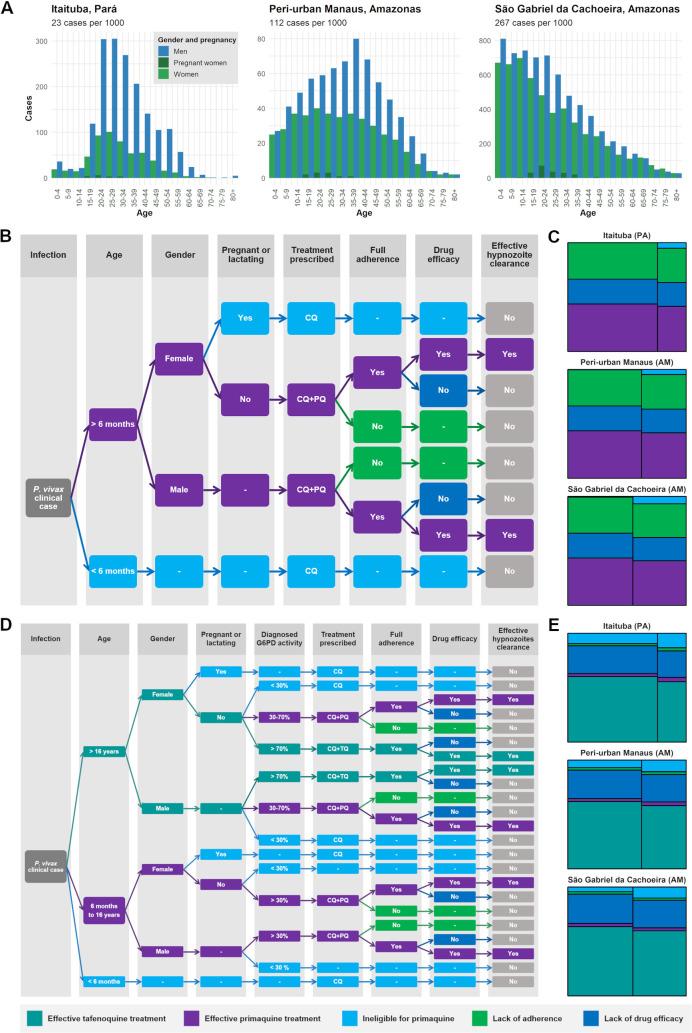
We evaluated the impact of introducing tafenoquine into case management practices on population-level transmission dynamics using a mathematical model of P. vivax transmission. The model was calibrated to reflect the transmission dynamics of P. vivax endemic settings in Brazil in 2018, informed by nationwide malaria case reporting data. Parameters for treatment pathways with chloroquine, primaquine, and tafenoquine with glucose-6-phosphate dehydrogenase deficiency (G6PDd) testing were informed by clinical trial data and the literature. We assumed 71.3% efficacy for primaquine and tafenoquine, a 66.7% adherence rate to the 7-day primaquine regimen, a mean 5.5% G6PDd prevalence, and 8.1% low metaboliser prevalence. The introduction of tafenoquine is predicted to improve effective hypnozoite clearance among P. vivax cases and reduce population-level transmission over time, with heterogeneous levels of impact across different transmission settings. According to the model, while achieving elimination in only few settings in Brazil, tafenoquine rollout in 2021 is estimated to improve the mean effective radical cure rate from 42% (95% uncertainty interval [UI] 41%-44%) to 62% (95% UI 54%-68%) among clinical cases, leading to a predicted 38% (95% UI 7%-99%) reduction in transmission and over 214,000 cumulative averted cases between 2021 and 2025. Higher impact is predicted in settings with low transmission, low pre-existing primaquine adherence, and a high proportion of cases in working-aged males. High-transmission settings with a high proportion of cases in children would benefit from a safe high-efficacy tafenoquine dose for children. Our methodological limitations include not accounting for the role of imported cases from outside the transmission setting, relying on reported clinical cases as a measurement of community-level transmission, and implementing treatment efficacy as a binary condition.
CONCLUSIONS
In our modelling study, we predicted that, provided there is concurrent rollout of G6PDd diagnostics, tafenoquine has the potential to reduce P. vivax transmission by improving effective radical cure through increased adherence and increased protection from new infections. While tafenoquine alone may not be sufficient for P. vivax elimination, its introduction will improve case management, prevent a substantial number of cases, and bring countries closer to achieving malaria elimination goals.
背景
尽管最近加强了控制措施,但间日疟原虫仍然是疟疾消除工作的一大挑战。能导致复发感染的肝期休眠子寄生虫可以用伯氨喹清除;然而,治疗依从性差会降低药物的有效性。泰法诺喹是一种新的单剂量治疗方法,为预防复发和减少传播提供了另一种选择。2018 年,巴西卫生系统报告了超过 23.7 万例疟疾病例,其中 91.5%是由间日疟原虫引起的。
方法和发现
我们使用间日疟原虫传播的数学模型来评估将泰法诺喹引入病例管理实践对人群水平传播动态的影响。该模型经过校准,以反映 2018 年巴西间日疟原虫流行地区的传播动态,这是通过全国疟疾病例报告数据得出的。氯喹、伯氨喹和泰法诺喹联合葡萄糖-6-磷酸脱氢酶缺乏症(G6PDd)检测的治疗途径参数是根据临床试验数据和文献得出的。我们假设伯氨喹和泰法诺喹的疗效为 71.3%,伯氨喹的 7 天疗程的依从率为 66.7%,平均 G6PDd 患病率为 5.5%,低代谢率者的患病率为 8.1%。引入泰法诺喹有望提高间日疟原虫病例的有效休眠子清除率,并随着时间的推移降低人群水平的传播,在不同的传播环境下具有不同的影响程度。根据模型,虽然在巴西只有少数几个地区能够实现消除,但 2021 年泰法诺喹的推出预计将使临床病例的平均有效根治率从 42%(95%置信区间[UI]41%-44%)提高到 62%(95% UI 54%-68%),从而导致传播减少 38%(95% UI 7%-99%),并在 2021 年至 2025 年间累计预防超过 21.4 万例病例。在低传播、低预先存在的伯氨喹依从性和工作年龄男性中病例比例高的环境中,预计影响更大。儿童病例比例高的高传播环境将受益于针对儿童的安全高效泰法诺喹剂量。我们的方法学局限性包括不考虑从传播环境以外输入的病例的作用,依赖报告的临床病例作为社区传播水平的衡量标准,以及实施治疗效果作为二进制条件。
结论
在我们的建模研究中,我们预测,如果同时推出 G6PDd 诊断,泰法诺喹有可能通过提高依从性和提高对新感染的保护,通过提高有效根治率来降低间日疟原虫的传播。虽然泰法诺喹本身可能不足以消除间日疟原虫,但它的引入将改善病例管理,预防大量病例,并使各国更接近实现消除疟疾的目标。


 Zotero 插件