Department of Ophthalmology, Keio University School of Medicine, Tokyo, Japan.
Otake Clinic Moon View Eye Center, Kanagawa, Japan.
PLoS One. 2021 Apr 23;16(4):e0250087. doi: 10.1371/journal.pone.0250087. eCollection 2021.
The aim of this study was to explore the status of quality of life between the ages 40-59 in relation to presbyopia and dry eye.
Near add power and preferred contact lens power were examined in 219 participants at three clinics. 2000 participants completed a web-based survey on presbyopic symptoms, symptomatic dry eye, sleep quality, and subjective happiness.
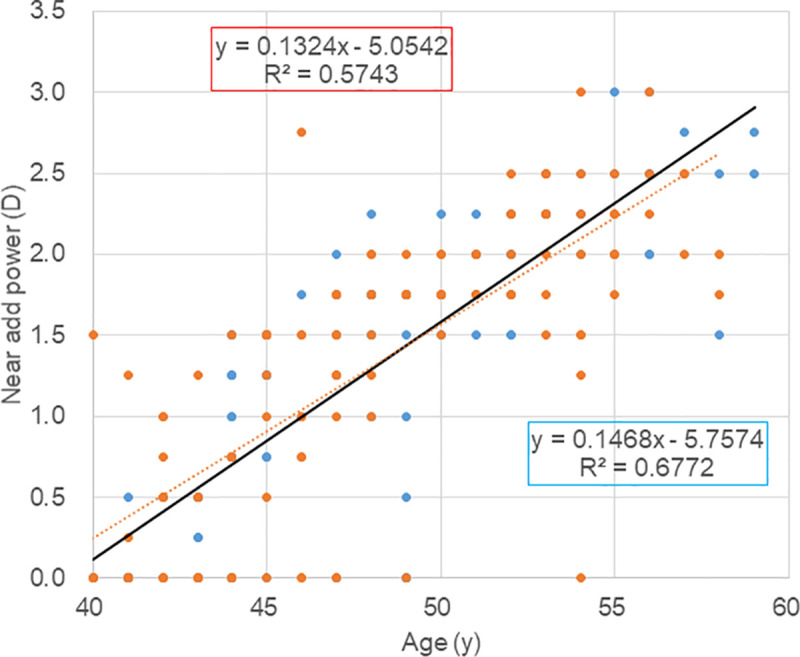
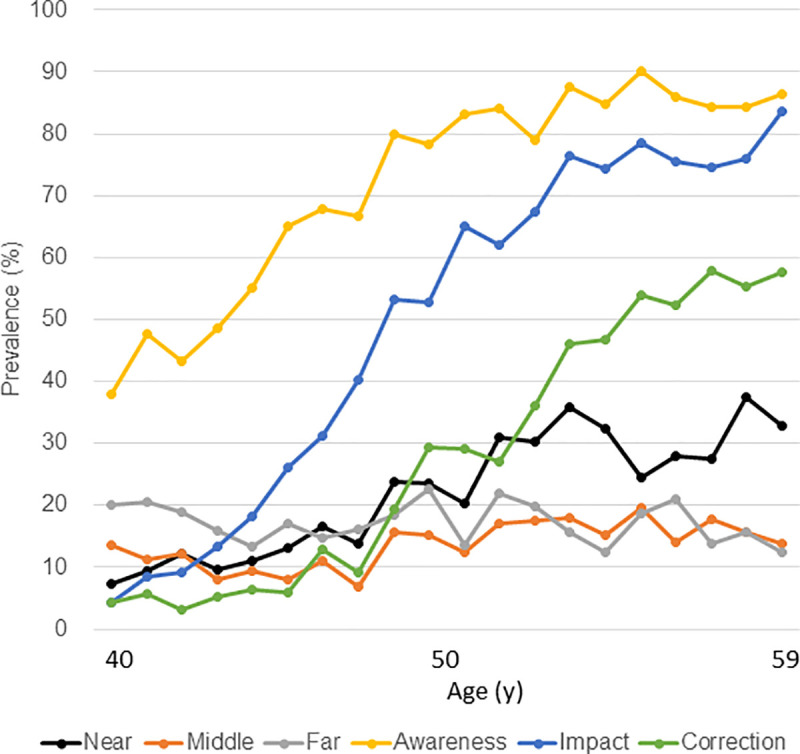
Mean preferred corrected visual acuity was less than 20/20 in women (vs men, P<0.01) who were more often prescribed under-corrected contact lenses, whereas men preferred full correction. According to the annual progression rate of near add power in men (0.1468D/year), the estimated difference in presbyopia progression between men and women was 0.75 years in the right eye, and 1.69 years in the left eye, implying men might suffer presbyopia earlier than women due to higher myopic power of daily use contact lenses. The web-based survey revealed that men reported lower subjective happiness than women (P<0.001) and earlier onset of presbyopic symptoms by 1.1-1.7 years (P<0.05). Men received their first reading glasses 0.8 years earlier than women (P = 0.066). Multiple regression analysis demonstrated that awareness of presbyopic symptoms, visual burden, and dry eyes were significantly correlated with poor sleep quality and subjective happiness.
Presbyopia and dry eye were significantly associated with sleep quality and subjective happiness in middle-adulthood.
本研究旨在探讨 40-59 岁人群中与老视和干眼症相关的生活质量状况。
在三个诊所中,对 219 名参与者的近附加力和首选接触镜力进行了检查。2000 名参与者完成了一项关于老视症状、症状性干眼症、睡眠质量和主观幸福感的网络调查。
女性的平均最佳矫正视力低于 20/20(与男性相比,P<0.01),她们更常被处方欠矫接触镜,而男性则更喜欢全矫。根据男性的近附加力年进展率(0.1468D/年),男性和女性之间的老视进展差异估计为右眼 0.75 年,左眼 1.69 年,这意味着由于日常使用接触镜的近视度数较高,男性可能比女性更早出现老视。网络调查显示,男性报告的主观幸福感低于女性(P<0.001),并且更早出现老视症状,提前 1.1-1.7 年(P<0.05)。男性比女性早 0.8 年开始使用阅读眼镜(P = 0.066)。多元回归分析表明,对老视症状的认识、视觉负担和干眼症与睡眠质量差和主观幸福感差显著相关。
老视和干眼症与中年人的睡眠质量和主观幸福感显著相关。