School of Community Health Sciences, University of Nevada, 1664 N. Virginia Street, Reno, NV, 89557, USA.
Department of Chemical Engineering, University of Utah, Salt Lake City, UT, USA.
Environ Health. 2021 Apr 23;20(1):47. doi: 10.1186/s12940-021-00733-y.
The effect of heatwaves on adverse birth outcomes is not well understood and may vary by how heatwaves are defined. The study aims to examine acute associations between various heatwave definitions and preterm and early-term birth.
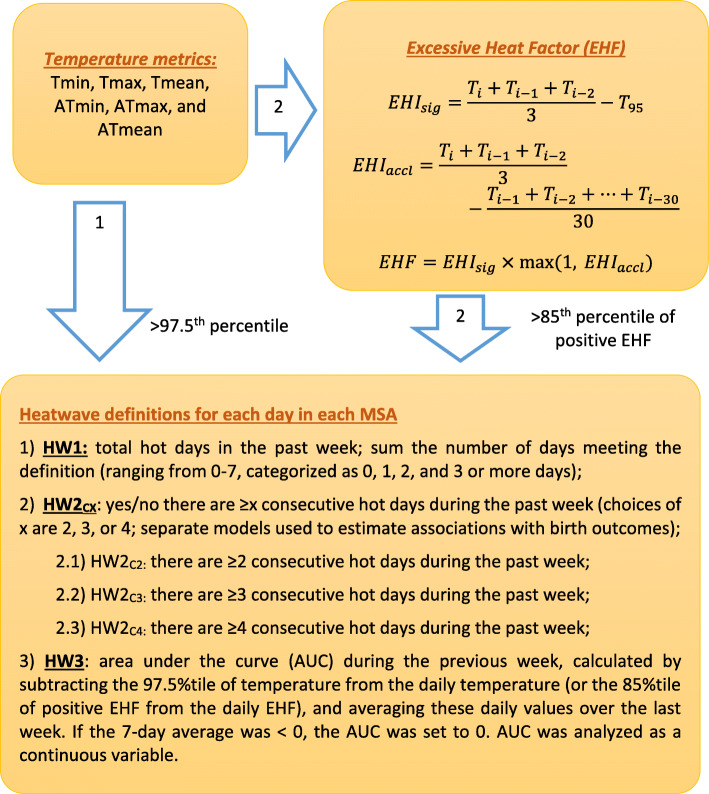
Using national vital records from 50 metropolitan statistical areas (MSAs) between 1982 and 1988, singleton preterm (< 37 weeks) and early-term births (37-38 weeks) were matched (1:1) to controls who completed at least 37 weeks or 39 weeks of gestation, respectively. Matching variables were MSA, maternal race, and maternal education. Sixty heatwave definitions including binary indicators for exposure to sustained heat, number of high heat days, and measures of heat intensity (the average degrees over the threshold in the past 7 days) based on the 97.5 percentile of MSA-specific temperature metrics, or the 85 percentile of positive excessive heat factor (EHF) were created. Odds ratios (OR) for heatwave exposures in the week preceding birth (or corresponding gestational week for controls) were estimated using conditional logistic regression adjusting for maternal age, marital status, and seasonality. Effect modification by maternal education, age, race/ethnicity, child sex, and region was assessed.
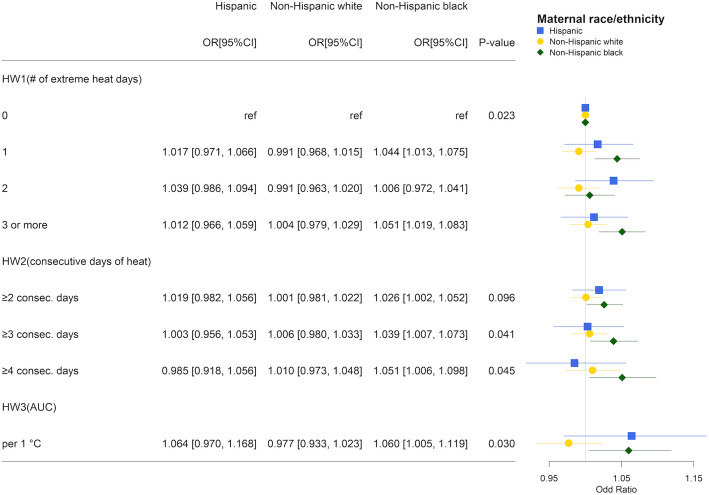
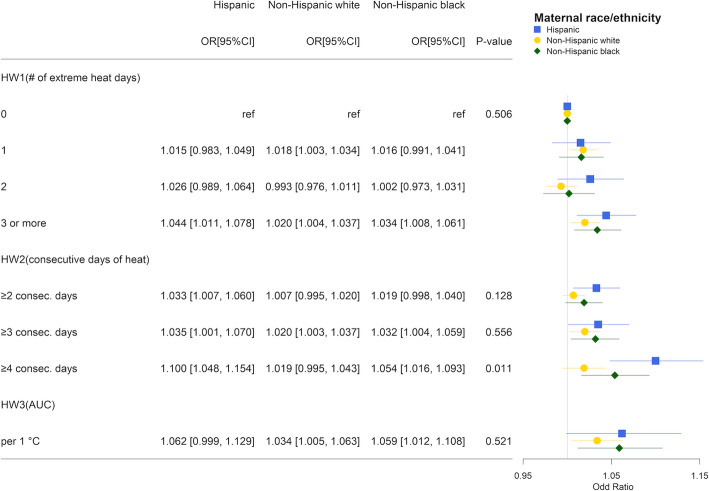
There were 615,329 preterm and 1,005,576 early-term case-control pairs in the analyses. For most definitions, exposure to heatwaves in the week before delivery was consistently associated with increased odds of early-term birth. Exposure to more high heat days and more degrees above the threshold yielded higher magnitude ORs. For exposure to 3 or more days over the 97.5 percentile of mean temperature in the past week compared to zero days, the OR was 1.027 for early-term birth (95%CI: 1.014, 1.039). Although we generally found null associations when assessing various heatwave definitions and preterm birth, ORs for both preterm and early-term birth were greater in magnitude among Hispanic and non-Hispanic black mothers.
Although associations varied across metrics and heatwave definitions, heatwaves were more consistently associated with early-term birth than with preterm birth. This study's findings may have implications for prevention programs targeting vulnerable subgroups as climate change progresses.
热浪对不良出生结局的影响尚不清楚,并且可能因热浪的定义方式而异。本研究旨在检验各种热浪定义与早产和早期分娩之间的急性关联。
使用 1982 年至 1988 年间 50 个大都市区(MSA)的国家生命记录,将单胎早产(<37 周)和早期分娩(37-38 周)与分别完成至少 37 周或 39 周妊娠的对照组相匹配(1:1)。匹配变量包括 MSA、产妇种族和产妇教育。根据 MSA 特定温度指标的第 97.5 百分位数或正过热因子(EHF)的第 85 百分位数,创建了 60 种热浪定义,包括暴露于持续高温、高温天数、热强度指标(过去 7 天内超过阈值的平均度数)的二进制指标。使用条件逻辑回归估计出生前一周(或对照组的相应妊娠周)热浪暴露的比值比(OR),并调整产妇年龄、婚姻状况和季节性。评估了产妇教育、年龄、种族/民族、儿童性别和地区的效应修饰作用。
分析中包括 615329 例早产和 1005576 例早期分娩病例对照对。对于大多数定义,分娩前一周暴露于热浪与早期分娩的几率增加相关。暴露于更多的高温天数和超过阈值的更多度数导致更高幅度的 OR。与暴露于过去一周平均温度第 97.5 百分位以上的 3 天或更多天相比,暴露于 0 天的早产 OR 为 1.027(95%CI:1.014,1.039)。尽管我们在评估各种热浪定义和早产时通常发现无关联,但西班牙裔和非西班牙裔黑人母亲的早产和早期分娩的 OR 幅度更大。
尽管关联因指标和热浪定义而异,但热浪与早期分娩的相关性比与早产的相关性更为一致。本研究的结果可能对针对脆弱亚群的预防计划具有意义,因为气候变化在继续。