Anaxomics Biotech, Carrer Diputació 237, 1°, 1ª, 08007, Barcelona, Catalonia, Spain.
Department of Pediatric Rheumatology & Immunology, University Children's Hospital, Albert-Schweitzer-Campus 1, 48149, Münster, Germany.
Arthritis Res Ther. 2021 Apr 23;23(1):126. doi: 10.1186/s13075-021-02507-w.
Systemic juvenile idiopathic arthritis (sJIA) and adult-onset Still's disease (AOSD) are manifestations of an autoinflammatory disorder with complex pathophysiology and significant morbidity, together also termed Still's disease. The objective of the current study is to set in silico models based on systems biology and investigate the optimal treat-to-target strategy for Still's disease as a proof-of-concept of the modeling approach.
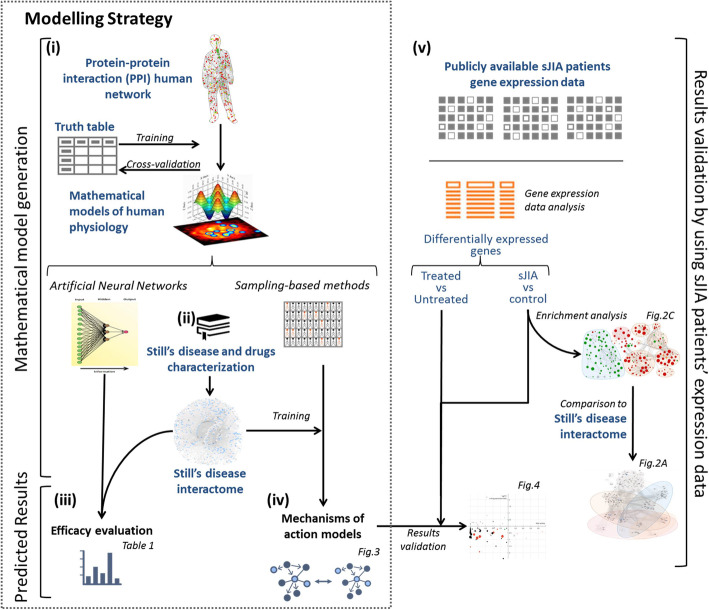
Molecular characteristics of Still's disease and data on biological inhibitors of interleukin (IL)-1 (anakinra, canakinumab), IL-6 (tocilizumab, sarilumab), and glucocorticoids as well as conventional disease-modifying anti-rheumatic drugs (DMARDs, methotrexate) were used to construct in silico mechanisms of action (MoA) models by means of Therapeutic Performance Mapping System (TPMS) technology. TPMS combines artificial neuronal networks, sampling-based methods, and artificial intelligence. Model outcomes were validated with published expression data from sJIA patients.
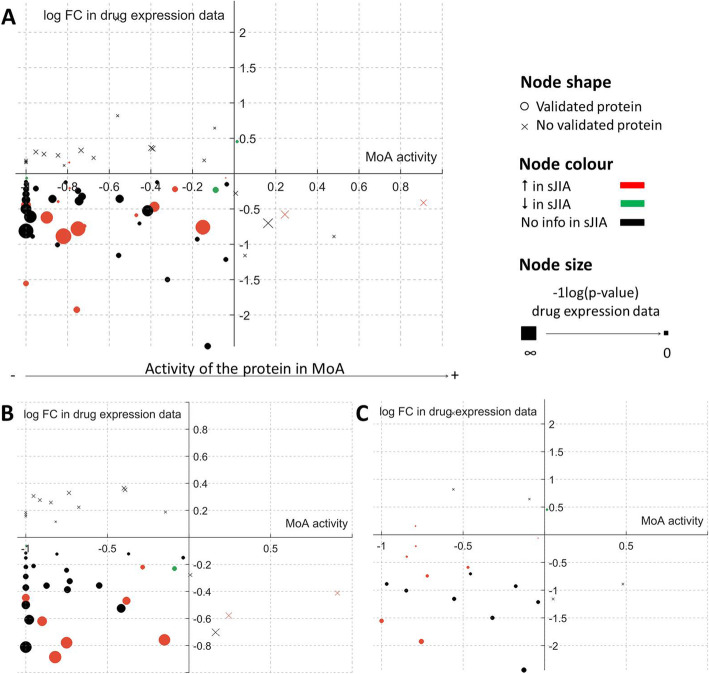
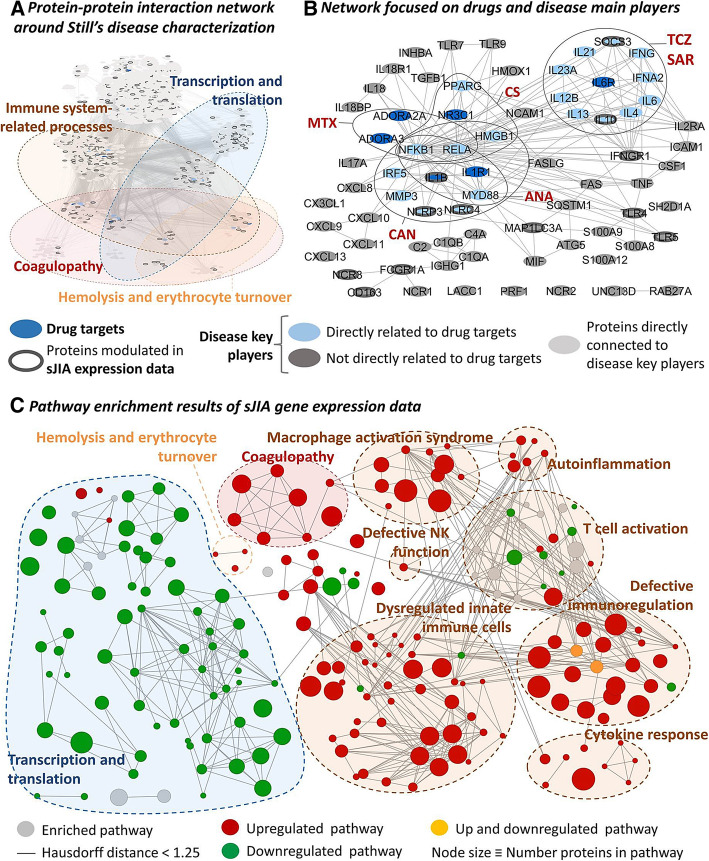
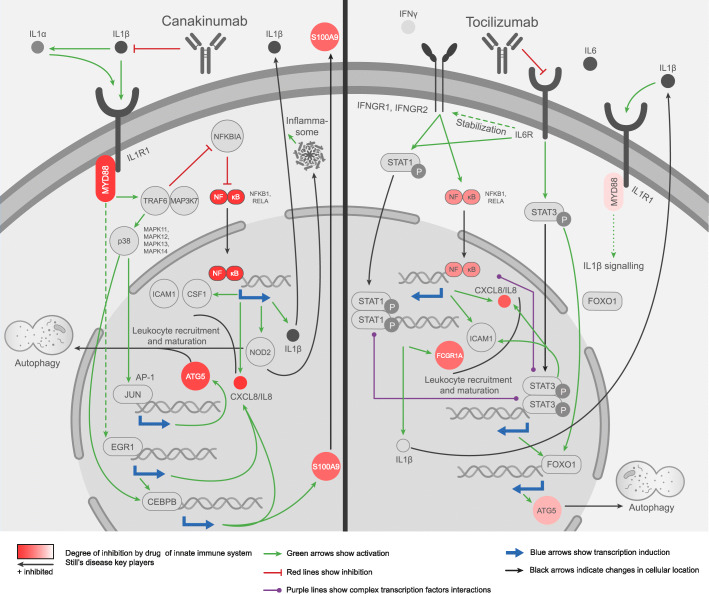
Biologicals demonstrated more pathophysiology-directed efficiency than non-biological drugs. IL-1 blockade mainly acts on proteins implicated in the innate immune system, while IL-6 signaling blockade has a weaker effect on innate immunity and rather affects adaptive immune mechanisms. The MoA models showed that in the autoinflammatory/systemic phases of Still's disease, in which the innate immunity plays a pivotal role, the IL-1β-neutralizing antibody canakinumab is more efficient than the IL-6 receptor-inhibiting antibody tocilizumab. MoA models reproduced 67% of the information obtained from expression data.
Systems biology-based modeling supported the preferred use of biologics as an immunomodulatory treatment strategy for Still's disease. Our results reinforce the role for IL-1 blockade on innate immunity regulation, which is critical in systemic autoinflammatory diseases. This further encourages early use on Still's disease IL-1 blockade to prevent the development of disease or drug-related complications. Further analysis at the clinical level will validate the findings and help determining the timeframe of the window of opportunity for canakinumab treatment.
全身性幼年特发性关节炎(sJIA)和成人Still 病(AOSD)是一种自身炎症性疾病的表现,具有复杂的病理生理学和显著的发病率,统称为 Still 病。本研究的目的是基于系统生物学建立计算机模型,并研究针对 Still 病的最佳靶向治疗策略,以此验证建模方法的可行性。
采用Still 病的分子特征和白介素(IL)-1(阿那白滞素、卡那单抗)、IL-6(托珠单抗、沙利鲁单抗)和糖皮质激素等生物抑制剂以及传统的疾病修饰抗风湿药物(DMARDs,甲氨蝶呤)的数据,通过治疗性能映射系统(TPMS)技术构建计算机作用机制(MoA)模型。TPMS 结合了人工神经网络、基于抽样的方法和人工智能。使用 sJIA 患者的已发表表达数据验证模型结果。
生物制剂比非生物药物更具有针对病理生理学的疗效。IL-1 阻断主要作用于先天免疫系统中涉及的蛋白质,而 IL-6 信号阻断对先天免疫的影响较弱,而是影响适应性免疫机制。MoA 模型表明,在 Still 病的自身炎症/系统性阶段,先天免疫起关键作用,IL-1β 中和抗体卡那单抗比 IL-6 受体抑制剂托珠单抗更有效。MoA 模型再现了从表达数据中获得的 67%的信息。
基于系统生物学的建模支持将生物制剂作为 Still 病的免疫调节治疗策略的首选。我们的结果强化了 IL-1 阻断在先天免疫调节中的作用,这在系统性自身炎症性疾病中至关重要。这进一步鼓励早期使用 Still 病的 IL-1 阻断来预防疾病发展或药物相关并发症。在临床水平上的进一步分析将验证这些发现,并有助于确定卡那单抗治疗的机会窗口时间。