Tokunaga Yuji, Tanaka Masahito, Iida Hitoshi, Kinoshita Moto, Tojima Yuya, Takeuchi Koh, Imashimizu Masahiko
Cellular and Molecular Biotechnology Research Institute, National Institute of Advanced Industrial Science and Technology, Tokyo, Japan.
Research Institute for Measurement and Analytical Instrumentation, National Institute of Advanced Industrial Science and Technology, Tsukuba, Japan.
Biophys J. 2021 Jun 15;120(12):2386-2393. doi: 10.1016/j.bpj.2021.04.013. Epub 2021 May 1.
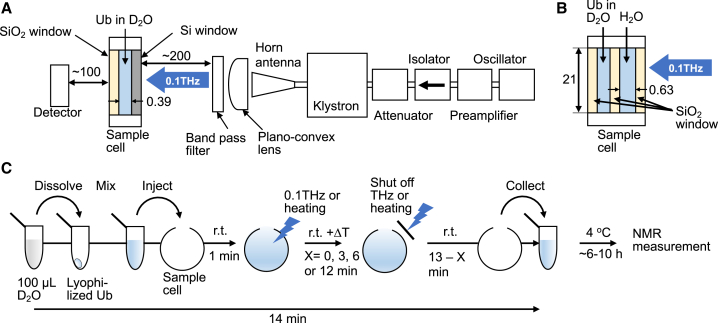
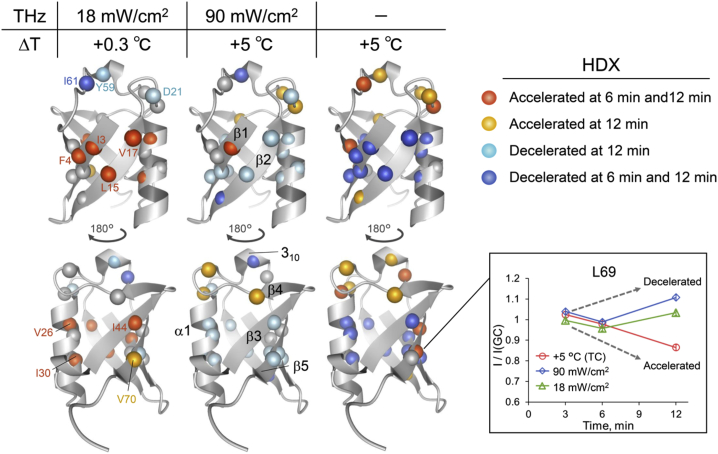
Water dynamics in the hydration layers of biomolecules play crucial roles in a wide range of biological functions. A hydrated protein contains multiple components of diffusional and vibrational dynamics of water and protein, which may be coupled at ∼0.1-THz frequency (10-ps timescale) at room temperature. However, the microscopic description of biomolecular functions based on various modes of protein-water-coupled motions remains elusive. A novel approach for perturbing the hydration dynamics in the subterahertz frequency range and probing them at the atomic level is therefore warranted. In this study, we investigated the effect of klystron-based, intense 0.1-THz excitation on the slow dynamics of ubiquitin using NMR-based measurements of hydrogen-deuterium exchange. We demonstrated that the subterahertz irradiation accelerated the hydrogen-deuterium exchange of the amides located in the interior of the protein and hydrophobic surfaces while decelerating this exchange in the amides located in the surface loop and short 3 helix regions. This subterahertz-radiation-induced effect was qualitatively contradictory to the increased-temperature-induced effect. Our results suggest that the heterogeneous water dynamics occurring at the protein-water interface include components that are nonthermally excited by the subterahertz radiation. Such subterahertz-excited components may be linked to the slow function-related dynamics of the protein.
生物分子水化层中的水动力学在广泛的生物功能中起着关键作用。一个水合蛋白质包含水和蛋白质扩散及振动动力学的多个组成部分,在室温下,它们可能在~0.1太赫兹频率(10皮秒时间尺度)下发生耦合。然而,基于蛋白质 - 水耦合运动的各种模式对生物分子功能的微观描述仍然难以捉摸。因此,需要一种在太赫兹以下频率范围内扰动水化动力学并在原子水平上进行探测的新方法。在这项研究中,我们使用基于核磁共振的氢 - 氘交换测量方法,研究了基于速调管的强0.1太赫兹激发对泛素慢动力学的影响。我们证明,太赫兹以下辐射加速了位于蛋白质内部和疏水表面的酰胺的氢 - 氘交换,同时减缓了位于表面环和短3螺旋区域的酰胺的这种交换。这种太赫兹辐射诱导的效应在性质上与温度升高诱导的效应相矛盾。我们的结果表明,在蛋白质 - 水界面发生的异质水动力学包括被太赫兹辐射非热激发的成分。这种太赫兹激发的成分可能与蛋白质的慢功能相关动力学有关。