Department of Anesthesiology, Beijing Jishuitan Hospital, Beijing, P.R. China.
Department of Thoracic Surgery, Beijing Jishuitan Hospital, Beijing, P.R. China.
Braz J Anesthesiol. 2022 Jan-Feb;72(1):115-121. doi: 10.1016/j.bjane.2021.04.004. Epub 2021 Apr 22.
To investigate the effects of Erector Spinae Plane Block (ESPB) and Retrolaminar Block (RLB) on intra- and postoperative analgesia in patients with Multiple Rib Fractures (MRFs).
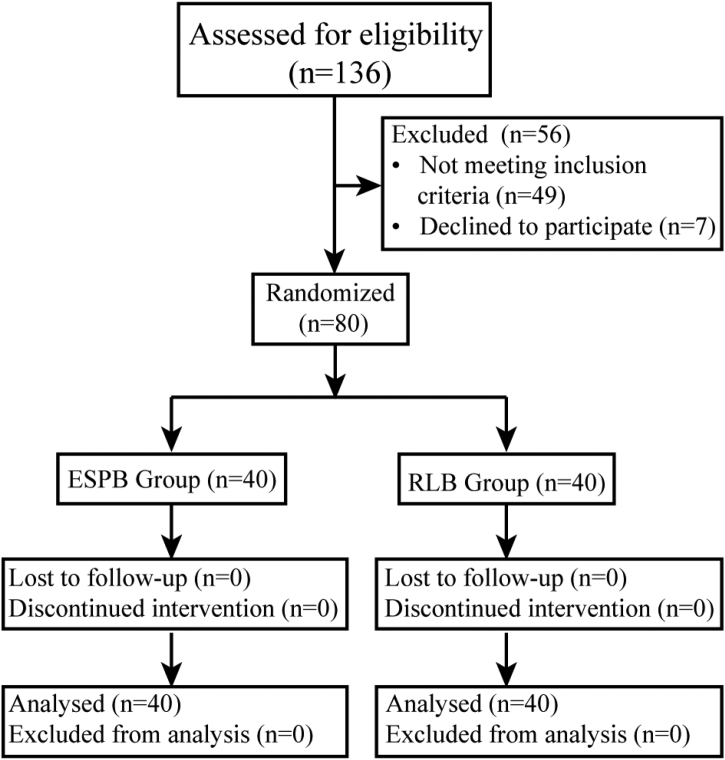
A total of 80 MRFs patients were randomly divided into the ESPB (Group E) and RLB (Group R) groups. After general anesthesia, ESPB and RLB were performed under ultrasound guidance, respectively, together with 20 mL of 0.5% ropivacaine and Patient-Controlled Intravenous Analgesia (PCIA).
Thirty-four cases in Group E and 33,cases in Group R showed unclear paravertebral spaces. The intraoperative dosage of remifentanil (mean ± SD) (392.8 ± 118.7 vs. 501.7 ± 190.0 μg) and postoperative morphine PCIA dosage, (7.35 ± 1.55 vs. 14.73 ± 2.18 mg) in Group R were significantly less than those in Group E; the Visual Analog Scale (VAS) scores in Group R at 2 (2.7 ± 1.2 vs. 3.4 ± 1.4), 4 (2.2 ± 1.1 vs. 2.8 ± 0.9), 12 (2.5 ± 0.9 vs. 3.0 ± 0.8), and 24 hours (2.6 ± 1.0 vs. 3.1 ± 0.9) after surgery were significantly lower than those in Group E. Finally, the normal respiratory diaphragm activity (2.17 ± 0.22 vs. 2.05 ± 0.19), pH (median [IQR] (7.38 [7.31-7.45] vs. 7.36 [7.30-7.42]), and partial pressure of carbon dioxide (PaCO) (44 [35-49] vs. 42.5 [30-46]) after the operation in Group R were significantly better than those in Group E (p < 0.05).
RLB was a more effective analgesic method than ESPB in the treatment of MRF.
探究竖脊肌平面阻滞(ESPB)和椎旁神经阻滞(RLB)对多发性肋骨骨折(MRFs)患者围术期镇痛的影响。
80 例 MRF 患者随机分为 ESPB 组(E 组)和 RLB 组(R 组)。全身麻醉后,在超声引导下分别进行 ESPB 和 RLB,各注入 20mL0.5%罗哌卡因和患者自控静脉镇痛(PCIA)。
E 组 34 例、R 组 33 例患者椎旁间隙显示不清。R 组术中瑞芬太尼用量(均数±标准差)(392.8±118.7 vs. 501.7±190.0μg)和术后吗啡 PCIA 用量(7.35±1.55 vs. 14.73±2.18mg)明显少于 E 组;R 组术后 2(2.7±1.2 vs. 3.4±1.4)、4(2.2±1.1 vs. 2.8±0.9)、12(2.5±0.9 vs. 3.0±0.8)和 24 小时(2.6±1.0 vs. 3.1±0.9)时视觉模拟评分(VAS)明显低于 E 组。最后,R 组术后呼吸正常的膈神经活动(2.17±0.22 vs. 2.05±0.19)、pH(中位数[IQR](7.38[7.31-7.45] vs. 7.36[7.30-7.42])和二氧化碳分压(PaCO)(44[35-49] vs. 42.5[30-46])明显优于 E 组(p<0.05)。
RLB 是治疗 MRF 比 ESPB 更有效的镇痛方法。