Regional Institute for Population Studies, University of Ghana, LG 96 Legon, Accra, Ghana.
Public Health Nutr. 2022 Jun;25(6):1563-1576. doi: 10.1017/S1368980021001750. Epub 2021 Apr 26.
Undernutrition and anaemia (the commonest micronutrient deficiency), continue to remain prevalent and persistent in sub-Saharan Africa (SSA) alongside a rising prevalence of overweight and obesity. However, there has been little research on the co-existence of all three conditions in the same household in recent years. The current study examines the co-existence and correlates of the different conditions of household burden of malnutrition in the same household across SSA.
The study involved twenty-three countries across SSA who conducted Demographic and Health Surveys between 2008 and 2017.
The analytical sample includes 145 020 households with valid data on the nutritional status of women and children pairs (i.e. women of reproductive age; 15-49 years and children under 5 years).
Logistic regression analyses were used to determine household correlates of household burden of malnutrition.
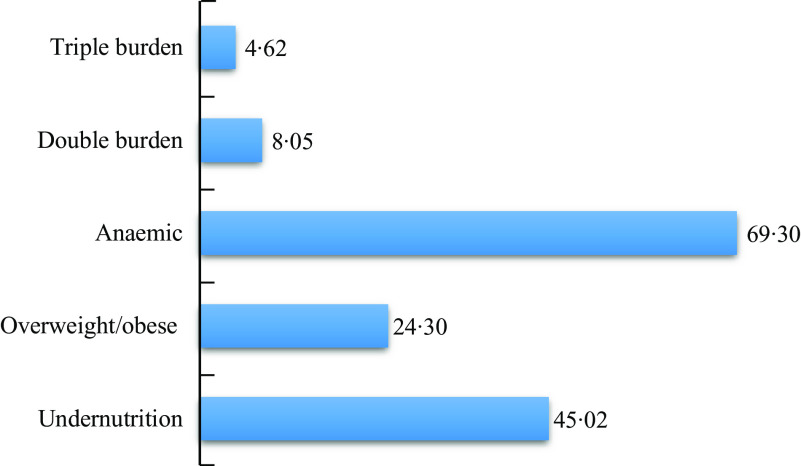
Anaemia was the most common form of household burden of malnutrition, affecting about seven out of ten households. Double and triple burden of malnutrition, though less common, was also found to be present in 8 and 5 % of the households, respectively. The age of the household head, location of the household, access to improved toilet facilities and household wealth status were found to be associated with various conditions of household burden of malnutrition.
The findings of the current study reveal that both double and triple burden of malnutrition is of public health concern in SSA, thus nutrition and health interventions in SSA must not be skewed towards addressing undernutrition only but also address overweight/obesity and anaemia.
在撒哈拉以南非洲(SSA),营养不良和贫血(最常见的微量营养素缺乏症)仍然普遍存在且持续存在,同时超重和肥胖的患病率也在上升。然而,近年来,关于同一家庭中这三种情况同时存在的研究甚少。本研究检查了 SSA 中同一家庭中不同程度家庭营养不良负担的共存和相关性。
该研究涉及 SSA 的 23 个国家,这些国家在 2008 年至 2017 年期间进行了人口与健康调查。
分析样本包括 145020 户有关于妇女和儿童营养状况的有效数据的家庭(即育龄妇女;15-49 岁和 5 岁以下儿童)。
使用逻辑回归分析来确定家庭营养不良负担的家庭相关性。
贫血是家庭营养不良负担最常见的形式,约十分之七的家庭受到影响。尽管双重和三重营养不良负担不太常见,但也分别在 8%和 5%的家庭中发现存在。家庭户主的年龄、家庭所在地、获得改良卫生设施的机会和家庭财富状况与各种家庭营养不良负担状况有关。
本研究的结果表明,双重和三重营养不良负担都是 SSA 的公共卫生关注问题,因此 SSA 的营养和健康干预措施不能仅仅偏向于解决营养不良问题,还必须解决超重/肥胖和贫血问题。