Bowden Davies Kelly A, Norman Juliette A, Thompson Andrew, Mitchell Katie L, Harrold Joanne A, Halford Jason C G, Wilding John P H, Kemp Graham J, Cuthbertson Daniel J, Sprung Victoria S
Department of Sport and Exercise Sciences, Manchester Metropolitan University, Manchester, United Kingdom.
Institute of Life Course and Medical Sciences, University of Liverpool, Liverpool, United Kingdom.
Front Physiol. 2021 Apr 9;12:659834. doi: 10.3389/fphys.2021.659834. eCollection 2021.
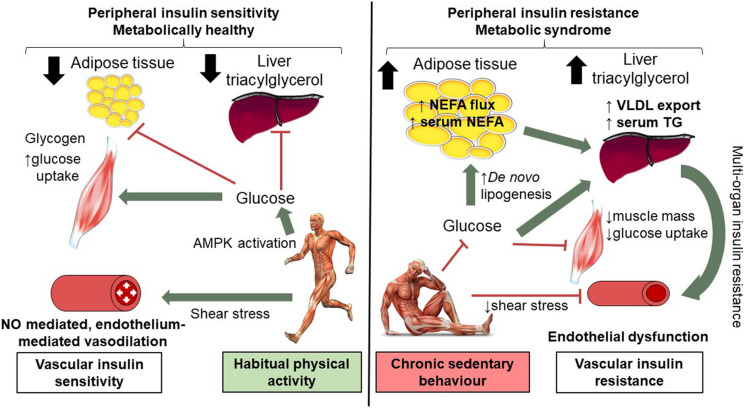
This study examined the effects of a short-term reduction in physical activity, and subsequent resumption, on metabolic profiles, body composition and cardiovascular (endothelial) function.
Twenty-eight habitually active (≥10,000 steps/day) participants (18 female, 10 male; age 32 ± 11 years; BMI 24.3 ± 2.5 kg/m) were assessed at baseline, following 14 days of step-reduction and 14 days after resuming habitual activity.
Physical activity was monitored throughout (SenseWear Armband). Endothelial function (flow mediated dilation; FMD), cardiorespiratory fitness ( peak) and body composition including liver fat (dual-energy x-ray absorptiometry and magnetic resonance spectroscopy) were determined at each assessment. Statistical analysis was performed using one-way within subject's ANOVA; data presented as mean (95% CI).
Participants decreased their step count from baseline by 10,111 steps/day (8949, 11,274; < 0.001), increasing sedentary time by 103 min/day (29, 177; < 0.001). Following 14 days of step-reduction, endothelial function was reduced by a 1.8% (0.4, 3.3; = 0.01) decrease in FMD. Following resumption of habitual activity, FMD increased by 1.4%, comparable to the baseline level 0.4% (-1.8, 2.6; = 1.00). Total body fat, waist circumference, liver fat, whole body insulin sensitivity and cardiorespiratory fitness were all adversely affected by 14 days step-reduction ( < 0.05) but returned to baseline levels following resumption of activity.
This data shows for the first time that whilst a decline in endothelial function is observed following short-term physical inactivity, this is reversed on resumption of habitual activity. The findings highlight the need for public health interventions that focus on minimizing time spent in sedentary behavior.
本研究探讨短期体力活动减少及随后恢复对代谢谱、身体成分和心血管(内皮)功能的影响。
选取28名习惯性活跃(每天步数≥10,000步)的参与者(18名女性,10名男性;年龄32±11岁;体重指数24.3±2.5kg/m),在基线、步数减少14天后以及恢复习惯性活动14天后进行评估。
全程监测体力活动(使用SenseWear臂带)。每次评估时测定内皮功能(血流介导的血管舒张;FMD)、心肺适能(峰值)以及包括肝脏脂肪在内的身体成分(双能X线吸收法和磁共振波谱法)。采用单因素重复测量方差分析进行统计分析;数据以均值(95%可信区间)表示。
参与者的每日步数较基线减少了10,111步(8949, 11,274;P<0.001),久坐时间每天增加103分钟(29, 177;P<0.001)。步数减少14天后,内皮功能因FMD下降1.8%(0.4, 3.3;P = 0.01)而降低。恢复习惯性活动后,FMD增加了1.4%,与基线水平相当,变化为0.4%(-1.8, 2.6;P = 1.00)。14天的步数减少对全身脂肪、腰围、肝脏脂肪、全身胰岛素敏感性和心肺适能均产生了不利影响(P<0.05),但活动恢复后恢复到了基线水平。
这些数据首次表明,短期缺乏体力活动会导致内皮功能下降,但恢复习惯性活动后这种情况会逆转。研究结果凸显了公共卫生干预措施关注尽量减少久坐行为时间的必要性。