Godo Shigeo, Takahashi Jun, Yasuda Satoshi, Shimokawa Hiroaki
Department of Cardiovascular Medicine, Tohoku University Graduate School of Medicine Sendai, Japan.
Eur Cardiol. 2021 Mar 30;16:e13. doi: 10.15420/ecr.2020.47. eCollection 2021 Feb.
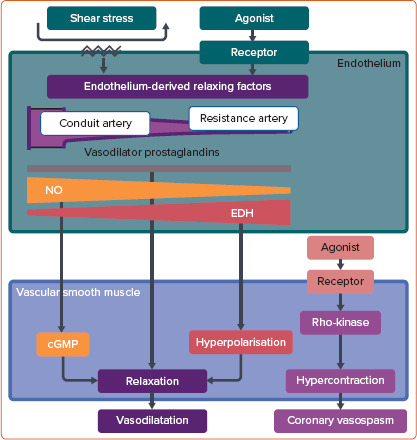
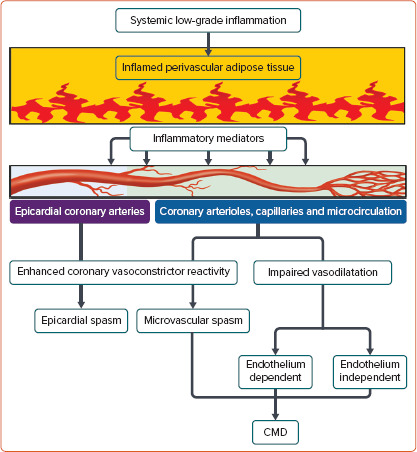
There is accumulating evidence highlighting a close relationship between inflammation and coronary microvascular dysfunction (CMD) in various experimental and clinical settings, with major clinical implications. Chronic low-grade vascular inflammation plays important roles in the underlying mechanisms behind CMD, especially in patients with coronary artery disease, obesity, heart failure with preserved ejection fraction and chronic inflammatory rheumatoid diseases. The central mechanisms of coronary vasomotion abnormalities comprise enhanced coronary vasoconstrictor reactivity, reduced endothelium-dependent and -independent coronary vasodilator capacity and increased coronary microvascular resistance, where inflammatory mediators and responses are substantially involved. How to modulate CMD to improve clinical outcomes of patients with the disorder and whether CMD management by targeting inflammatory responses can benefit patients remain challenging questions in need of further research. This review provides a concise overview of the current knowledge of the involvement of inflammation in the pathophysiology and molecular mechanisms of CMD from bench to bedside.
越来越多的证据表明,在各种实验和临床环境中,炎症与冠状动脉微血管功能障碍(CMD)之间存在密切关系,具有重要的临床意义。慢性低度血管炎症在CMD背后的潜在机制中起重要作用,尤其是在冠状动脉疾病、肥胖、射血分数保留的心力衰竭和慢性炎症性类风湿疾病患者中。冠状动脉血管运动异常的核心机制包括增强的冠状动脉血管收缩反应性、降低的内皮依赖性和非内皮依赖性冠状动脉舒张能力以及增加的冠状动脉微血管阻力,其中炎症介质和反应大量参与。如何调节CMD以改善该疾病患者的临床结局,以及通过靶向炎症反应管理CMD是否能使患者受益,仍然是需要进一步研究的具有挑战性的问题。本综述简要概述了从实验室到临床,炎症在CMD病理生理学和分子机制中的作用的当前知识。