Center for Dentistry and Oral Hygiene, University Medical Center Groningen (UMCG), University of Groningen, Groningen, the Netherlands.
Medical Statistics and Decision Making, Department of Epidemiology, UMCG, University of Groningen, Groningen, the Netherlands.
J Clin Periodontol. 2021 Jul;48(7):907-918. doi: 10.1111/jcpe.13472. Epub 2021 May 7.
To investigate the association between dietary inflammatory potential and poor periodontal health.
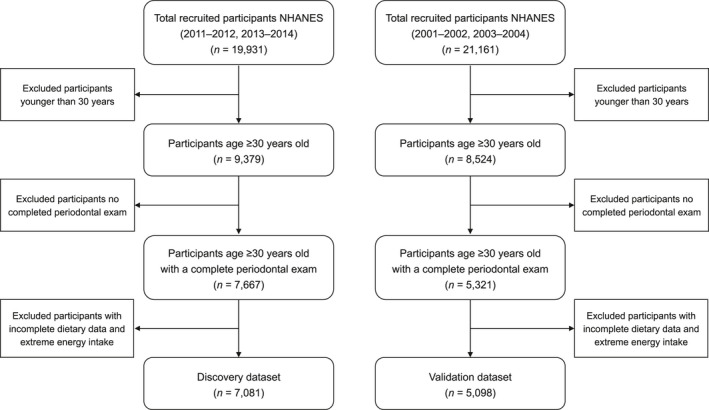
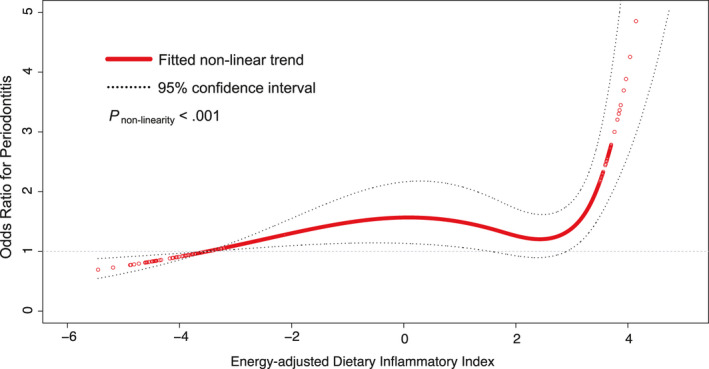
A cross-sectional analysis of a nationally representative sample of participants was performed. NHANES 2011-2014 (n = 7081) and NHANES 2001-2004 (n = 5098) were used as discovery and validation datasets, respectively. The energy-adjusted dietary inflammatory index (E-DII) score was calculated for each participant based on 24-h dietary recalls to assess diet-associated inflammation. Periodontitis was defined by the CDC/AAP using clinical periodontal parameters. Natural cubic spline was applied to identify any non-linear associations of the E-DII score with moderate/severe periodontitis. Furthermore, interaction analyses were performed by age, gender, and race/ethnicity to explore the moderating roles of these factors.
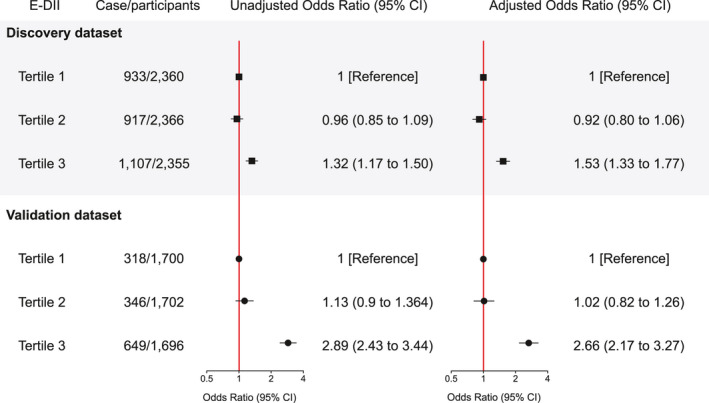
In the discovery dataset, a non-linear positive relationship with periodontitis was identified for the E-DII score (p < .001) after adjustment for potential confounders. Compared with those individuals in the lowest tertile of E-DII, participants in the highest tertile who consumed a pro-inflammatory diet were 53% more likely to be periodontitis (OR = 1.53, 95% CI: 1.33-1.77). The validation dataset showed similar associations. Relatively stronger associations were seen in older adults and males.
Consuming a pro-inflammatory diet indicated by the E-DII score is associated with periodontal disease in the U.S. general adult population.
研究饮食炎症潜能与牙周健康不良之间的关联。
对一项具有全国代表性的参与者的横断面分析进行了研究。分别使用 NHANES 2011-2014 年(n=7081)和 NHANES 2001-2004 年(n=5098)作为发现和验证数据集。根据 24 小时膳食回忆,为每个参与者计算能量调整后的饮食炎症指数(E-DII)评分,以评估与饮食相关的炎症。使用临床牙周参数通过 CDC/AAP 定义牙周炎。应用自然三次样条来确定 E-DII 评分与中重度牙周炎之间的任何非线性关联。此外,还进行了年龄、性别和种族/民族的交互分析,以探讨这些因素的调节作用。
在发现数据集中,在调整了潜在混杂因素后,E-DII 评分与牙周炎之间存在非线性正相关(p<0.001)。与 E-DII 评分最低三分位的个体相比,摄入促炎饮食的最高三分位个体患牙周炎的可能性增加 53%(OR=1.53,95%CI:1.33-1.77)。验证数据集也显示出类似的关联。在老年人和男性中,关联更为明显。
E-DII 评分提示的促炎饮食与美国一般成年人群的牙周病有关。