School of Social Work, San Diego State University, San Diego, CA.
Departments of Medicine, and Psychiatry University of California San Diego, San Diego, CA.
J Acquir Immune Defic Syndr. 2021 Aug 15;87(5):1128-1135. doi: 10.1097/QAI.0000000000002711.
Mediated and moderated processes that lead to intervention efficacy may underlie results of trials ruled as nonefficacious. The overall purpose of this study was to examine such processes to explain the findings of one of the largest, rigorously conducted behavioral intervention randomized controlled trials, EXPLORE.
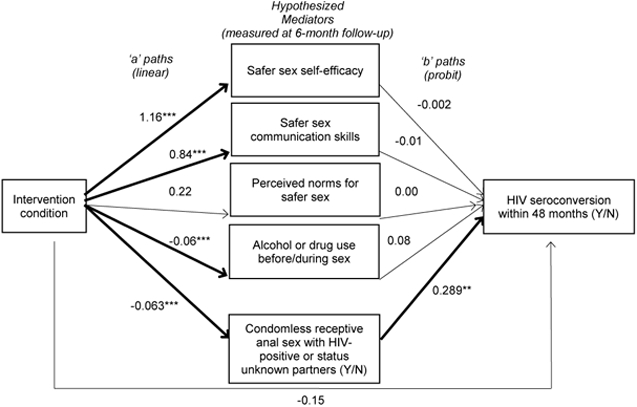
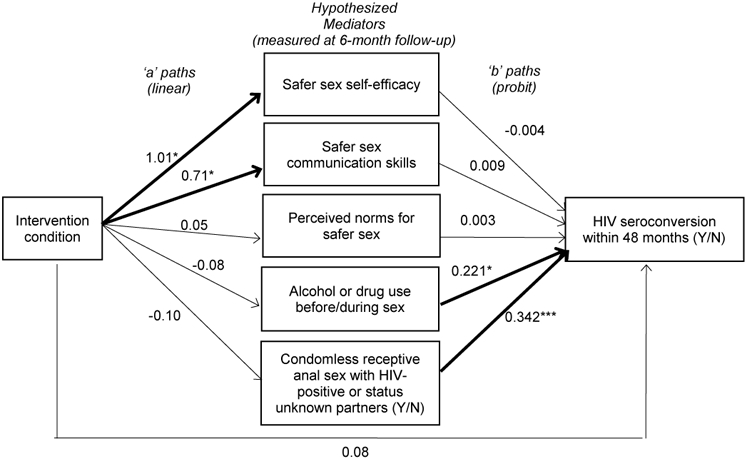
Four thousand two hundred ninety-five HIV-negative men who have sex with men (MSM) in the United States were randomized in a 2-armed trial. Participants completed follow-up and an HIV test every 6 months up to 48 months. We used multiple and causal mediation analyses to test 5 mediators, including safer sex self-efficacy and condomless receptive anal sex with HIV-positive or status-unknown partners on our primary outcome (HIV seroconversion). We also examined whether intervention effects on the mediators would be moderated by robust correlates of HIV among MSM, including stimulant use.
There were significant effects of the intervention on all hypothesized mediators. Stimulant use moderated the effect on condomless receptive anal sex In stratified multiple mediation models, we found that among MSM with low stimulant use, the intervention significantly prevented HIV by reducing condomless receptive anal sex with HIV-positive or status-unknown partners. Among MSM with higher stimulant use, there were no indirect effects of the intervention on HIV through any of the hypothesized mediators.
The results suggest that the null effect found in the original EXPLORE trial might have occurred as a function of previously unexplored mediated and moderated processes. This study illustrates the value of testing mediated and moderated pathways in randomized trials, even in trials ruled out as nonefficacious.
导致干预效果的中介和调节过程可能是试验结果无效的原因。本研究的总体目的是检验这些过程,以解释最大、最严格的行为干预随机对照试验之一——EXPLORE 的研究结果。
在美国,4295 名 HIV 阴性的男男性行为者(MSM)被随机分为两组进行试验。参与者每 6 个月完成一次随访和 HIV 检测,最长可达 48 个月。我们使用多元和因果中介分析来测试 5 个中介变量,包括安全性行为自我效能和与 HIV 阳性或未知状态的伴侣进行无保护的接受性肛交,作为我们的主要结局(HIV 血清转换)。我们还检查了干预对中介变量的影响是否会受到 MSM 中 HIV 的强有力相关因素(包括兴奋剂使用)的调节。
干预对所有假设的中介变量都有显著影响。兴奋剂使用调节了对无保护的接受性肛交的影响。在分层多元中介模型中,我们发现,在兴奋剂使用较低的 MSM 中,干预通过减少与 HIV 阳性或未知状态的伴侣进行无保护的接受性肛交,显著预防了 HIV。在兴奋剂使用较高的 MSM 中,干预通过任何假设的中介变量对 HIV 都没有间接影响。
研究结果表明,EXPLORE 试验中发现的无效效应可能是由于以前未被探索的中介和调节过程所致。本研究说明了在随机试验中测试中介和调节途径的价值,即使在被判定为无效的试验中也是如此。