Johns Hopkins University, Baltimore, Maryland, USA.
Bristol Myers Squibb, San Diego, California, USA.
Antimicrob Agents Chemother. 2021 Jun 17;65(7):e0025321. doi: 10.1128/AAC.00253-21.
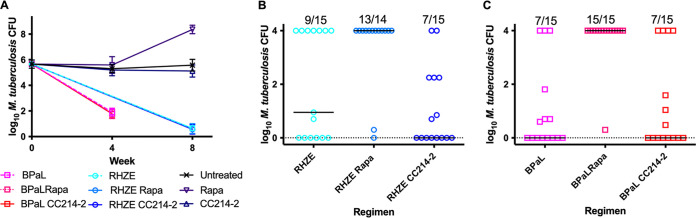
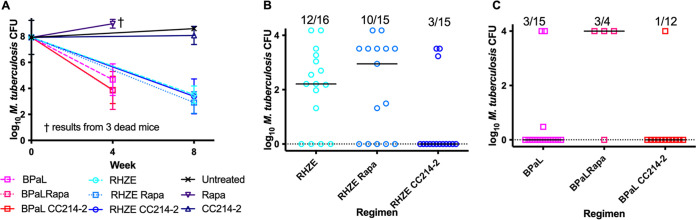
Efforts to develop more effective and shorter-course therapies for tuberculosis have included a focus on host-directed therapy (HDT). The goal of HDT is to modulate the host response to infection, thereby improving immune defenses to reduce the duration of antibacterial therapy and/or the amount of lung damage. As a mediator of innate and adaptive immune responses involved in eliminating intracellular pathogens, autophagy is a potential target for HDT in tuberculosis. Because Mycobacterium tuberculosis modulates mammalian target of rapamycin (mTOR) signaling to impede autophagy, pharmacologic mTOR inhibition could provide effective HDT. mTOR exists within two distinct multiprotein complexes, mTOR complex-1 (mTORC1) and mTOR complex-2 (mTORC2). Rapamycin and its analogs only partially inhibit mTORC1. We hypothesized that novel mTOR kinase inhibitors blocking both complexes would have expanded therapeutic potential. We compared the effects of two mTOR inhibitors, rapamycin and the orally available mTOR kinase domain inhibitor CC214-2, which blocks both mTORC1 and mTORC2, as adjunctive therapies against murine TB when added to the first-line regimen (isoniazid, rifampin, pyrazinamide, and ethambutol [RHZE]) or the novel bedaquiline-pretomanid-linezolid (BPaL) regimen. Neither mTOR inhibitor affected lung CFU counts after 4 to 8 weeks of treatment when combined with BPaL or RHZE. However, addition of CC214-2 to BPaL and RHZE was associated with significantly fewer relapses in C3HeB/FeJ mice compared to addition of rapamycin and, in RHZE-treated mice, resulted in fewer relapses than RHZE alone. Therefore, CC214-2 and related mTOR kinase inhibitors may be more effective candidates for HDT than rapamycin analogs and may have the potential to shorten the duration of TB treatment.
为了开发更有效和更短疗程的结核病治疗方法,人们关注了宿主导向治疗(HDT)。HDT 的目标是调节宿主对感染的反应,从而增强免疫防御,减少抗菌治疗的持续时间和/或肺部损伤。自噬作为参与消除细胞内病原体的固有和适应性免疫反应的介质,是结核病 HDT 的潜在靶点。由于结核分枝杆菌调节哺乳动物雷帕霉素靶蛋白(mTOR)信号以阻碍自噬,因此药理学 mTOR 抑制可能提供有效的 HDT。mTOR 存在于两个不同的多蛋白复合物中,即 mTOR 复合物 1(mTORC1)和 mTOR 复合物 2(mTORC2)。雷帕霉素及其类似物仅部分抑制 mTORC1。我们假设,阻断这两个复合物的新型 mTOR 激酶抑制剂将具有扩展的治疗潜力。我们比较了两种 mTOR 抑制剂雷帕霉素和可口服的 mTOR 激酶结构域抑制剂 CC214-2 的效果,CC214-2 可阻断 mTORC1 和 mTORC2,当添加到一线方案(异烟肼、利福平、吡嗪酰胺和乙胺丁醇[RHZE])或新型贝达喹啉-pretomanid-利奈唑胺(BPaL)方案中时,可作为辅助治疗用于治疗小鼠结核病。当与 BPaL 或 RHZE 联合使用时,两种 mTOR 抑制剂在治疗 4 至 8 周后均未影响肺部 CFU 计数。然而,与添加雷帕霉素相比,CC214-2 添加到 BPaL 和 RHZE 中与 C3HeB/FeJ 小鼠的复发率显著降低,并且与 RHZE 单独治疗相比,RHZE 治疗的小鼠复发率更低。因此,CC214-2 和相关的 mTOR 激酶抑制剂可能比雷帕霉素类似物更适合作为 HDT 的候选药物,并且有可能缩短结核病治疗的持续时间。