Sino-British Research Center for Molecular Oncology, National Center for the International Research in Cell and Gene Therapy, School of Basic Sciences, Academy of Medical Sciences, Zhengzhou University, Zhengzhou, Henan, P.R. China.
The Academy of Medical Science, Precision Medicine Center of the Second Affiliated Hospital of Zhengzhou University, Zhengzhou University, Henan, P.R. China.
Aging (Albany NY). 2021 Apr 26;13(8):12273-12293. doi: 10.18632/aging.202934.
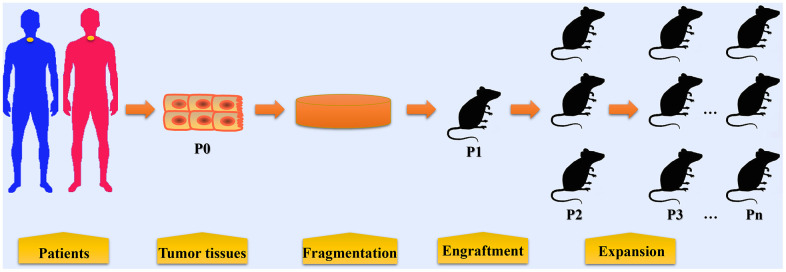
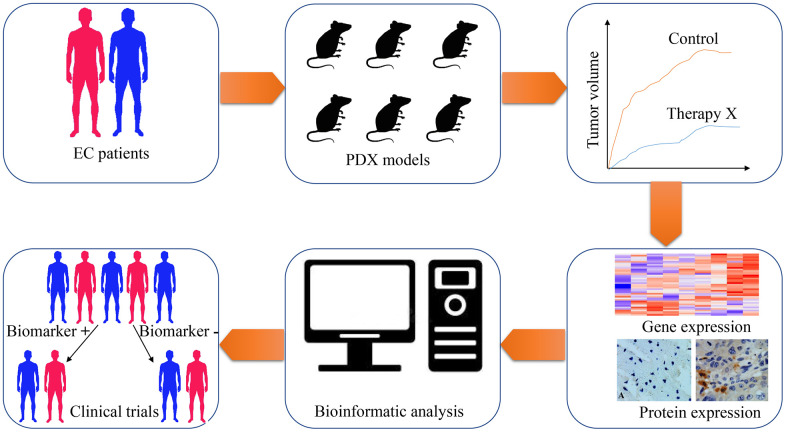
Esophageal cancer (EC) represents a human malignancy, diagnosed often at the advanced stage of cancer and resulting in high morbidity and mortality. The development of precision medicine allows for the identification of more personalized therapeutic strategies to improve cancer treatment. By implanting primary cancer tissues into immunodeficient mice for expansion, patient-derived xenograft (PDX) models largely maintain similar histological and genetic representations naturally found in patients' tumor cells. PDX models of EC (EC-PDX) provide fine platforms to investigate the tumor microenvironment, tumor genomic heterogeneity, and tumor response to chemoradiotherapy, which are necessary for new drug discovery to combat EC in addition to optimization of current therapeutic strategies for EC. In this review, we summarize the methods used for establishing EC-PDX models and investigate the utilities of EC-PDX in screening predictive biomarkers and potential therapeutic targets. The challenge of this promising research tool is also discussed.
食管癌(EC)是一种人类恶性肿瘤,通常在癌症晚期诊断,导致高发病率和死亡率。精准医学的发展允许确定更个性化的治疗策略,以改善癌症治疗。通过将原发性癌组织植入免疫缺陷小鼠中进行扩增,患者来源的异种移植(PDX)模型在很大程度上保持了患者肿瘤细胞中自然存在的相似组织学和遗传表现。EC 的 PDX 模型(EC-PDX)为研究肿瘤微环境、肿瘤基因组异质性以及肿瘤对放化疗的反应提供了精细的平台,这对于发现新的药物以对抗 EC 以及优化 EC 的现有治疗策略是必要的。在这篇综述中,我们总结了建立 EC-PDX 模型的方法,并研究了 EC-PDX 在筛选预测性生物标志物和潜在治疗靶点方面的应用。还讨论了这一有前途的研究工具所面临的挑战。