Department of Internal Medicine-Molecular Medicine, Wake Forest School of Medicine, Winston-Salem, North Carolina, USA.
Department of Nutrition, Food & Exercise Sciences, Florida State University, Tallahassee, Florida, USA.
Ann Nutr Metab. 2021;77 Suppl 2(Suppl 2):21-27. doi: 10.1159/000515700. Epub 2021 Apr 27.
Alzheimer's disease (AD) is the most common form of dementia, particularly in older adults, with clinical manifestations of progressive cognitive decline and functional impairment. The prevalence of AD and related dementia is mounting worldwide, but its etiology remains unresolved, with no available preventative or ameliorative therapy. Emerging evidence suggests that the gut microbiota of patients with AD is different from cognitively normal counterparts.
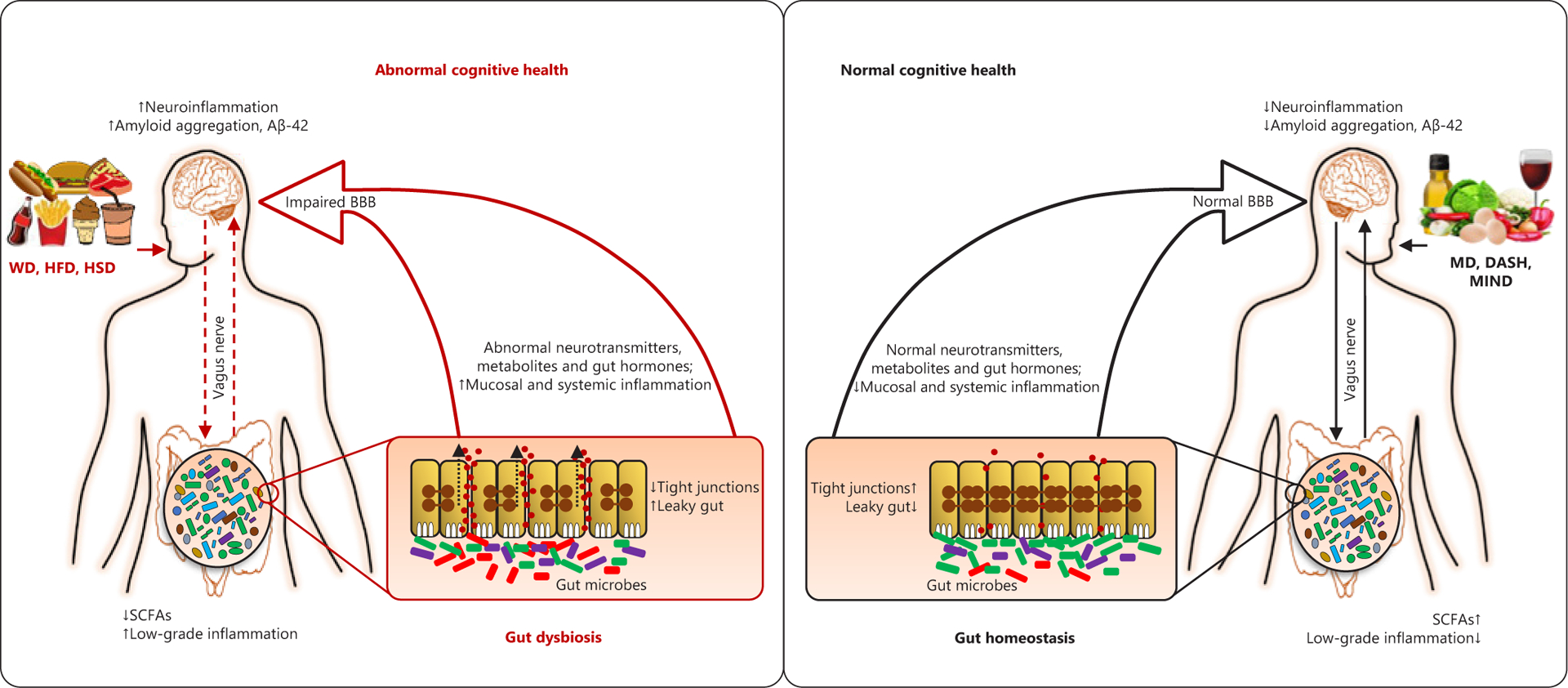
Communication between gut and brain (gut-brain axis) plays a crucial role in AD pathology. Bacteria inhabiting the gut strongly influence this gut-brain axis and thus may participate in AD pathology. Diet, one of the strongest modulators of gut microbiota, also strongly influences brain health and AD pathology. Gut microbiota metabolites including short-chain fatty acids, pro-inflammatory factors, and neurotransmitters may also affect AD pathogenesis and associated cognitive decline. Therefore, investigation of diet-microbiota-brain axis is important to better understand its contribution in AD pathology and its potential use as a target to prevent and treat AD. Herein, we discuss the link between AD and gut microbiota and ponder how microbiota modulation through nutritional approaches may offer avenues for discovering novel preventive and therapeutic strategies against AD. Key Message: A strong association exists between lifestyle factors and AD prevalence wherein unhealthy dietary factors have been linked to neurodegeneration. Specific prudent dietary patterns might help in preventing or delaying AD progression by affecting β-amyloid production and tau processing and regulating AD-associated inflammation, metabolism and oxidative stress, plausibly via modulating gut microbiota.
阿尔茨海默病(AD)是最常见的痴呆症形式,尤其在老年人中,其临床表现为进行性认知能力下降和功能障碍。AD 和相关痴呆症的患病率在全球范围内不断上升,但病因仍未解决,目前尚无有效的预防或改善疗法。新出现的证据表明,AD 患者的肠道微生物群与认知正常的人不同。
肠道与大脑之间的通讯(肠脑轴)在 AD 病理中起着至关重要的作用。居住在肠道中的细菌强烈影响这个肠脑轴,因此可能参与 AD 病理。饮食是最强的肠道微生物群调节剂之一,它也强烈影响大脑健康和 AD 病理。肠道微生物群代谢物,包括短链脂肪酸、促炎因子和神经递质,也可能影响 AD 的发病机制和相关认知能力下降。因此,研究饮食-微生物群-大脑轴对于更好地理解其在 AD 病理中的作用以及将其作为预防和治疗 AD 的靶点具有重要意义。本文讨论了 AD 与肠道微生物群之间的联系,并探讨了通过营养方法调节微生物群可能为发现预防和治疗 AD 的新策略提供途径。关键信息:生活方式因素与 AD 患病率之间存在很强的关联,其中不健康的饮食因素与神经退行性变有关。特定的谨慎饮食模式可能有助于通过影响β-淀粉样蛋白的产生和 tau 处理以及调节 AD 相关炎症、代谢和氧化应激,从而预防或延缓 AD 的进展,这种作用可能是通过调节肠道微生物群实现的。