Rozi Ismail E, Syahrani Lepa, Permana Dendi H, Asih Puji B S, Sumiwi Maria E, Lobo Neil F, Hawley William A, Syafruddin Din
Eijkman Research Center for Molecular Biology, National Research and Innovation Agency (BRIN), Cibinong, Indonesia.
Doctoral Program in Faculty of Medicine, Hasanuddin University, Makassar, Indonesia.
PLoS One. 2025 Apr 11;20(4):e0311076. doi: 10.1371/journal.pone.0311076. eCollection 2025.
Malaria in eastern Indonesia remains high despite significant reductions and local elimination in other parts of the country. Malaria control activities that have been implemented include early diagnosis and prompt treatment, provision of Long-lasting insecticide-treated nets (LLINs), and indoor residual spraying (IRS). To expedite malaria elimination in this region, a rapid entomological assessment combined with human behaviour observations (HBOs) were conducted in eight high malaria endemic regencies in Papua Province, Indonesia. The present study focuses on identifying gaps in protection against mosquito biting indoors and outdoors that may contribute to the sustained transmission and persistently high endemicity.
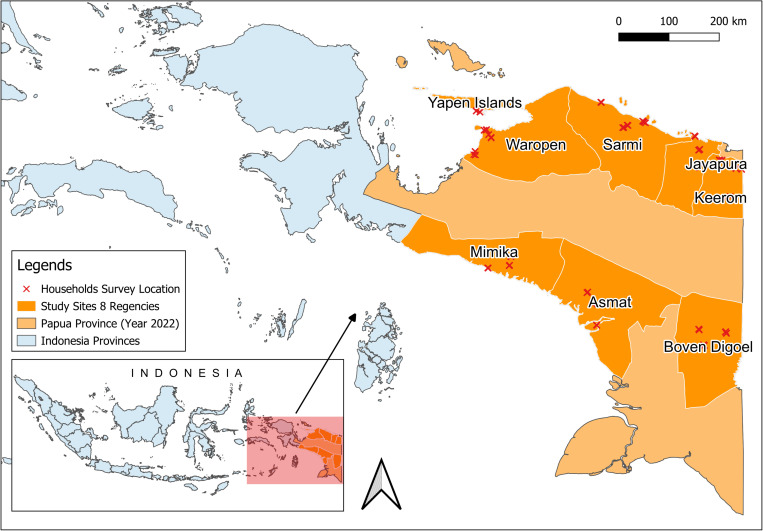
This research was carried out alongside a rapid entomological assessment across 48 villages in all eight regencies over 150 days. It included human landing catches (HLCs) of adult mosquitoes, with human behavior recorded through direct observation during these HLCs. The human behavior observation (HBO) data concentrated on temporal (overnight) and spatial (domestic or peri-domestic) presence, in addition to bed net usage and sleeping patterns. Household surveys, which were also conducted during the entomological collections, gathered information on house construction materials, mosquito bite prevention practices, livestock presence, and other intervention usage.
Behavior-adjusted exposure for unprotected individuals in 14 villages shows gaps in protection of ITN usage before sleeping. Meanwhile, an analysis of household survey in each regency identified several gaps in protection against mosquito bites. Human exposure to mosquito bites was driven by ITN usage, IRS coverage, indoor presence without protection prior to sleeping, the absence of mosquito house screens, and outdoor presence without protection.
The data reveals several gaps in protection against mosquito exposure across all eight regencies of Papua assessed. There is a need to optimize indoor interventions, as current vector control efforts do not adequately address outdoor exposure. Assessing spatial and temporal exposure can help identify effective protective vector strategies for these areas while highlighting persistent exposure risks. Community-based larval source management could enhance overall exposure reduction. Additionally, innovative measures like spatial repellents may address some protective gaps, together with improved case detection and treatment. The findings indicate that the existing strategy may not suffice to eradicate malaria in the region, necessitating a reconsidered, evidence-based, and adaptive approach.
尽管印度尼西亚其他地区的疟疾发病率显著下降甚至实现了局部消除,但该国东部的疟疾发病率仍然很高。已实施的疟疾控制活动包括早期诊断和及时治疗、提供长效驱虫蚊帐(LLINs)以及室内滞留喷洒(IRS)。为了加快该地区的疟疾消除工作,在印度尼西亚巴布亚省的八个高疟疾流行县进行了一项快速昆虫学评估,并结合了人类行为观察(HBOs)。本研究的重点是确定在室内和室外防蚊叮咬方面存在的差距,这些差距可能导致疟疾的持续传播和高流行率。
本研究是在150天内对所有八个县的48个村庄进行快速昆虫学评估的同时进行的。它包括对成年蚊子的人饵诱捕(HLCs),并在这些人饵诱捕过程中通过直接观察记录人类行为。人类行为观察(HBO)数据集中在时间(过夜)和空间(家庭或家庭周边)的存在情况,以及蚊帐使用和睡眠模式。在昆虫学采集期间也进行了家庭调查,收集了有关房屋建筑材料、防蚊叮咬措施、牲畜存在情况以及其他干预措施使用情况的信息。
对14个村庄未受保护个体的行为调整暴露情况显示,在睡前使用驱虫蚊帐的保护方面存在差距。同时,对每个县的家庭调查分析确定了在防蚊叮咬保护方面的几个差距。人类接触蚊虫叮咬的情况受到驱虫蚊帐使用、室内滞留喷洒覆盖率、睡前无保护措施的室内停留、无纱窗以及无保护措施的室外停留等因素的影响。
数据显示,在所评估的巴布亚所有八个县中,在防蚊暴露方面存在几个差距。有必要优化室内干预措施,因为目前的病媒控制工作没有充分解决室外暴露问题。评估空间和时间暴露情况有助于确定这些地区有效的保护性病媒控制策略,同时突出持续的暴露风险。基于社区的幼虫源管理可以加强整体暴露减少。此外,空间驱避剂等创新措施可能有助于填补一些保护差距,同时改善病例检测和治疗。研究结果表明,现有的策略可能不足以在该地区根除疟疾,需要重新考虑、基于证据且具有适应性的方法。