Department of Psychology, University of Michigan, 2227 East Hall, 530 Church Street, Ann Arbor, MI, 48109, USA.
Sci Rep. 2021 Apr 27;11(1):9114. doi: 10.1038/s41598-021-88279-4.
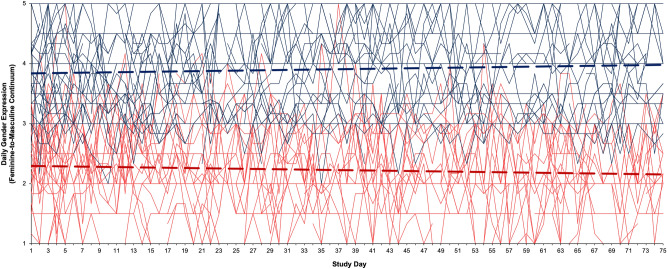
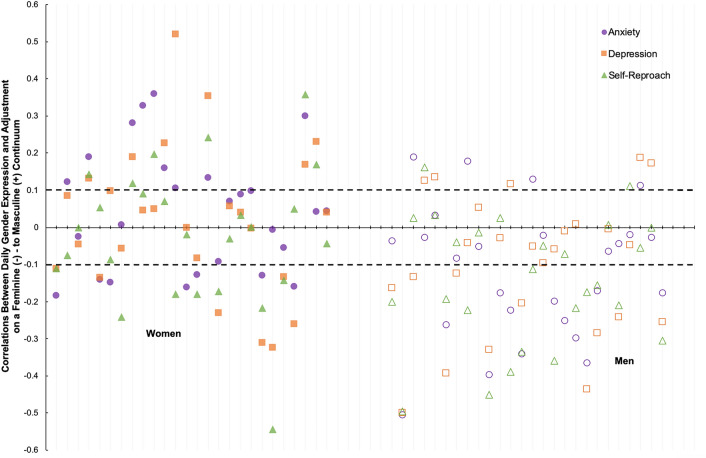
To what extent does gender expression vary day-to-day? Are daily changes related to psychological adjustment in the same way for all individuals? A person-specific approach was used to answer these questions in a 75-day intensive longitudinal study. Fifty-seven cisgender adults (27 women) provided over 4000 reports of daily masculinity and femininity and of three indices of internalizing problems. Results revealed: (a) substantial daily fluctuations in gender expression, especially in women; (b) sample-level links between daily increases in femininity or reductions in masculinity and heightened anxiety, depression, and self-reproach for men, but no apparent links for women; and (c) person-specific links between gender expression and psychological adjustment, such that some women reported internalizing problems with reduced masculinity (average male pattern) and some men reported problems with heightened masculinity (opposite the average male pattern). Findings highlight how intensive longitudinal research can illuminate the uniqueness of gender-related daily experiences, and their implications for the wellbeing of individuals.
性别表达在一天之中会变化到什么程度?对于所有个体而言,每日变化与心理调节的关联方式是否相同?在一项为期 75 天的密集纵向研究中,采用个体特定的方法来回答这些问题。57 名顺性别成年人(27 名女性)提供了 4000 多次关于每日男性化和女性化以及三个内化问题指标的报告。结果显示:(a)性别表达存在大量的日常波动,尤其是在女性中;(b)男性的日常女性化增加或男性化减少与焦虑、抑郁和自责水平升高之间存在样本水平的关联,但女性似乎没有这种关联;(c)性别表达与心理调节之间存在个体特定的关联,一些女性报告称,男性化程度降低(平均男性模式)会出现内化问题,而一些男性报告称,男性化程度升高(与平均男性模式相反)会出现问题。这些发现强调了密集纵向研究如何阐明与性别相关的日常体验的独特性,以及它们对个体幸福感的影响。