Palliative Care Outcomes Collaboration, Australian Health Services Research Institute, University of Wollongong, Building 234 (iC Enterprise 1), Wollongong, NSW 2522, Australia.
Int J Qual Health Care. 2021 May 19;33(2). doi: 10.1093/intqhc/mzab075.
Implementation of routinely collected patient-reported outcome measures (PROMs) ensures patients' priorities are at the forefront of care planning and helps to standardize approaches to quality improvement. In palliative care, barriers to PROMs are widely known but what are not understood are the clinical and care settings in which patients are more likely to report and when proxy reporting is needed.
To examine the incidence of patient-reported symptom distress compared to the incidence of proxy reporting in palliative care and influencing factors.
A national observational study using routinely collected PROMs data with influencing factors investigated by logistic regression modelling. Participants were patients with an advanced life-limiting illness receiving palliative care in an inpatient or a community healthcare setting in Australia.
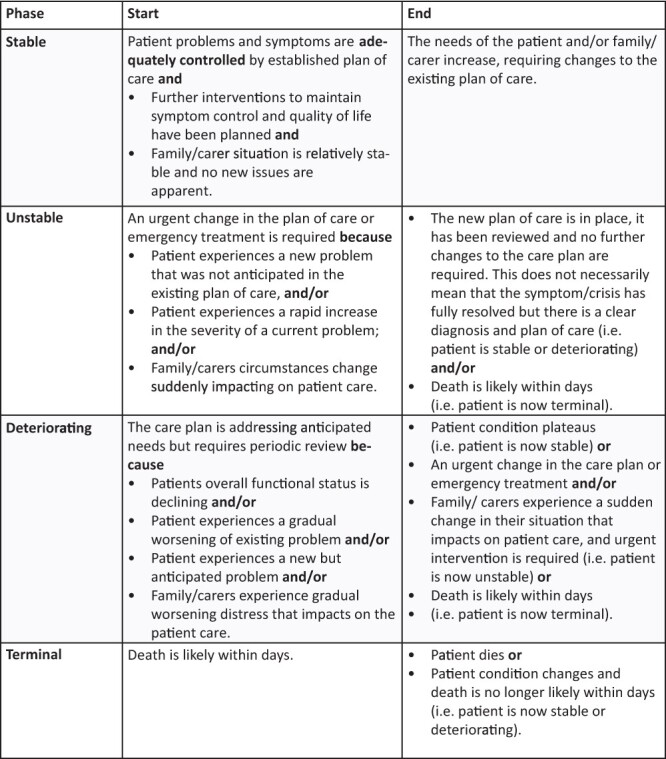
Sixteen thousand one hundred and fifty-eight reports of symptom distress were collected from 1117 patients seen by 21 palliative care services. The majority of respondents were diagnosed with cancer (76%), were older (≥65 years, 72%) and had nominated English as their first language (88%). The majority of symptom distress reports were completed by patients (61%). The odds of a patient providing a self-report where grater when they were receiving community versus inpatient palliative care (odds ratio (OR): 3.0; 95% confidence interval (CI): 2.25-4.01), for patients diagnosed with malignant versus non-malignant disease (OR 1.7; 95% CI: 1.26-2.31), and for those who required an urgent change in their care plan versus those whose symptoms and problems were adequately managed (OR: 1.38; 95% CI: 1.04-1.83).
Three factors are associated with an increased likelihood of patient versus proxy reporting in palliative care: healthcare setting, diagnosis, and the acuity and urgency of the patient's clinical needs. PROMs are feasible in most clinical scenarios in palliative care, including when an urgent clinical response is required.
实施常规收集的患者报告结局测量(PROMs)可确保患者的首要需求处于护理计划的最前沿,并有助于标准化质量改进方法。在姑息治疗中,人们广泛了解 PROMs 的障碍,但不了解的是患者更有可能报告的临床和护理环境,以及何时需要代理报告。
比较姑息治疗中患者报告的症状困扰发生率与代理报告的发生率,并探讨影响因素。
一项全国性的观察性研究,使用常规收集的 PROMs 数据,并通过逻辑回归模型来研究影响因素。参与者为在澳大利亚的住院或社区医疗保健环境中接受姑息治疗的患有晚期生命有限疾病的患者。
从 21 个姑息治疗服务机构的 1117 名患者中收集了 16158 份症状困扰报告。大多数受访者被诊断患有癌症(76%),年龄较大(≥65 岁,72%),并将英语作为第一语言(88%)。大多数症状困扰报告是由患者完成的(61%)。当患者在社区接受姑息治疗而非住院治疗时(比值比(OR):3.0;95%置信区间(CI):2.25-4.01)、患有恶性疾病而非非恶性疾病时(OR:1.7;95%CI:1.26-2.31)、以及其护理计划需要紧急改变时(OR:1.38;95%CI:1.04-1.83),患者自我报告的可能性更大。
有三个因素与姑息治疗中患者与代理报告的可能性增加相关:医疗保健环境、诊断以及患者临床需求的紧急程度。PROMs 在姑息治疗的大多数临床情况下都是可行的,包括需要紧急临床反应的情况。