Preuss Hanna, Capito Klara, van Eickels Rahel Lea, Zemp Martina, Kolar David Raphael
Department of Child and Adolescent Psychiatry and Psychotherapy, University Medical Center of the Johannes Gutenberg University Mainz, Langenbeckstraße 1, 55131 Mainz, Germany.
Department of Clinical and Health Psychology, University of Vienna, Renngasse 6-8, 1010 Vienna, Austria.
Internet Interv. 2021 Apr 6;24:100388. doi: 10.1016/j.invent.2021.100388. eCollection 2021 Apr.
Parenting during pandemic restrictions places extreme demands on everyday family life, leading to increased stress levels for parents and distressed parent-child interactions. This RCT aimed to investigate whether cognitive reappraisal and self-compassion are helpful emotion regulation (ER) strategies to reduce individual and parental stress during the COVID-19 pandemic.
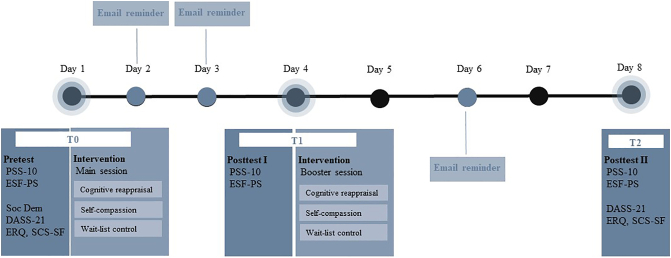
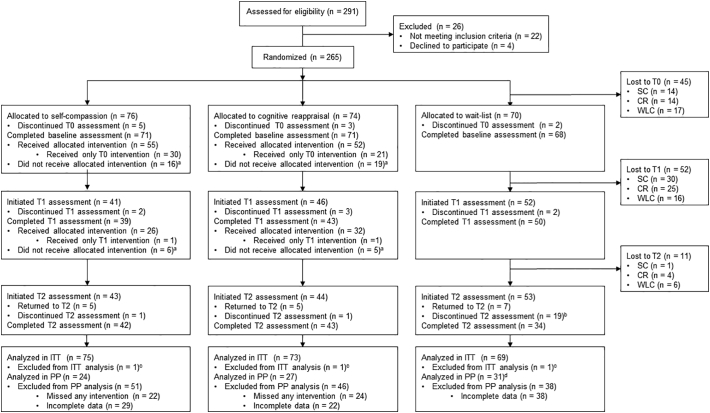
An online intervention for parents was developed focusing on the application of ER strategies to pandemic requirements of families. A sample of 265 parents were randomly assigned to either cognitive reappraisal (CR; = 88), self-compassion (SC; = 90) or wait-list control (WLC; = 87) group. Interventions included two video sessions (day 1 and day 3) and three email reminders to transfer the application of ER strategies to daily family life (days 2, 4, 5). Parents' perceived individual stress and parental stress were assessed at baseline (T0), at T1 prior to the booster session on day 3, and at T2 (7 days after baseline).
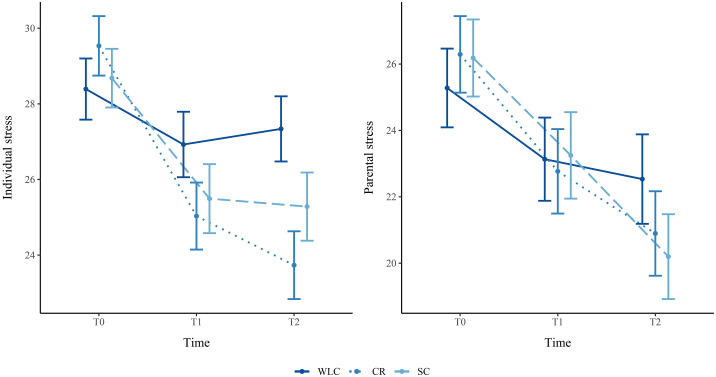
Significant decreases from T0 to T2 emerged for both primary stress outcomes in both intervention groups. Individual stress significantly decreased in CR compared to WLC at T2, but not compared to SC. No time × group interactions for parental stress were found. However, mediation analyses suggested that parental stress was indirectly decreased via reductions in individual stress for CR compared to WLC at both time points.
COVID-19 will not be the last pandemic to affect family life. Cognitive reappraisal as a brief online intervention can ease acute stress and strengthen the mental health of parents in acute crises.
疫情限制期间的育儿对日常家庭生活提出了极高要求,导致父母压力水平增加以及亲子互动出现困扰。这项随机对照试验旨在调查认知重评和自我同情是否为有助于在新冠疫情期间减轻个体和父母压力的情绪调节策略。
针对父母开发了一项在线干预措施,重点是将情绪调节策略应用于家庭的疫情需求。265名父母样本被随机分配到认知重评组(CR;n = 88)、自我同情组(SC;n = 90)或等待名单对照组(WLC;n = 87)。干预措施包括两次视频课程(第1天和第3天)以及三次电子邮件提醒,以将情绪调节策略的应用转移到日常家庭生活中(第2天、第4天、第5天)。在基线(T0)、第3天强化课程前的T1以及T2(基线后7天)评估父母感知的个体压力和父母压力。
两个干预组的两个主要压力结果从T0到T2均出现显著下降。与WLC相比,CR组在T2时个体压力显著降低,但与SC组相比未降低。未发现父母压力的时间×组间交互作用。然而,中介分析表明,与WLC相比,CR组在两个时间点上,父母压力均通过个体压力的降低而间接降低。
新冠疫情不会是影响家庭生活的最后一次大流行。认知重评作为一种简短的在线干预措施,可以缓解急性压力并增强处于急性危机中的父母的心理健康。