MMWR Morb Mortal Wkly Rep. 2021 Apr 30;70(17):622-626. doi: 10.15585/mmwr.mm7017a4.
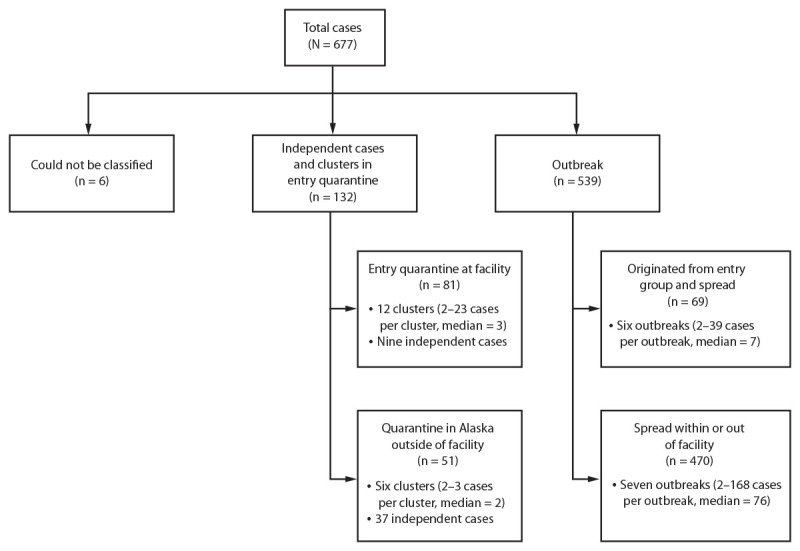
Large COVID-19 outbreaks have occurred in high-density workplaces, such as food processing facilities (1). Alaska's seafood processing industry attracts approximately 18,000 out-of-state workers annually (2). Many of the state's seafood processing facilities are located in remote areas with limited health care capacity. On March 23, 2020, the governor of Alaska issued a COVID-19 health mandate (HM10) to address health concerns related to the impending influx of workers amid the COVID-19 pandemic (3). HM10 required employers bringing critical infrastructure (essential) workers into Alaska to submit a Community Workforce Protective Plan.* On May 15, 2020, Appendix 1 was added to the mandate, which outlined specific requirements for seafood processors, to reduce the risk for transmission of SARS-CoV-2, the virus that causes COVID-19, in these high-density workplaces (4). These requirements included measures to prevent introduction of SARS-CoV-2 into the workplace, including testing of incoming workers and a 14-day entry quarantine before workers could enter nonquarantine residences. After 13 COVID-19 outbreaks in Alaska seafood processing facilities and on processing vessels during summer and early fall 2020, State of Alaska personnel and CDC field assignees reviewed the state's seafood processing-associated cases. Requirements were amended in November 2020 to address gaps in COVID-19 prevention. These revised requirements included restricting quarantine groups to ≤10 persons, pretransfer testing, and serial testing (5). Vaccination of this essential workforce is important (6); until high vaccination coverage rates are achieved, other mitigation strategies are needed in this high-risk setting. Updating industry guidance will be important as more information becomes available.
大规模的 COVID-19 疫情爆发发生在高密度工作场所,例如食品加工厂(1)。阿拉斯加的海鲜加工行业每年吸引约 18000 名外州工人(2)。该州的许多海鲜加工厂都位于医疗保健能力有限的偏远地区。2020 年 3 月 23 日,阿拉斯加州长发布了 COVID-19 健康指令(HM10),以解决 COVID-19 大流行期间即将涌入工人所带来的健康问题(3)。HM10 要求将关键基础设施(必要)工人带入阿拉斯加的雇主提交一份社区劳动力保护计划*。2020 年 5 月 15 日,该指令增加了附录 1,其中概述了海鲜加工商的具体要求,以降低这些高密度工作场所中 SARS-CoV-2(导致 COVID-19 的病毒)传播的风险(4)。这些要求包括防止 SARS-CoV-2 引入工作场所的措施,包括对进入工人的检测以及工人进入非检疫住所前的 14 天入境检疫。2020 年夏季和初秋期间,阿拉斯加海鲜加工厂和加工船上发生了 13 起 COVID-19 疫情后,阿拉斯加州人员和 CDC 现场分配人员审查了该州与海鲜加工相关的病例。2020 年 11 月对要求进行了修订,以解决 COVID-19 预防方面的差距。这些经修订的要求包括将检疫组限制为≤10 人、预转移检测和连续检测(5)。为这个必要的劳动力接种疫苗非常重要(6);在高疫苗接种率实现之前,在这种高风险环境中还需要其他缓解策略。随着更多信息的出现,更新行业指南将是重要的。