Laboratorio di Nanomedicina ed Imaging Molecolare, Istituti Clinici Scientifici Maugeri IRCCS, 27100 Pavia, Italy.
Molecular Targeting Unit, Department of Research, Fondazione IRCCS Istituto Nazionale dei Tumori, 20133 Milan, Italy.
Int J Mol Sci. 2021 Apr 3;22(7):3737. doi: 10.3390/ijms22073737.
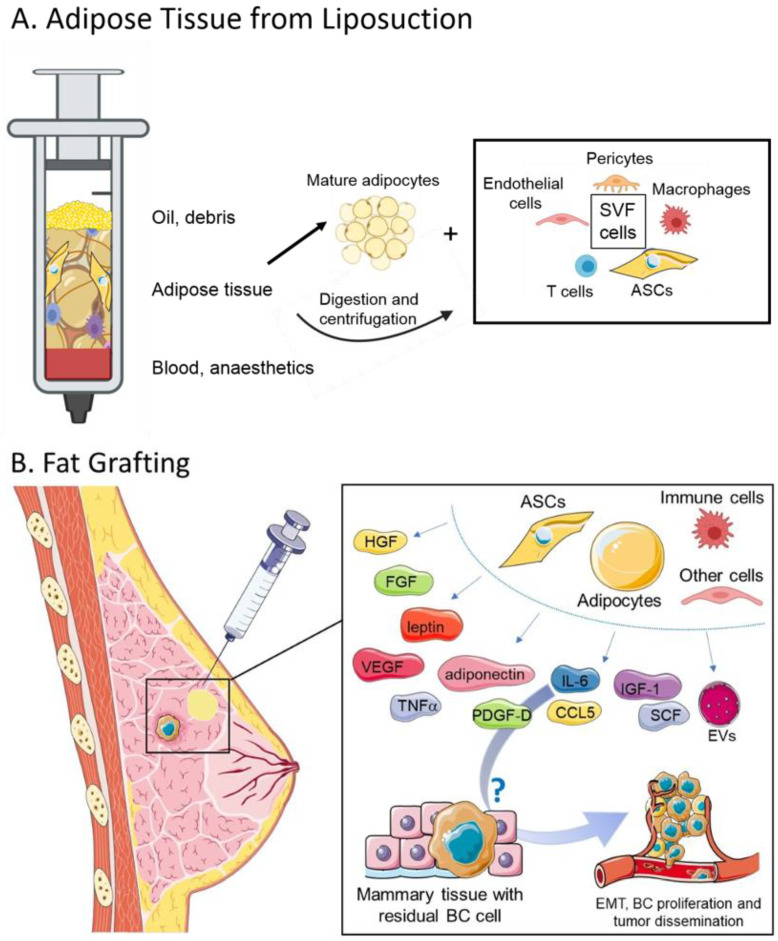
Lipofilling (LF) is a largely employed technique in reconstructive and esthetic breast surgery. Over the years, it has demonstrated to be extremely useful for treatment of soft tissue defects after demolitive or conservative breast cancer surgery and different procedures have been developed to improve the survival of transplanted fat graft. The regenerative potential of LF is attributed to the multipotent stem cells found in large quantity in adipose tissue. However, a growing body of pre-clinical evidence shows that adipocytes and adipose-derived stromal cells may have pro-tumorigenic potential. Despite no clear indication from clinical studies has demonstrated an increased risk of cancer recurrence upon LF, these observations challenge the oncologic safety of the procedure. This review aims to provide an updated overview of both the clinical and the pre-clinical indications to the suitability and safety of LF in breast oncological surgery. Cellular and molecular players in the crosstalk between adipose tissue and cancer are described, and heterogeneous contradictory results are discussed, highlighting that important issues still remain to be solved to get a clear understanding of LF safety in breast cancer patients.
脂肪移植(LF)是重建和美容乳房手术中广泛应用的技术。多年来,它已被证明对于治疗破坏性或保守性乳腺癌手术后的软组织缺损非常有用,并且已经开发出不同的方法来提高移植脂肪的存活率。LF 的再生潜力归因于大量存在于脂肪组织中的多能干细胞。然而,越来越多的临床前证据表明,脂肪细胞和脂肪来源的基质细胞可能具有致癌潜能。尽管临床研究没有明确表明 LF 会增加癌症复发的风险,但这些观察结果对该手术的肿瘤安全性提出了挑战。本综述旨在提供 LF 在乳腺癌手术中的临床和临床前适应证的最新概述,以评估其适用性和安全性。描述了脂肪组织和癌症之间相互作用的细胞和分子参与者,并讨论了存在异质性的矛盾结果,突出表明,为了更清楚地了解 LF 在乳腺癌患者中的安全性,仍有一些重要问题有待解决。