Department of Family Medicine, UC San Diego, La Jolla, CA 92093, USA.
Herbert Wertheim School of Public Health and Human Longevity Science, UC San Diego, La Jolla, CA 92093, USA.
Int J Environ Res Public Health. 2021 Apr 8;18(8):3909. doi: 10.3390/ijerph18083909.
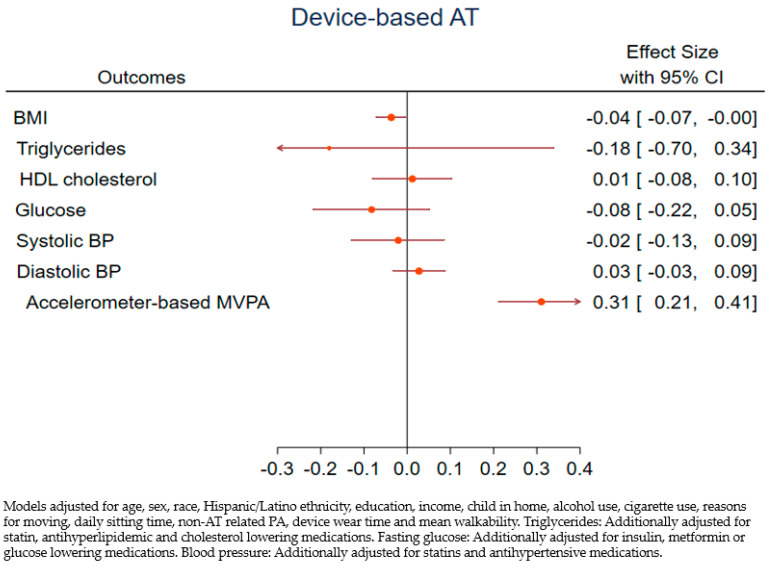
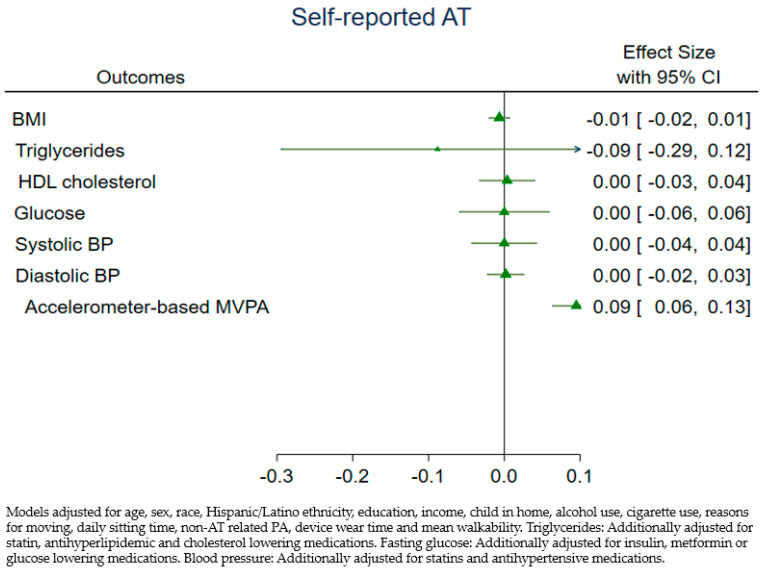
Active travel (AT) provides an opportunity to alleviate the physical inactivity and climate crises contributing to the global chronic disease burden, including cardiovascular diseases (CVD). Though AT shows promising links to reduced CVD risk, prior studies relied on self-reported AT assessment. In the present study, device-measured and self-reported AT were compared across population subgroups and relationships with CVD risk biomarkers were evaluated for both measures. The study recruited an ethnically diverse sample (N = 602, mean age 59 years, 42% Hispanic/Latino ethnicity) from neighborhoods that varied by walkability and food access. AT was assessed using concurrently collected accelerometer and GPS data and self-report data from a validated survey. Relationships with body mass index (BMI), triglycerides, high-density lipoprotein (HDL) cholesterol, blood pressure (BP), and moderate-to-vigorous physical activity (MVPA) were modeled using multivariable linear regression. Devices captured more AT than did self-report. We found differences in AT measures by population subgroups, including race, ethnicity, education, income, vehicle access, and walkability. Men had more accelerometer-measured MVPA, though women self-reported more daily minutes. Both device and survey AT measures were positively associated with total accelerometer-measured MVPA, though the relationship was stronger with device-measured AT. Device-measured AT was associated with lower BMI. No other CVD risk biomarker was associated with either AT measure. No effect modification by Hispanic/Latino ethnicity was detected. Further studies with device-based measures are warranted to better understand the relationship between AT and cardiovascular health.
积极出行(AT)为减轻导致全球慢性病负担的身体活动不足和气候危机提供了机会,包括心血管疾病(CVD)。尽管 AT 显示出与降低 CVD 风险有一定的关联,但先前的研究依赖于自我报告的 AT 评估。在本研究中,对设备测量和自我报告的 AT 进行了比较,以评估两种方法在不同人群亚组中的相关性,以及与 CVD 风险生物标志物的关系。该研究从步行便利性和食物获取情况不同的社区招募了一个种族多样化的样本(N = 602,平均年龄 59 岁,42%为西班牙裔/拉丁裔)。AT 是通过同时收集的加速度计和 GPS 数据以及来自经过验证的调查的自我报告数据进行评估的。使用多变量线性回归模型评估了与身体质量指数(BMI)、甘油三酯、高密度脂蛋白(HDL)胆固醇、血压(BP)和中等到剧烈的身体活动(MVPA)的关系。设备捕捉到的 AT 比自我报告的多。我们发现,人口亚组之间的 AT 测量值存在差异,包括种族、民族、教育、收入、车辆使用情况和步行便利性。男性的加速度计测量的 MVPA 更多,而女性自我报告的每日分钟数更多。设备和调查 AT 测量值均与总加速度计测量的 MVPA 呈正相关,尽管与设备测量的 AT 相关性更强。设备测量的 AT 与 BMI 降低有关。没有其他 CVD 风险生物标志物与任何 AT 测量值相关。未检测到西班牙裔/拉丁裔的族群修饰效应。需要进一步进行基于设备的测量研究,以更好地了解 AT 与心血管健康之间的关系。