Center for Performance Expertise, CAPS, U1093 INSERM, University of Bourgogne-Franche-Comté, Faculty of Sport Sciences, 3 allée des Stades Universitaires, BP 27877, 21078 Dijon CEDEX, France.
Int J Environ Res Public Health. 2021 Apr 8;18(8):3928. doi: 10.3390/ijerph18083928.
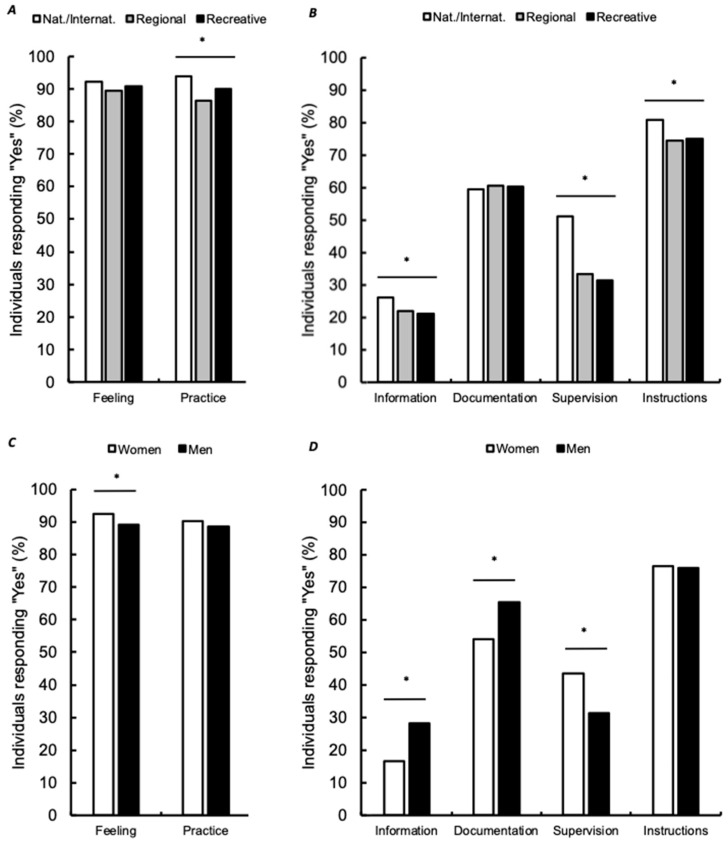
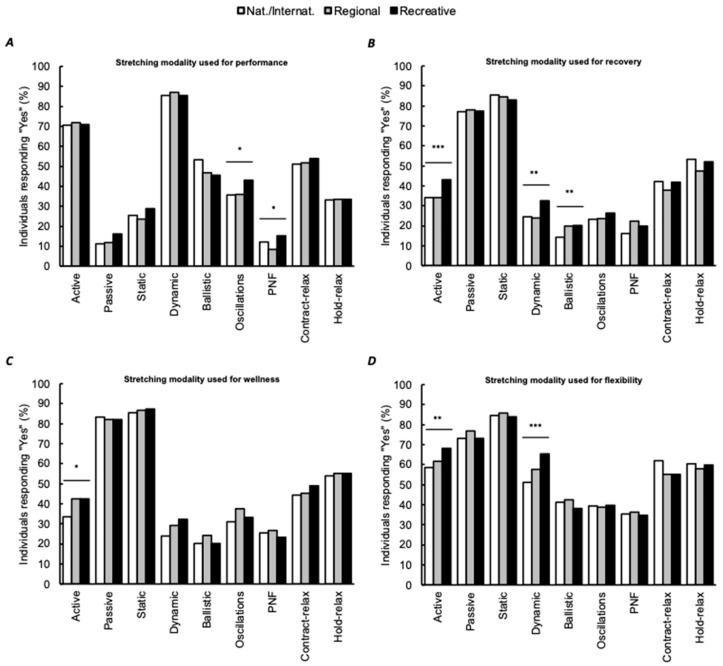
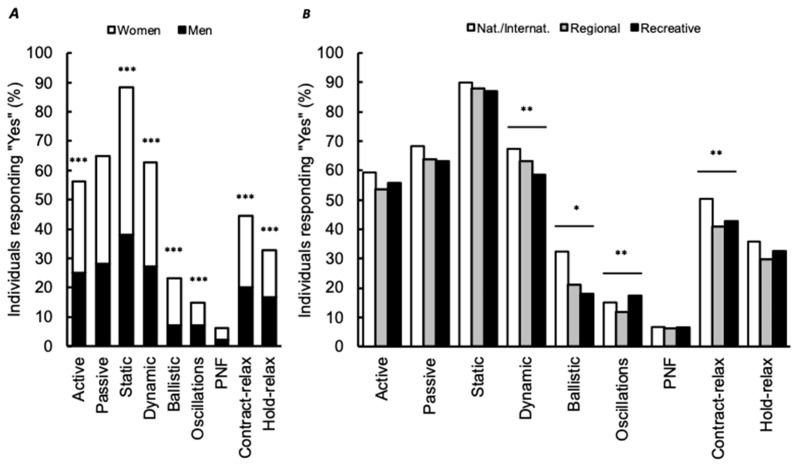
Recommendations for prescribing stretching exercises are regularly updated. It appears that coaches progressively follow the published guidelines, but the real stretching practices of athletes are unknown. The present study aimed to investigate stretching practices in individuals from various sports or physical activity programs. A survey was completed online to determine some general aspects of stretching practices. The survey consisted of 32 multiple-choice or open-ended questions to illustrate the general practices of stretching, experiences and reasons for stretching. In total, 3546 questionnaires were analyzed (47.3% women and 52.7% men). Respondents practiced at the national/international level (25.2%), regional level (29.8%), or recreationally (44.9%). Most respondents (89.3%) used stretching for recovery (74.9%) or gains of flexibility (57.2%). Stretching was generally performed after training (72.4%). The respondents also indicated they performed stretching as a pre-exercise routine (for warm-up: 49.9%). Static stretching was primarily used (88.2%) but when applied for warm-up reasons, respondents mostly indicated performing dynamic stretching (86.2%). Only 37.1% of the respondents indicated being supervised. Finally, some gender and practice level differences were noticed. The present survey revealed that the stretching practices were only partly in agreement with recent evidence-based recommendations. The present survey also pointed out the need to improve the supervision of stretching exercises.
拉伸运动的建议经常更新。教练似乎逐渐遵循已发表的指南,但运动员的实际拉伸实践情况尚不清楚。本研究旨在调查来自不同运动或体育活动项目的个体的拉伸实践情况。通过在线调查来确定拉伸实践的一些一般方面。该调查包括 32 个多项选择或开放式问题,以说明拉伸实践的一般情况、经验和拉伸的原因。共分析了 3546 份问卷(47.3%为女性,52.7%为男性)。受访者在国家/国际水平(25.2%)、地区水平(29.8%)或娱乐水平(44.9%)进行拉伸运动。大多数受访者(89.3%)使用拉伸运动来恢复(74.9%)或增加柔韧性(57.2%)。拉伸运动通常在训练后进行(72.4%)。受访者还表示,他们将拉伸作为运动前的常规活动(49.9%用于热身)。主要使用静态拉伸(88.2%),但当用于热身原因时,受访者大多表示进行动态拉伸(86.2%)。只有 37.1%的受访者表示有监督。最后,注意到一些性别和实践水平的差异。本调查显示,拉伸实践仅部分符合最近基于证据的建议。本调查还指出需要加强对拉伸运动的监督。