Abuhelwa Ahmad Y, Kichenadasse Ganessan, McKinnon Ross A, Rowland Andrew, Hopkins Ashley M, Sorich Michael J
College of Medicine and Public Health, Flinders University, Adelaide 5000, Australia.
Department of Medical Oncology, Flinders Centre for Innovation in Cancer/Flinders Medical Centre, Adelaide 5000, Australia.
Cancers (Basel). 2021 Apr 21;13(9):2001. doi: 10.3390/cancers13092001.
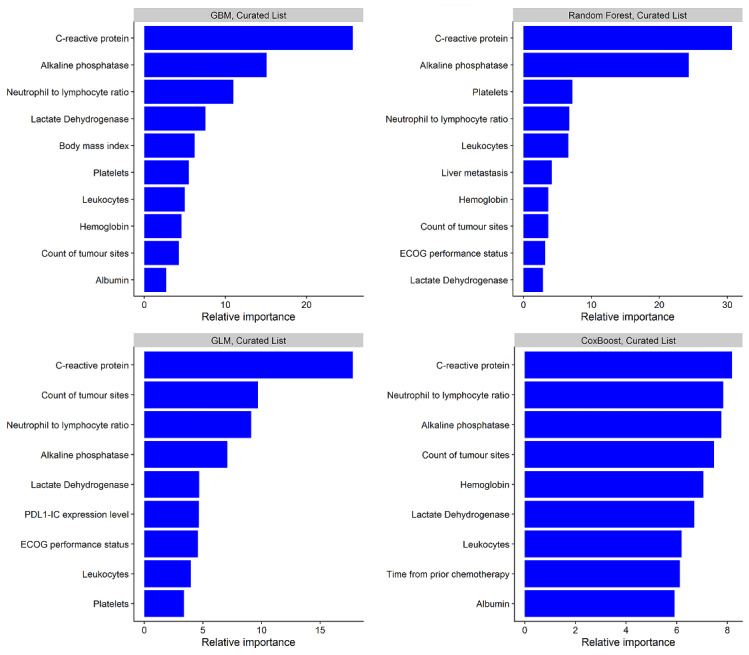
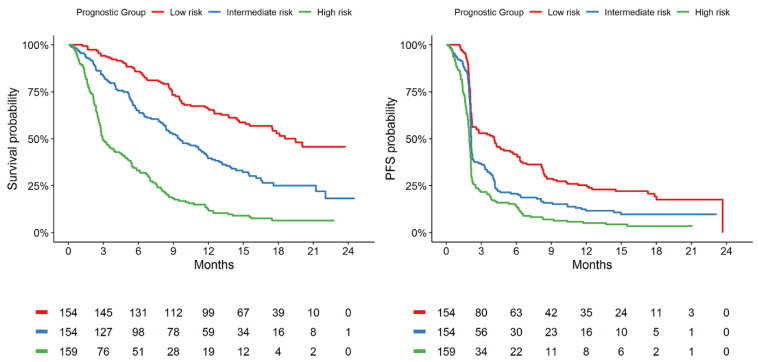
Machine learning (ML) may enhance the efficiency of developing accurate prediction models for survival, which is critical in informing disease prognosis and care planning. This study aimed to develop an ML prediction model for survival outcomes in patients with urothelial cancer-initiating atezolizumab and to compare model performances when built using an expert-selected (curated) versus an all-in list (uncurated) of variables. Gradient-boosted machine (GBM), random forest, Cox-boosted, and penalised, generalised linear models (GLM) were evaluated for predicting overall survival (OS) and progression-free survival (PFS) outcomes. C-statistic (c) was utilised to evaluate model performance. The atezolizumab cohort in IMvigor210 was used for model training, and IMvigor211 was used for external model validation. The curated list consisted of 23 pretreatment factors, while the all-in list consisted of 75. Using the best-performing model, patients were stratified into risk tertiles. Kaplan-Meier analysis was used to estimate survival probabilities. On external validation, the curated list GBM model provided slightly higher OS discrimination (c = 0.71) than that of the random forest (c = 0.70), CoxBoost (c = 0.70), and GLM (c = 0.69) models. All models were equivalent in predicting PFS (c = 0.62). Expansion to the uncurated list was associated with worse OS discrimination (GBM c = 0.70; random forest c = 0.69; CoxBoost c = 0.69, and GLM c = 0.69). In the atezolizumab IMvigor211 cohort, the curated list GBM model discriminated 1-year OS probabilities for the low-, intermediate-, and high-risk groups at 66%, 40%, and 12%, respectively. The ML model discriminated urothelial-cancer patients with distinctly different survival risks, with the GBM applied to a curated list attaining the highest performance. Expansion to an all-in approach may harm model performance.
机器学习(ML)可能会提高开发准确生存预测模型的效率,这对于了解疾病预后和护理规划至关重要。本研究旨在开发一种用于接受阿替利珠单抗治疗的尿路上皮癌患者生存结果的ML预测模型,并比较使用专家选择(精选)变量列表与全包含(未精选)变量列表构建模型时的性能。对梯度提升机(GBM)、随机森林、Cox增强和惩罚广义线性模型(GLM)进行了评估,以预测总生存期(OS)和无进展生存期(PFS)结果。使用C统计量(c)评估模型性能。IMvigor210中的阿替利珠单抗队列用于模型训练,IMvigor211用于外部模型验证。精选列表包含23个预处理因素,而全包含列表包含75个。使用性能最佳的模型,将患者分为风险三分位数。采用Kaplan-Meier分析来估计生存概率。在外部验证中,精选列表GBM模型的OS辨别力(c = 0.71)略高于随机森林(c = 0.70)、CoxBoost(c = 0.70)和GLM(c = 0.69)模型。所有模型在预测PFS方面相当(c = 0.62)。扩展到未精选列表与较差的OS辨别力相关(GBM c = 0.7,0;随机森林c = 0.69;CoxBoost c = 0.69,GLM c = 0.69)。在阿替利珠单抗IMvigor211队列中,精选列表GBM模型对低、中、高风险组的1年OS概率辨别分别为66%、40%和12%。ML模型能够辨别生存风险明显不同的尿路上皮癌患者,应用于精选列表的GBM性能最高。扩展到全包含方法可能会损害模型性能。