Institute for Neuro- and Bioinformatics, University of Lübeck, 23562 Lübeck, Germany.
Mathematics Department, Faculty of Science, South Valley University, Qena 83523, Egypt.
Sensors (Basel). 2021 Jan 11;21(2):455. doi: 10.3390/s21020455.
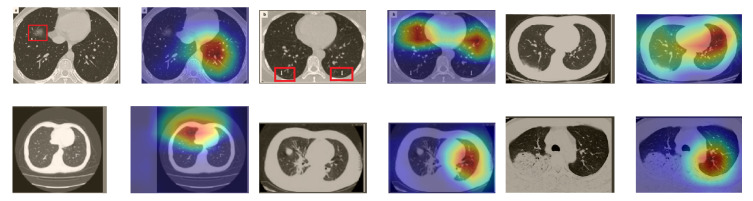
This paper explores how well deep learning models trained on chest CT images can diagnose COVID-19 infected people in a fast and automated process. To this end, we adopted advanced deep network architectures and proposed a transfer learning strategy using custom-sized input tailored for each deep architecture to achieve the best performance. We conducted extensive sets of experiments on two CT image datasets, namely, the SARS-CoV-2 CT-scan and the COVID19-CT. The results show superior performances for our models compared with previous studies. Our best models achieved average accuracy, precision, sensitivity, specificity, and F1-score values of 99.4%, 99.6%, 99.8%, 99.6%, and 99.4% on the SARS-CoV-2 dataset, and 92.9%, 91.3%, 93.7%, 92.2%, and 92.5% on the COVID19-CT dataset, respectively. For better interpretability of the results, we applied visualization techniques to provide visual explanations for the models' predictions. Feature visualizations of the learned features show well-separated clusters representing CT images of COVID-19 and non-COVID-19 cases. Moreover, the visualizations indicate that our models are not only capable of identifying COVID-19 cases but also provide accurate localization of the COVID-19-associated regions, as indicated by well-trained radiologists.
本文探讨了基于胸部 CT 图像训练的深度学习模型如何在快速自动化的过程中诊断 COVID-19 感染者。为此,我们采用了先进的深度网络架构,并提出了一种使用针对每个深度架构定制大小的输入的迁移学习策略,以实现最佳性能。我们在两个 CT 图像数据集上进行了广泛的实验,即 SARS-CoV-2 CT 扫描和 COVID19-CT。结果表明,与之前的研究相比,我们的模型表现出色。我们的最佳模型在 SARS-CoV-2 数据集上的平均准确率、精度、敏感度、特异性和 F1 得分为 99.4%、99.6%、99.8%、99.6%和 99.4%,在 COVID19-CT 数据集上的平均准确率、精度、敏感度、特异性和 F1 得分为 92.9%、91.3%、93.7%、92.2%和 92.5%。为了更好地解释结果,我们应用了可视化技术来为模型的预测提供可视化解释。学习特征的特征可视化显示了代表 COVID-19 和非 COVID-19 病例的 CT 图像的良好分离簇。此外,可视化结果表明,我们的模型不仅能够识别 COVID-19 病例,还能够提供 COVID-19 相关区域的准确定位,这与训练有素的放射科医生的指示一致。