Department of Abdominal and General Surgery and Oncology, National Cancer Institute, 1 Santariskiu Str., LT-08406 Vilnius, Lithuania.
Faculty of Medicine, Vilnius University, M. K. Ciurlionio Str. 21, LT-03101 Vilnius, Lithuania.
Int J Environ Res Public Health. 2021 Apr 15;18(8):4165. doi: 10.3390/ijerph18084165.
We aimed to investigate age-specific and sex-specific incidence trends of melanoma in Lithuania from 1991 to 2015.
Analysis was based on data from the population-based Lithuanian Cancer Registry database for 1991-2015, and 6024 cases of skin melanoma were identified. Age-adjusted rates (ASRs) by sex and age group were calculated. Adjustment for ASRs was done using the old European standard population, where a total of three age groups were considered: 0-39, 40-59 and 60+. Additionally, the annual percent change (APC) was calculated, and 95% confidence intervals for APC were calculated.
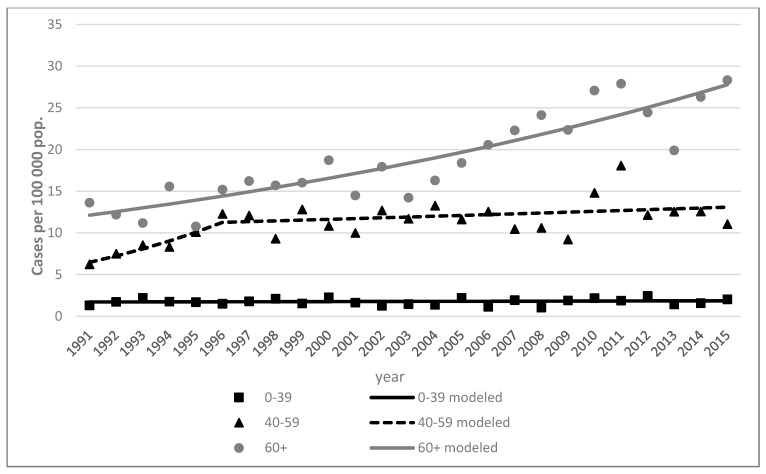
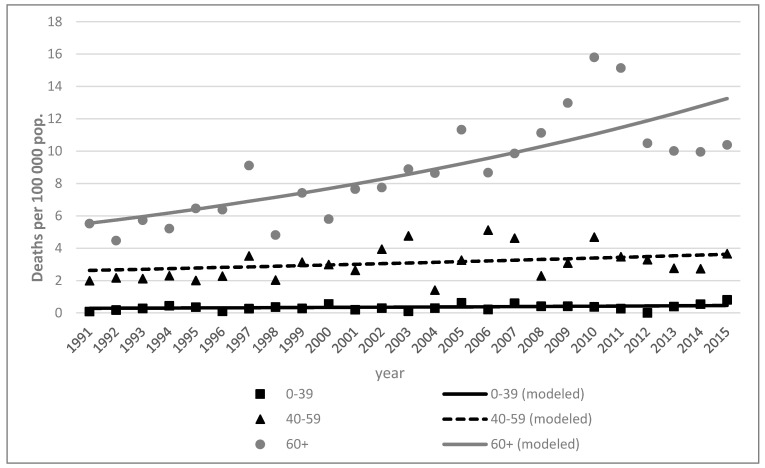
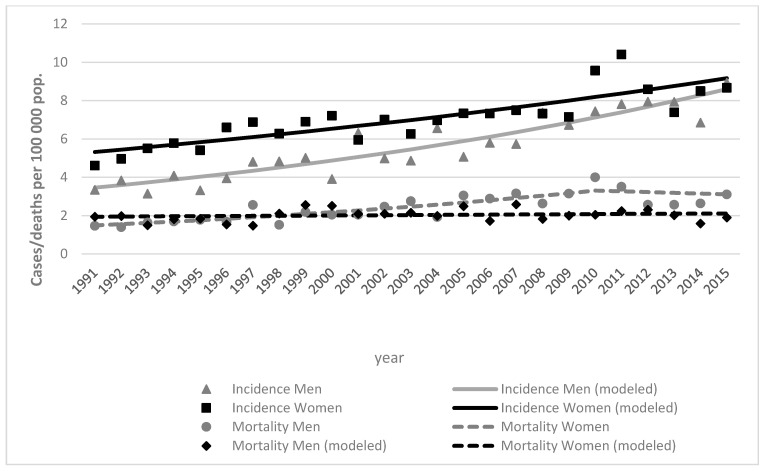
Between 1991 and 2015, the overall melanoma rates increased by an annual percent change (APC) of 3.9% in men (95% CI, 3.6-4.1%) and 2.3% in women (95% CI, 2.1-2.5%). The highest incidences of new cutaneous melanoma cases were observed between old adults (60+) of both sexes, while the lowest incidence rates were observed in the young adult group (up to 39 years old), with the lowest APC (1.6% in males and 0.4% in females). The overall number of melanoma deaths during 1991 and 2015 increased from 64 to 103 deaths per year, and the age-standardized rate (ASR) increased 1.3 times (from 1.8 to 2.4).
The incidence and mortality of skin melanoma seem to be increased in all age groups. These trends indicate that skin protection behavior is not sufficient in our population and more efforts need to be taken in order to decrease incidence and mortality rates.
本研究旨在调查 1991 年至 2015 年期间立陶宛黑色素瘤的年龄和性别特异性发病趋势。
分析基于 1991-2015 年人群为基础的立陶宛癌症登记数据库的数据,共确定了 6024 例皮肤黑色素瘤病例。按性别和年龄组计算了年龄调整发病率(ASR)。通过使用旧的欧洲标准人口对 ASR 进行调整,共考虑了三个年龄组:0-39 岁、40-59 岁和 60 岁以上。此外,还计算了年度百分比变化(APC),并计算了 APC 的 95%置信区间。
1991 年至 2015 年间,男性黑色素瘤总体发病率每年增加 3.9%(95%CI,3.6-4.1%),女性发病率每年增加 2.3%(95%CI,2.1-2.5%)。新发生的皮肤黑色素瘤病例发生率最高的是老年(60 岁以上)人群,而年轻成人(18-39 岁)组的发病率最低,APC 也最低(男性为 1.6%,女性为 0.4%)。1991 年至 2015 年间,黑色素瘤死亡人数从每年 64 人增加到 103 人,年龄标准化率(ASR)增加了 1.3 倍(从 1.8 增加到 2.4)。
所有年龄组的皮肤黑色素瘤发病率和死亡率似乎都在增加。这些趋势表明,我们人群中的皮肤保护行为还不够充分,需要做出更多努力来降低发病率和死亡率。