Meireles Da Costa Nathalia, Mendes Fábio A, Pontes Bruno, Nasciutti Luiz Eurico, Ribeiro Pinto Luis Felipe, Palumbo Júnior Antonio
Programa de Carcinogênese Molecular, Instituto Nacional de Câncer-INCA, Rua André Cavalcanti, 37-Centro, Rio de Janeiro 20231-050, Brazil.
Instituto de Ciências Biomédicas, Prédio de Ciências da Saúde-Cidade Universitária, Universidade Federal do Rio de Janeiro, Ilha do Fundão, A. Carlos Chagas, Rio de Janeiro 21941-902, Brazil.
Cancers (Basel). 2021 Apr 15;13(8):1890. doi: 10.3390/cancers13081890.
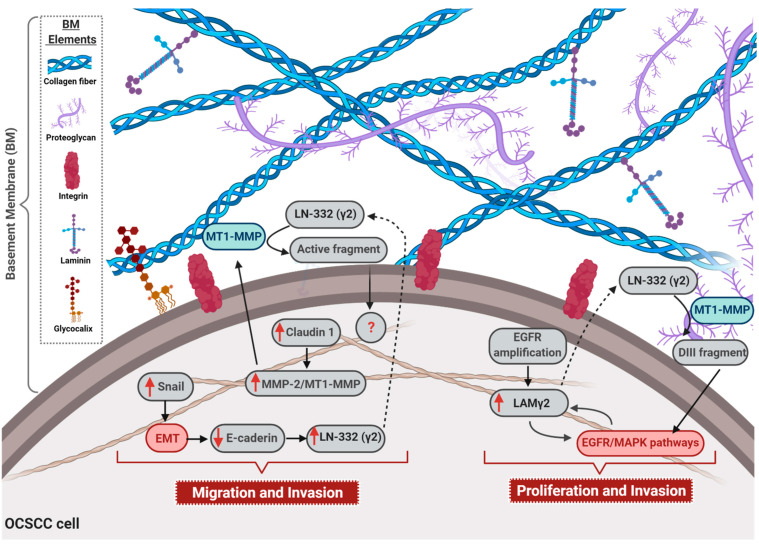
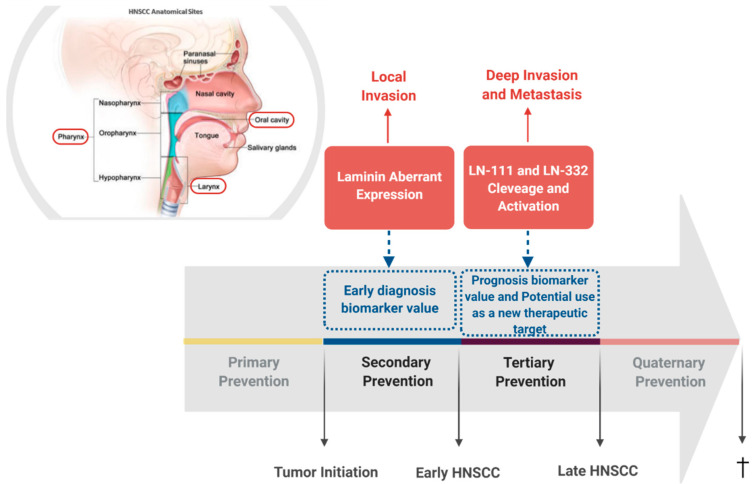
Head and neck squamous cell carcinomas (HNSCC) are among the most common and lethal tumors worldwide, occurring mostly in oral cavity, pharynx, and larynx tissues. The squamous epithelia homeostasis is supported by the extracellular matrix (ECM), and alterations in this compartment are crucial for cancer development and progression. Laminin is a fundamental component of ECM, where it represents one of the main components of basement membrane (BM), and data supporting its contribution to HNSCC genesis and progression has been vastly explored in oral cavity squamous cell carcinoma. Laminin subtypes 111 (LN-111) and 332 (LN-332) are the main isoforms associated with malignant transformation, contributing to proliferation, adhesion, migration, invasion, and metastasis, due to its involvement in the regulation of several pathways associated with HNSCC carcinogenesis, including the activation of the EGFR/MAPK signaling pathway. Therefore, it draws attention to the possibility that laminin may represent a convergence point in HNSCC natural history, and an attractive potential therapeutic target for these tumors.
头颈部鳞状细胞癌(HNSCC)是全球最常见且致命的肿瘤之一,主要发生在口腔、咽和喉组织中。细胞外基质(ECM)维持着鳞状上皮的稳态,该区域的改变对于癌症的发生和发展至关重要。层粘连蛋白是ECM的基本成分,是基底膜(BM)的主要成分之一,关于其在口腔鳞状细胞癌中对头颈部鳞状细胞癌发生和发展作用的数据已得到广泛研究。层粘连蛋白亚型111(LN - 111)和332(LN - 332)是与恶性转化相关的主要异构体,由于其参与调节与头颈部鳞状细胞癌发生相关的多种途径,包括表皮生长因子受体/丝裂原活化蛋白激酶(EGFR/MAPK)信号通路的激活,从而促进增殖、黏附、迁移、侵袭和转移。因此,层粘连蛋白可能是头颈部鳞状细胞癌自然病程中的一个交汇点,也是这些肿瘤有吸引力的潜在治疗靶点,这一可能性引起了关注。