Fengou Lemonia-Christina, Lianou Alexandra, Tsakanikas Panagiοtis, Mohareb Fady, Nychas George-John E
Laboratory of Microbiology and Biotechnology of Foods, Department of Food Science and Human Nutrition, School of Food and Nutritional Sciences, Agricultural University of Athens, 11855 Athens, Greece.
Division of Genetics, Cell Biology and Development, Department of Biology, University of Patras, 26504 Patras, Greece.
Foods. 2021 Apr 15;10(4):861. doi: 10.3390/foods10040861.
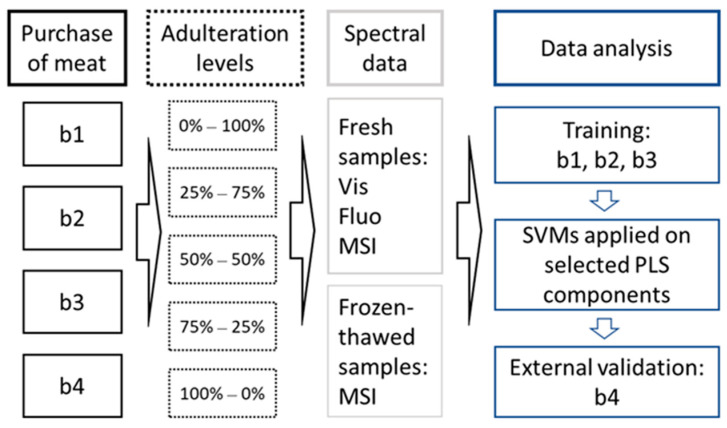
Minced meat is a vulnerable to adulteration food commodity because species- and/or tissue-specific morphological characteristics cannot be easily identified. Hence, the economically motivated adulteration of minced meat is rather likely to be practiced. The objective of this work was to assess the potential of spectroscopy-based sensors in detecting fraudulent minced meat substitution, specifically of (i) beef with bovine offal and (ii) pork with chicken (and vice versa) both in fresh and frozen-thawed samples. For each case, meat pieces were minced and mixed so that different levels of adulteration with a 25% increment were achieved while two categories of pure meat also were considered. From each level of adulteration, six different samples were prepared. In total, 120 samples were subjected to visible (Vis) and fluorescence (Fluo) spectra and multispectral image (MSI) acquisition. Support Vector Machine classification models were developed and evaluated. The MSI-based models outperformed the ones based on the other sensors with accuracy scores varying from 87% to 100%. The Vis-based models followed in terms of accuracy with attained scores varying from 57% to 97% while the lowest performance was demonstrated by the Fluo-based models. Overall, spectroscopic data hold a considerable potential for the detection and quantification of minced meat adulteration, which, however, appears to be sensor-specific.
碎肉是一种容易掺假的食品商品,因为特定物种和/或组织的形态特征不易识别。因此,出于经济动机对碎肉进行掺假的情况很可能会发生。这项工作的目的是评估基于光谱的传感器在检测碎肉欺诈性替代方面的潜力,特别是在新鲜和冻融样品中检测(i)牛肉与牛内脏的掺假以及(ii)猪肉与鸡肉的掺假(反之亦然)。对于每种情况,将肉块切碎并混合,以实现不同程度的掺假,掺假量以25%的增量增加,同时还考虑了两类纯肉。从每个掺假水平制备六个不同的样品。总共120个样品进行了可见(Vis)光谱、荧光(Fluo)光谱和多光谱图像(MSI)采集。开发并评估了支持向量机分类模型。基于MSI的模型优于基于其他传感器的模型,准确率得分在87%至100%之间。基于Vis的模型在准确率方面次之,得分在57%至97%之间,而基于Fluo的模型表现最差。总体而言,光谱数据在检测和量化碎肉掺假方面具有相当大的潜力,然而,这似乎因传感器而异。