Han Jonghyeuk, Jeong Wonwoo, Kim Min-Kyeong, Nam Sang-Hyeon, Park Eui-Kyun, Kang Hyun-Wook
Department of Biomedical Engineering, Ulsan National Institute of Science and Technology 50, UNIST-gil, Ulju-gun, Ulsan 44919, Korea.
Department of Pathology and Regenerative Medicine, School of Dentistry, Kyungpook National University, 2177 Dalgubeol-daero, Jung-gu, Daegu 41940, Korea.
Polymers (Basel). 2021 Apr 15;13(8):1294. doi: 10.3390/polym13081294.
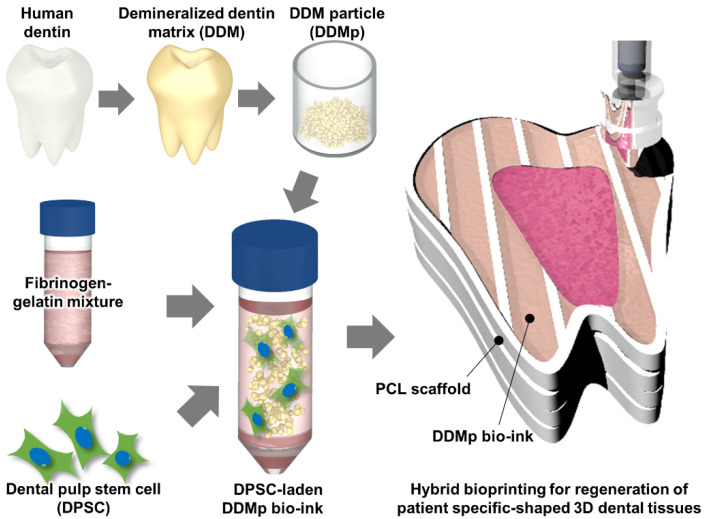
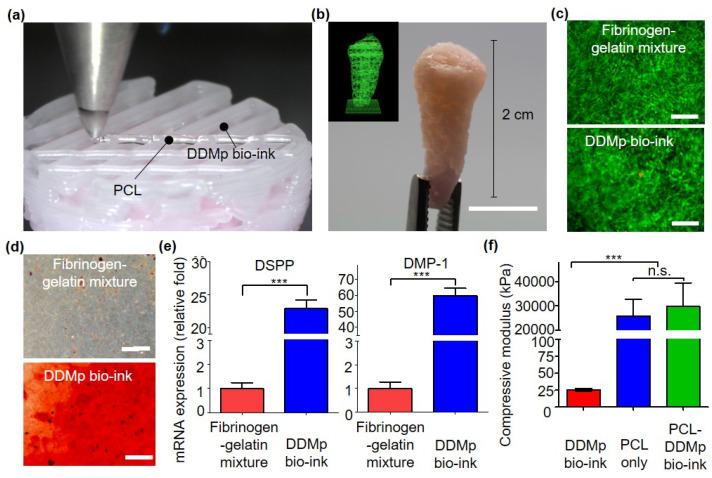
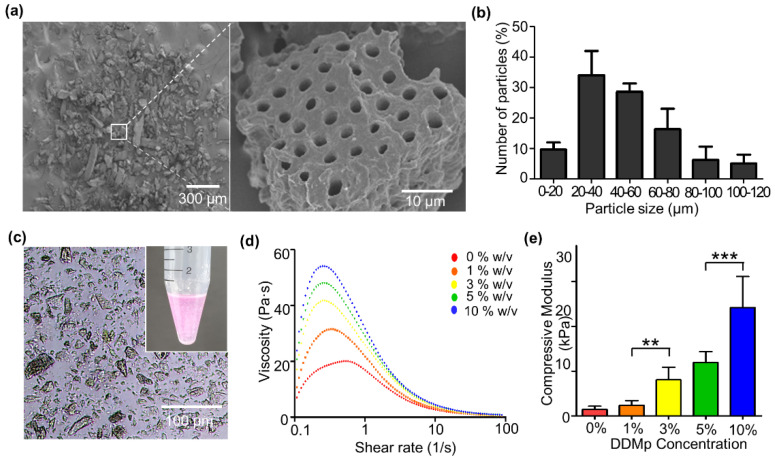
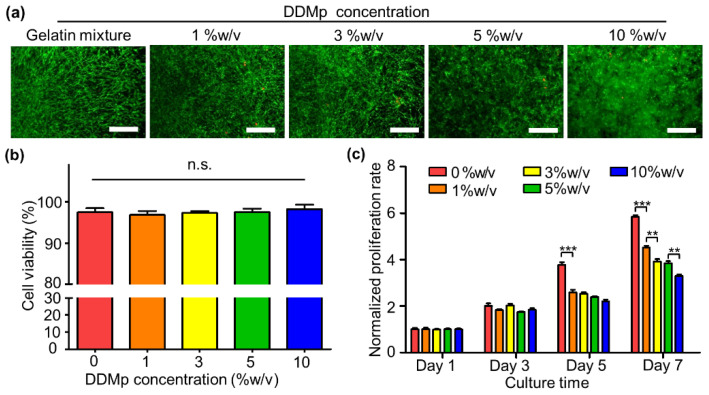
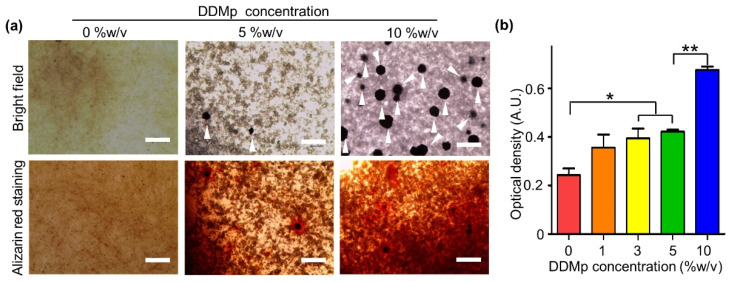
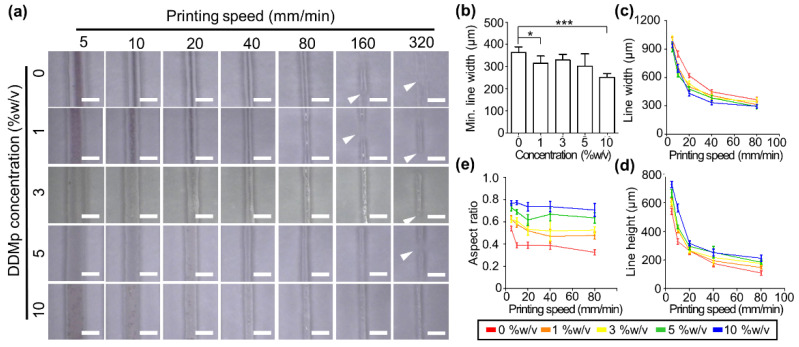
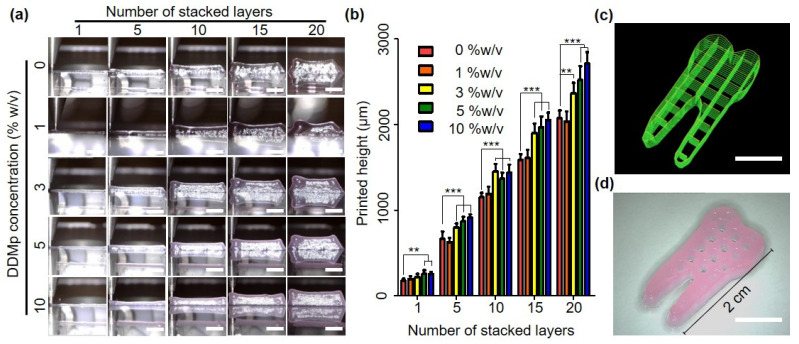
Demineralized dentin matrix (DDM)-based materials have been actively developed and are well-known for their excellent performance in dental tissue regeneration. However, DDM-based bio-ink suitable for fabrication of engineered dental tissues that are patient-specific in terms of shape and size, has not yet been developed. In this study, we developed a DDM particle-based bio-ink (DDMp bio-ink) with enhanced three-dimensional (3D) printability. The bio-ink was prepared by mixing DDM particles and a fibrinogen-gelatin mixture homogeneously. The effects of DDMp concentration on the 3D printability of the bio-ink and dental cell compatibility were investigated. As the DDMp concentration increased, the viscosity and shear thinning behavior of the bio-ink improved gradually, which led to the improvement of the ink's 3D printability. The higher the DDMp content, the better were the printing resolution and stacking ability of the 3D printing. The printable minimum line width of 10% / DDMp bio-ink was approximately 252 μm, whereas the fibrinogen-gelatin mixture was approximately 363 μm. The ink's cytocompatibility test with dental pulp stem cells (DPSCs) exhibited greater than 95% cell viability. In addition, as the DDMp concentration increased, odontogenic differentiation of DPSCs was significantly enhanced. Finally, we demonstrated that cellular constructs with 3D patient-specific shapes and clinically relevant sizes could be fabricated through co-printing of polycaprolactone and DPSC-laden DDMp bio-ink.
基于脱矿牙本质基质(DDM)的材料已得到积极研发,并且因其在牙组织再生方面的优异性能而闻名。然而,尚未开发出适用于制造形状和尺寸符合患者特定需求的工程化牙组织的基于DDM的生物墨水。在本研究中,我们开发了一种具有增强三维(3D)可打印性的基于DDM颗粒的生物墨水(DDMp生物墨水)。该生物墨水通过将DDM颗粒与纤维蛋白原 - 明胶混合物均匀混合制备而成。研究了DDMp浓度对生物墨水3D可打印性和牙细胞相容性的影响。随着DDMp浓度的增加,生物墨水的粘度和剪切变稀行为逐渐改善,这导致墨水3D可打印性的提高。DDMp含量越高,3D打印的分辨率和堆积能力越好。10% / DDMp生物墨水的可打印最小线宽约为252μm,而纤维蛋白原 - 明胶混合物约为363μm。该墨水与牙髓干细胞(DPSC)的细胞相容性测试显示细胞活力大于95%。此外,随着DDMp浓度的增加,DPSC的牙源性分化显著增强。最后,我们证明了通过共打印聚己内酯和载有DPSC的DDMp生物墨水,可以制造出具有3D患者特定形状和临床相关尺寸的细胞构建体。