Ciferri Maria Chiara, Quarto Rodolfo, Tasso Roberta
Department of Experimental Medicine, University of Genova, 16132 Genova, Italy.
U.O. Cellular Oncology, IRCCS Ospedale Policlinico San Martino, 16132 Genova, Italy.
Biology (Basel). 2021 Apr 23;10(5):359. doi: 10.3390/biology10050359.
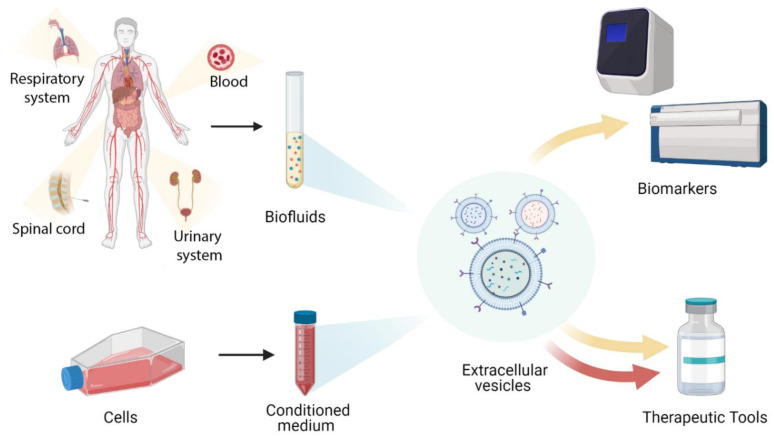
Extracellular vesicles (EVs) are ubiquitous masters of intercellular communication, being detectable in tissues, circulation, and body fluids. Their complex cargo reflects the (patho)physiologic status of the cells from which they originate. Due to these properties, the potential of EVs, and in particular exosomes, to serve as biomarkers or therapeutics has grown exponentially over the past decade. On one side, numerous studies have demonstrated that EV-associated nucleic acids and proteins are implicated in cancer progression, as well as neurodegenerative, infectious, and autoimmune disorders. On the other, the therapeutic use of EVs secreted by various cell types, and in particular stem/progenitor cells, present significant advantages in comparison to the corresponding parental cells, such as the less complex production and storage conditions. In this review, we examine some of the major pre-clinical studies dealing with EVs and exosomes, that led to the development of numerous completed clinical trials.
细胞外囊泡(EVs)是细胞间通讯的普遍介质,可在组织、循环系统和体液中检测到。它们复杂的货物反映了其来源细胞的(病理)生理状态。由于这些特性,在过去十年中,EVs,尤其是外泌体,作为生物标志物或治疗剂的潜力呈指数级增长。一方面,大量研究表明,EV相关的核酸和蛋白质与癌症进展以及神经退行性、感染性和自身免疫性疾病有关。另一方面,与相应的亲代细胞相比,各种细胞类型,特别是干细胞/祖细胞分泌的EVs的治疗应用具有显著优势,例如生产和储存条件较简单。在这篇综述中,我们研究了一些关于EVs和外泌体的主要临床前研究,这些研究促成了众多已完成的临床试验的开展。