Dalvit Carvalho da Silva Rodrigo, Jenkyn Thomas Richard, Carranza Victor Alexander
Craniofacial Injury and Concussion Research Laboratory, Western University, London, ON N6A 3K7, Canada.
Faculty of Engineering, School of Biomedical Engineering, Western University, London, ON N6A 3K7, Canada.
J Pers Med. 2021 Apr 16;11(4):310. doi: 10.3390/jpm11040310.
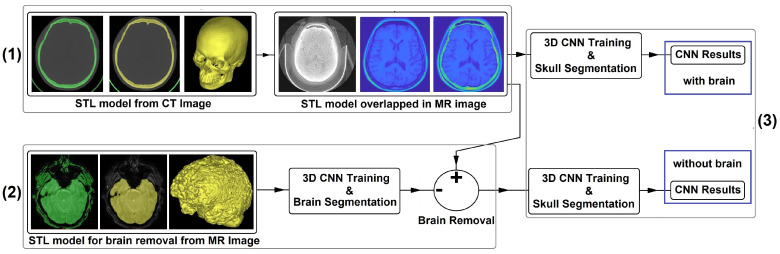
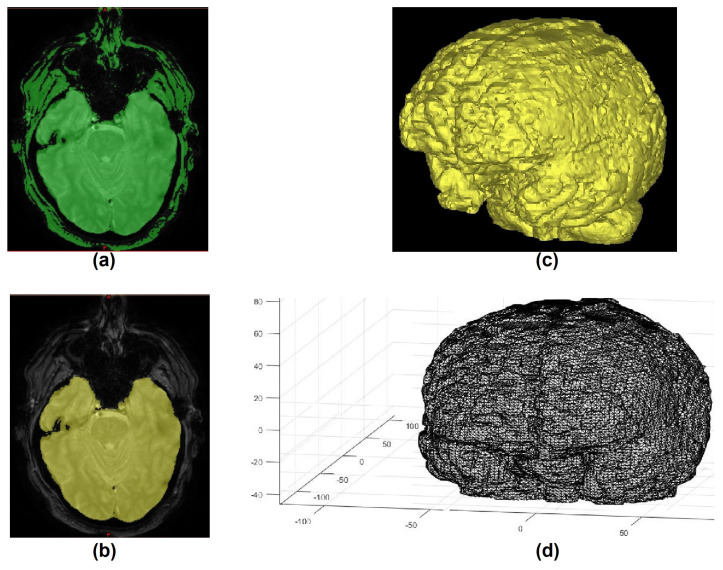
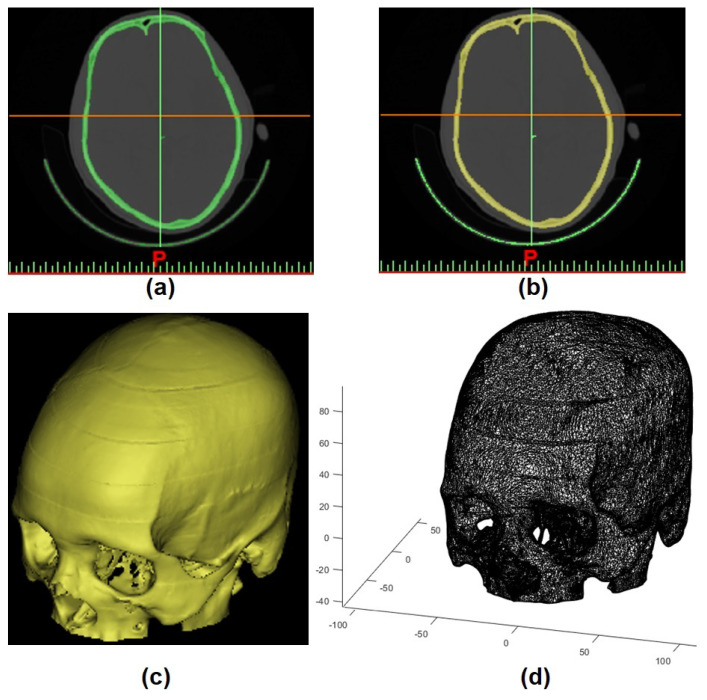
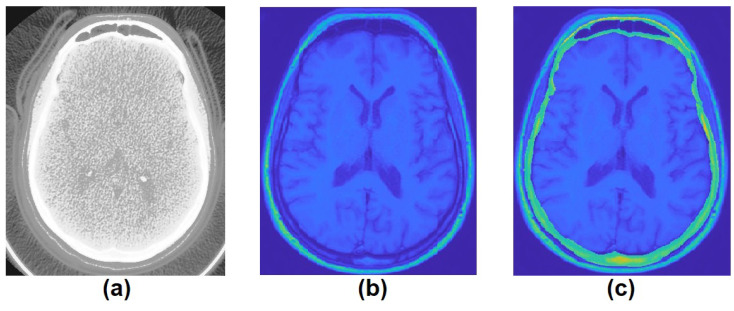
Segmentation is crucial in medical imaging analysis to help extract regions of interest (ROI) from different imaging modalities. The aim of this study is to develop and train a 3D convolutional neural network (CNN) for skull segmentation in magnetic resonance imaging (MRI). 58 gold standard volumetric labels were created from computed tomography (CT) scans in standard tessellation language (STL) models. These STL models were converted into matrices and overlapped on the 58 corresponding MR images to create the MRI gold standards labels. The CNN was trained with these 58 MR images and a mean ± standard deviation (SD) Dice similarity coefficient (DSC) of 0.7300 ± 0.04 was achieved. A further investigation was carried out where the brain region was removed from the image with the help of a 3D CNN and manual corrections by using only MR images. This new dataset, without the brain, was presented to the previous CNN which reached a new mean ± SD DSC of 0.7826 ± 0.03. This paper aims to provide a framework for segmenting the skull using CNN and STL models, as the 3D CNN was able to segment the skull with a certain precision.
在医学影像分析中,分割对于从不同成像模态中提取感兴趣区域(ROI)至关重要。本研究的目的是开发并训练一个用于磁共振成像(MRI)中颅骨分割的三维卷积神经网络(CNN)。从计算机断层扫描(CT)扫描的标准镶嵌语言(STL)模型中创建了58个金标准体积标签。这些STL模型被转换为矩阵,并与58幅相应的MR图像重叠,以创建MRI金标准标签。使用这58幅MR图像对CNN进行训练,平均±标准差(SD)的骰子相似系数(DSC)达到了0.7300±0.04。进一步的研究是在仅使用MR图像的情况下,借助三维CNN和手动校正从图像中去除脑区。这个没有脑区的新数据集被提供给之前的CNN,其新的平均±标准差DSC达到了0.7826±0.03。本文旨在提供一个使用CNN和STL模型分割颅骨的框架,因为三维CNN能够以一定精度分割颅骨。