Peggion Caterina, Tonello Fiorella
Department of Biomedical Sciences, University of Padova, Via U. Bassi, 58/B, 35131 Padova, Italy.
CNR of Italy, Neuroscience Institute, viale G. Colombo 3, 35131 Padova, Italy.
Toxins (Basel). 2021 Apr 20;13(4):290. doi: 10.3390/toxins13040290.
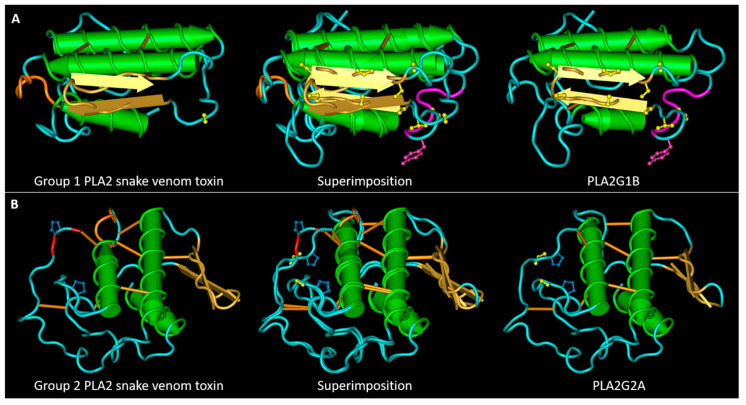
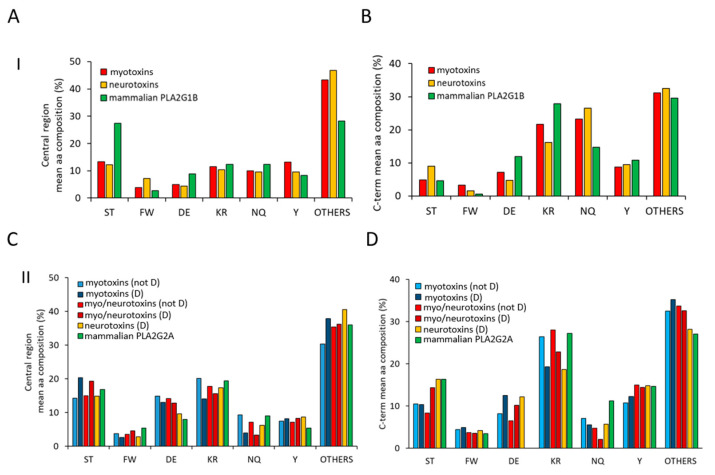
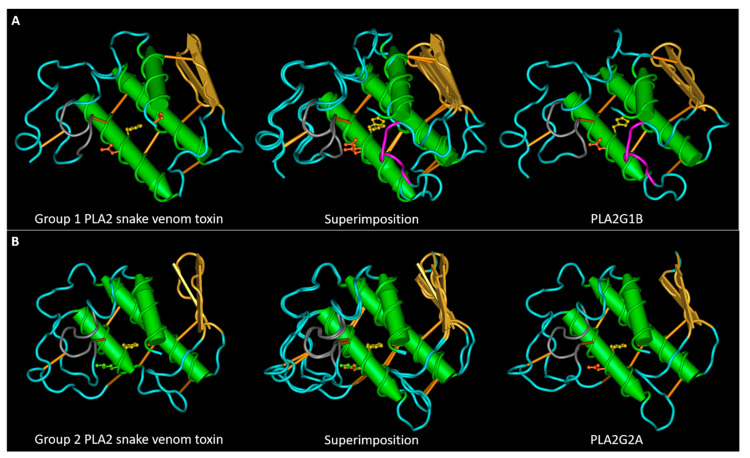
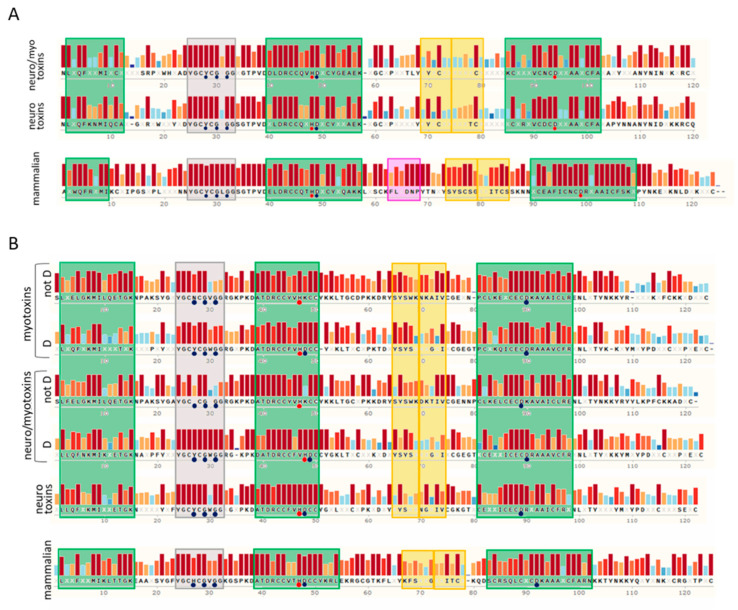
Snake venom phospholipases A2 (PLA2s) have sequences and structures very similar to those of mammalian group I and II secretory PLA2s, but they possess many toxic properties, ranging from the inhibition of coagulation to the blockage of nerve transmission, and the induction of muscle necrosis. The biological properties of these proteins are not only due to their enzymatic activity, but also to protein-protein interactions which are still unidentified. Here, we compare sequence alignments of snake venom and mammalian PLA2s, grouped according to their structure and biological activity, looking for differences that can justify their different behavior. This bioinformatics analysis has evidenced three distinct regions, two central and one C-terminal, having amino acid compositions that distinguish the different categories of PLA2s. In these regions, we identified short linear motifs (SLiMs), peptide modules involved in protein-protein interactions, conserved in mammalian and not in snake venom PLA2s, or vice versa. The different content in the SLiMs of snake venom with respect to mammalian PLA2s may result in the formation of protein membrane complexes having a toxic activity, or in the formation of complexes whose activity cannot be blocked due to the lack of switches in the toxic PLA2s, as the motif recognized by the prolyl isomerase Pin1.
蛇毒磷脂酶A2(PLA2s)的序列和结构与哺乳动物I组和II组分泌型PLA2s非常相似,但它们具有许多毒性特性,从抑制凝血到阻断神经传递,以及诱导肌肉坏死。这些蛋白质的生物学特性不仅归因于它们的酶活性,还归因于尚未确定的蛋白质-蛋白质相互作用。在这里,我们比较了根据结构和生物学活性分组的蛇毒和哺乳动物PLA2s的序列比对,寻找能够解释它们不同行为的差异。这种生物信息学分析证明了三个不同的区域,两个位于中央,一个位于C端,其氨基酸组成区分了不同类别的PLA2s。在这些区域中,我们鉴定出了短线性基序(SLiMs),即参与蛋白质-蛋白质相互作用的肽模块,在哺乳动物PLA2s中保守而在蛇毒PLA2s中不保守,或者反之亦然。蛇毒与哺乳动物PLA2s的SLiMs含量不同,可能导致形成具有毒性活性的蛋白质膜复合物,或者由于有毒PLA2s中缺乏如脯氨酰异构酶Pin1识别的基序等开关而形成活性无法被阻断的复合物。